
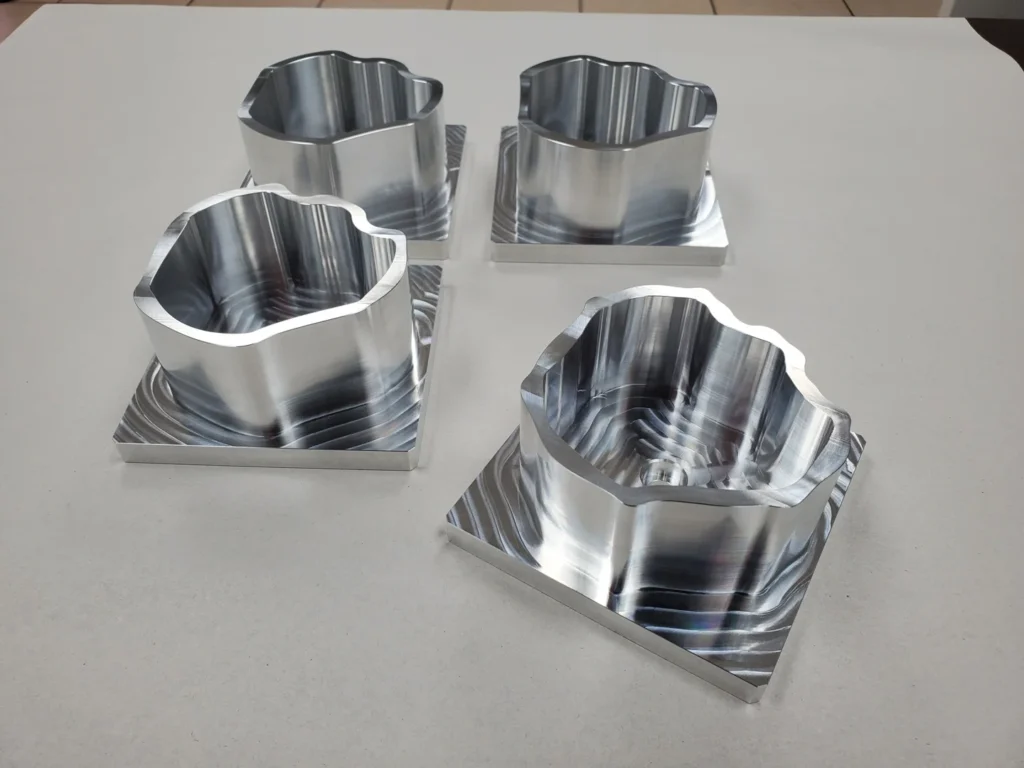
Why Sourcing the Right CNC Parts Matters for Your Production Line
Keeping your machines running starts with knowing which CNC parts to source, when to source them, and where to get them fast.
Here is a quick overview of the most common CNC parts buyers need:
| CNC Part Category | Common Examples | Typical Use |
|---|---|---|
| Spindle components | Spindle motors, drawbar grippers, encoder belts | Core cutting and tool-holding functions |
| Drive and motion | Servo motors, ball screws, linear guides | Axis movement and positioning |
| Lubrication and filtration | Way lube systems, coolant filters, air filters | Machine protection and longevity |
| Electrical and controls | Encoders, limit switches, VFDs | Machine feedback and control |
| Structural hardware | Mounting brackets, base plates, clamp blocks | Frame integrity and alignment |
Whether you need a replacement servo motor to get a machine back online today, or precision-machined structural components for a new automation build, the sourcing decisions you make directly affect your uptime, output quality, and total cost of ownership.
The stakes are especially high in tube and pipe manufacturing, where unplanned downtime on a mill line or scarfing system can stall an entire production run.
I’m Jarek Szpakowski of ITSE Inc., a Lake Zurich, IL-based US manufacturer with hands-on experience supplying precision CNC parts and custom components for tube mill equipment, industrial automation, and OEM applications. In this guide, I’ll walk you through everything you need to make smarter sourcing decisions.
Essential CNC Parts for Machine Maintenance and Downtime Prevention
Every modern machine shop in the Chicago metropolitan area—whether operating in Elk Grove Village, Schaumburg, or right here in Lake Zurich—knows that a CNC machine is only as reliable as its weakest component. When a critical motion or electrical part fails, the entire production line grinds to a halt.
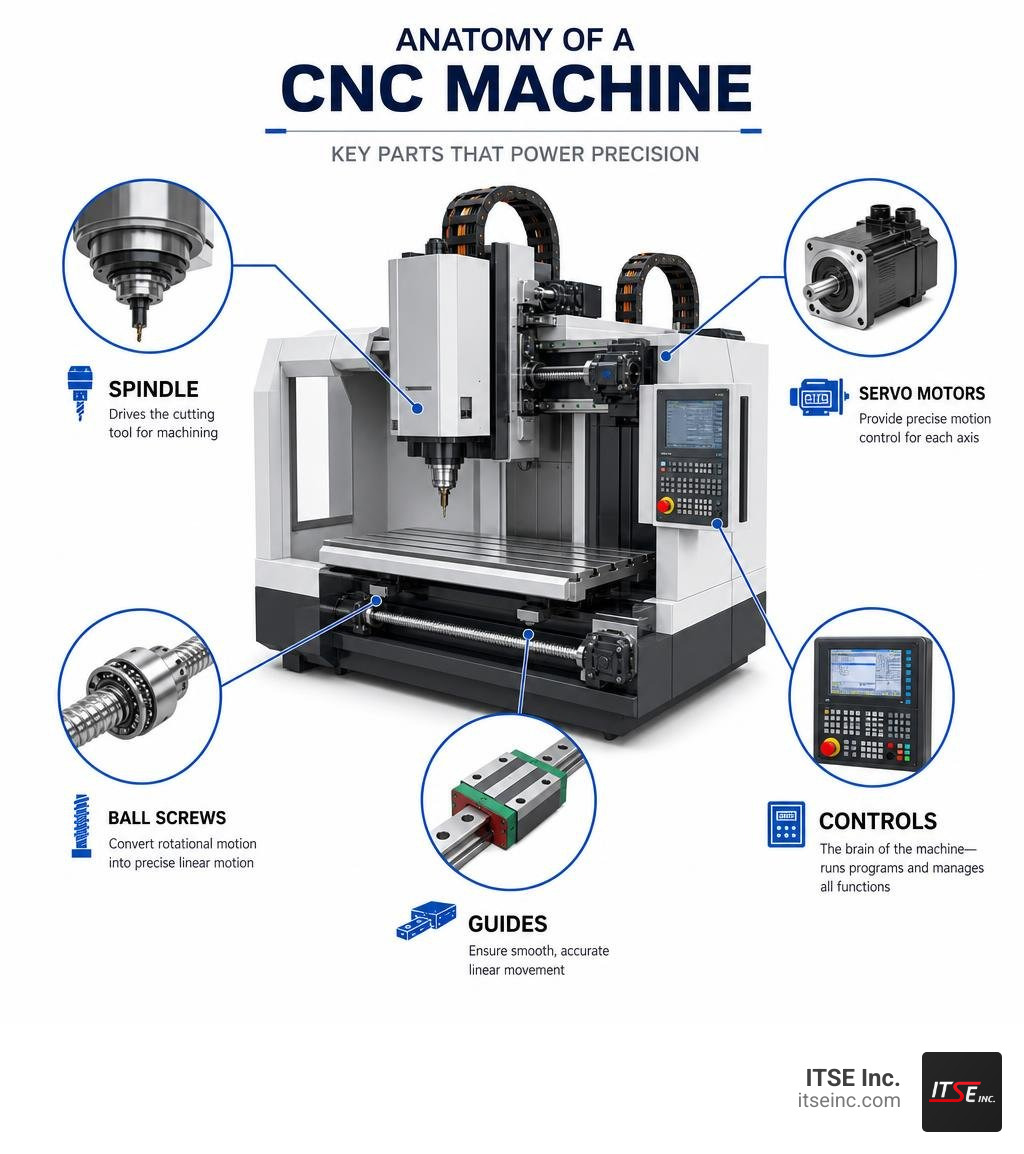
To prevent these costly bottlenecks, it is vital to understand the primary mechanical and electrical systems that drive your machinery. Spindle motors provide the raw rotational force required for high-speed cutting, while high-torque servo motors govern the precise positioning of each axis. These motors work in tandem with linear guides and precision-ground ball screws to translate rotary motion into smooth, highly accurate linear travel.
Protecting these mechanical assemblies are telescopic way covers, which shield delicate guideways from abrasive metal chips, hot swarf, and corrosive coolant. Neglecting these covers often leads to premature wear on your linear guides, resulting in lost positioning accuracy. To understand how these components coordinate to produce perfect cuts, check out our comprehensive resource, Making the Cut: A Beginner’s Guide to Precision CNC Machining.
Critical Mechanical and Electrical CNC Parts to Keep in Stock
Active machine shops must manage their inventory to ensure that high-wear parts are always on hand. Waiting days for a standard replacement part to ship can devastate your production schedule. We recommend keeping the following critical spares on your shelves:
- Drawbar Gripper Fingers: These mechanical fingers hold the tool holder securely inside the spindle taper. Over time, the constant clamping and unclamping cycles fatigue the metal, leading to tool slippage or runout.
- Tool Changer Components: Automatic tool changers (ATCs) rely on a series of pneumatic cylinders, alignment arms, and dual-arm removal tools. Keeping replacement seals and alignment kits on hand prevents tool-dropping disasters.
- Rotary Encoders: Encoders provide closed-loop feedback to the CNC controller, tracking the exact rotational position of your servo motors. If an encoder gets contaminated with oil mist or fails electronically, the machine will lose its home position or trigger critical axis faults.
- Limit Switches and Sensors: Proximity sensors and physical limit switches prevent the machine axes from over-traveling and crashing into the frame. Because they are exposed to harsh cutting environments, they are highly prone to electrical shorting.
For shops throughout Illinois, partnering with a reliable regional supplier ensures you can secure critical spares and tooling accessories without relying on unpredictable international shipping channels.
Preventative Maintenance and Filtration Systems
Preventative maintenance is your primary defense against unplanned downtime. A clean machine is a reliable machine, and proper filtration is what keeps internal components pristine.
Coolant filtration systems must be regularly maintained to remove fine metal particulates and tramp oils from the cutting fluid. If recirculated, these micro-abrasives act like sandpaper, scoring the surface of your workpiece and rapidly wearing down spindle seals. Similarly, your machine’s way lube system must deliver a clean, consistent film of oil to the linear guides. Using high-quality lubricants prevents stick-slip conditions and ensures smooth, friction-free movement.
Do not overlook the electrical cabinet. CNC controllers and variable frequency drives (VFDs) generate significant heat and rely on cooling fans to maintain safe operating temperatures. Installing replaceable, roll-type air filters over cabinet vents prevents airborne dust, grease, and atomized coolant from settling on sensitive circuit boards and causing catastrophic electrical shorts. By establishing a strict maintenance checklist—including daily oil level checks, weekly filter replacements, and monthly drawbar force measurements—you can easily reduce your machine’s annual downtime by up to 30%.
Sourcing Strategies: OEM vs. Aftermarket and Custom CNC Parts
When a component fails or a new project demands custom structural plates, procurement managers face a critical decision: should they buy Original Equipment Manufacturer (OEM) parts, source aftermarket alternatives, or commission custom-machined components?
Each sourcing channel has distinct trade-offs regarding cost, delivery speed, and performance. To help demystify these choices, we have compiled a detailed comparison matrix:
| Sourcing Option | Average Lead Time | Relative Cost | Best Used For | Key Advantage |
|---|---|---|---|---|
| OEM Parts | 5 to 15 business days | High (100%) | Proprietary electronics, spindle motors, complex VFDs | Guaranteed compatibility and original factory warranty |
| Aftermarket Parts | 1 to 3 business days | Low (30% to 50% of OEM) | Consumables, filters, belts, standard drawbar springs | Fast shipping, highly cost-effective for wear items |
| Custom CNC Parts | 4 to 14 business days | Moderate to High | Unique structural plates, custom brackets, specialized shafts | Built exactly to your custom engineering specifications |
Navigating these sourcing channels requires a solid understanding of how parts are designed and manufactured. If you are looking to deepen your team’s manufacturing knowledge, read The No-Nonsense Guide to Understanding CNC Machining for an intuitive breakdown of the process.
Comparing OEM, Aftermarket, and Custom CNC Parts
OEM parts provide unmatched peace of mind. When you buy a replacement servo motor directly from the machine builder, you know it will bolt up perfectly and communicate seamlessly with your controller. However, this convenience comes at a premium. OEM components are frequently marked up significantly, and if the machine model is older, the builder may no longer stock the part, leading to long factory backorders.
Aftermarket suppliers specialize in high-wear, standardized components. These parts—ranging from spindle drive belts to way cover wiper blades—are often engineered to meet or exceed OEM specifications while being two-to-three times cheaper. Sourcing aftermarket parts is an excellent way to maximize cost efficiency on routine maintenance items. The primary risk is quality variance; it is vital to source aftermarket spares from reputable distributors who back their products with extended warranties.
Custom machining enters the picture when you require specialized structural components, adapter plates, or replacement parts for obsolete machinery. If you run a custom tube mill in Addison, IL, or a high-speed packaging line in Schaumburg, standard catalog parts simply won’t fit your unique setup. In these scenarios, working with a precision machine shop to manufacture custom cnc parts is the only way to achieve the exact tolerances and material properties your process demands.
Sourcing Channels: Factory-Direct, Digital Networks, and Specialized Suppliers
Where you buy your parts is just as important as what you buy. Today’s manufacturing landscape in Illinois offers three primary sourcing channels:
- Factory-Direct CNC Shops: Working directly with established local machine shops allows for direct engineering collaboration. These shops provide exceptional quality control, material traceability, and tailored manufacturing runs.
- Digital Manufacturing Networks: These web-based platforms match your 3D CAD designs with a distributed network of machine shops. While they offer fast online quoting, they often lack the personalized technical support, local accountability, and deep application expertise of a dedicated local manufacturing partner.
- Specialized Aftermarket Suppliers: These distributors focus exclusively on replacement parts and maintenance tooling for specific machine brands. They are your best resource for rapid prototyping support and overnight shipping on standard wear items like drawbar force gauges or tool-changer alignment kits.
For highly specialized applications, such as ultra-precise aerospace components or heavy-duty industrial machinery, relying on a regional expert ensures that your parts are machined on state-of-the-art equipment by experienced local machinists who understand your industry’s rigorous standards.
Material Selection and Surface Treatments for Structural Components

Selecting the right material and surface treatment for your cnc parts is critical to ensuring long-term structural integrity and performance. Whether you are designing structural frames for a packaging line in Des Plaines or lightweight end-effectors for a robotic assembly system in Carol Stream, your material choices directly dictate load capacity, fatigue life, and environmental resistance.
High-Performance Metals and Engineering Plastics
The optimal material balances physical performance characteristics with manufacturing cost and machinability. Here are the primary materials utilized in high-performance structural design:
- Aluminum 6061-T651: The workhorse of the machining industry. This stress-relieved alloy offers excellent corrosion resistance, high weldability, and a tensile strength of 310 MPa. The T651 tempering process is crucial for structural plates; it relieves internal residual stresses, preventing the material from warping or bowing during heavy milling operations.
- Aluminum 7075-T6: When strength-to-weight ratio is paramount, 7075-T6 is the premier choice. Offering a tensile strength of 503 MPa at a density of just 2.81 g/cm³, it matches the strength of many structural steels while remaining 70% lighter. It is widely specified for high-load robotic joints and UAV structural connectors.
- TC4 Titanium (Ti-6Al-4V): Titanium provides an extraordinary 950 MPa tensile strength at a density of 4.43 g/cm³, delivering up to 40% weight savings compared to equivalent steel components. It is highly bio-compatible and corrosion-resistant, making it ideal for surgical robotics and aerospace structures. Precision CNC machining can achieve minimum wall thicknesses down to 0.8 mm in TC4 titanium for extreme lightweighting.
- Stainless Steel 304: Offering excellent corrosion resistance and a tensile strength of 515 MPa, SS304 is the standard for food processing, chemical handling, and outdoor structural hardware.
- PEEK (Polyetheretherketone): For applications requiring non-magnetic, chemically inert, or electrically insulating properties, PEEK is the gold standard of engineering plastics. It retains its mechanical strength at elevated temperatures and is frequently used for high-load gears and insulating components in medical devices.
Surface Treatments for Wear and Corrosion Resistance
Raw machined metal is vulnerable to environmental degradation and mechanical wear. Applying the correct surface treatment drastically extends the service life of your structural components:
- Hard Anodizing Type III: This electrochemical process creates a dense aluminum oxide layer (25 to 75 μm thick) on the surface of aluminum parts. It achieves a surface hardness of 400 to 600 HV, providing exceptional wear resistance and electrical insulation. It is highly recommended for robotic slide rails and high-friction mounting brackets.
- Passivation (ASTM A967): For stainless steel parts, passivation removes free iron from the surface using a mild acid bath. This enhances the natural chromium oxide protective layer, preventing rust and tea-staining in humid or corrosive environments.
- Powder Coating: This thermoplastic or thermoset polymer coating is baked onto the surface of steel or aluminum frames. It provides a thick, impact-resistant barrier that shields heavy structural weldments from physical chipping, chemical exposure, and UV damage.
- Electroless Nickel Plating: This chemical process deposits an even layer of nickel-phosphorus alloy over complex geometries, including deep blind holes and internal threads. It offers superb corrosion resistance and uniform thickness, making it ideal for precision-matched assemblies.
High-Precision Standards for Aerospace, UAV, and Robotics Components
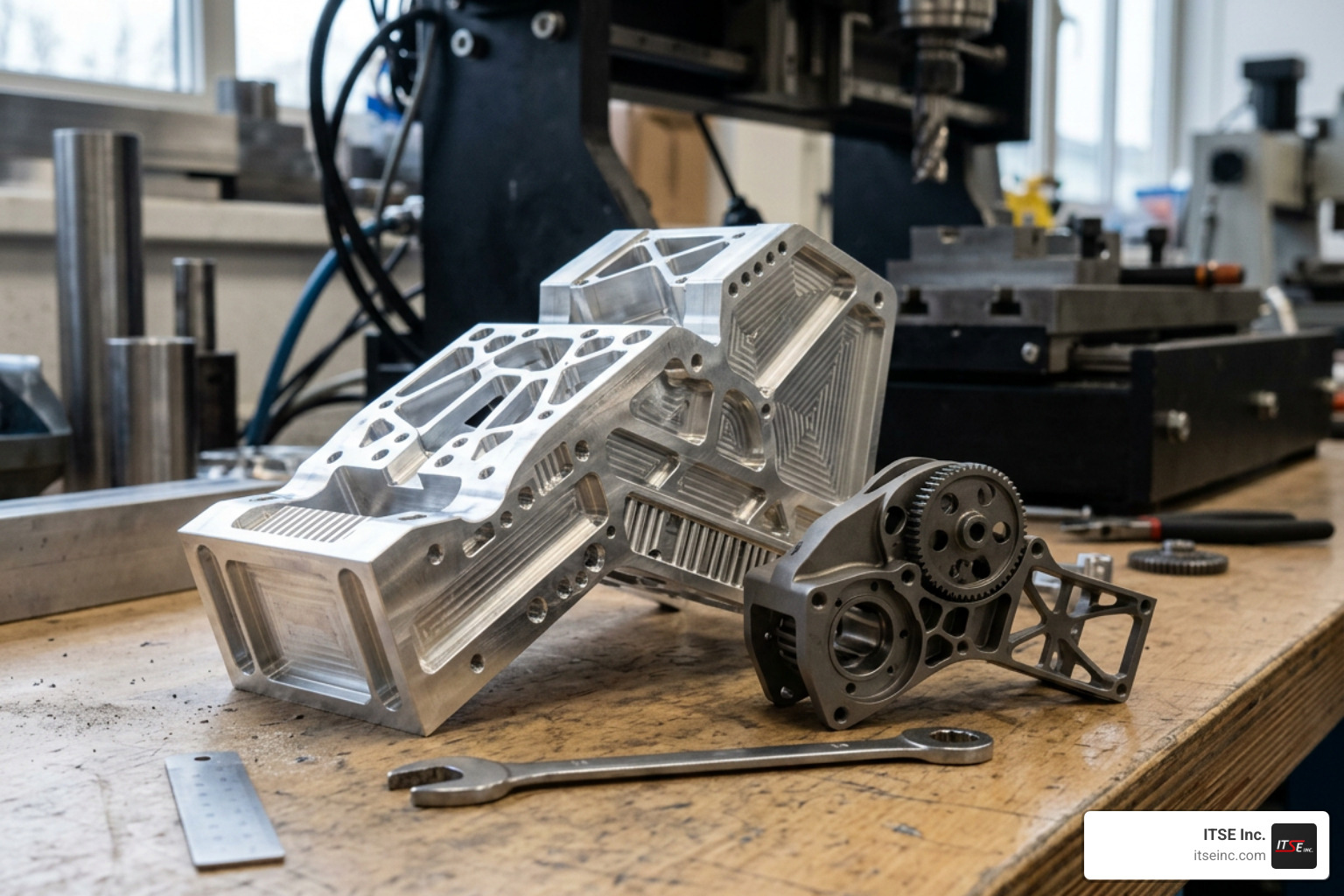
High-precision industries like aerospace, unmanned aerial vehicles (UAVs), and medical robotics leave absolutely no room for error. A single dimensional deviation of a few microns can cause a mechanical joint to bind, an aerial vehicle to lose stability, or a surgical instrument to fail. To maintain absolute consistency, manufacturers must operate under strict quality standards and leverage advanced multi-axis machining capabilities. If you are seeking high-precision manufacturing services in the northern suburbs, explore our local capabilities through Precision 5-Axis CNC Machining Services in Lake Zurich.
Quality Certifications and Inspection Methods
High-precision machining shops must implement rigorous quality assurance protocols to verify that every part matches its digital design.
- CMM Inspection: Coordinate Measuring Machines (CMMs) use highly sensitive tactile probes or non-contact lasers to measure the physical coordinates of a part down to ±0.001 mm. This is essential for verifying hole position tolerances of ±0.01 mm and flatness of ±0.005 mm on critical mounting surfaces.
- GD&T (Geometric Dimensioning & Tolerancing): This standardized system of symbols and rules allows engineers to specify the exact allowable variation of geometric features, such as concentricity, cylindricity, runout, and parallelism.
- ISO 9001: The baseline quality management standard that ensures a manufacturer has documented, repeatable processes for design, production, and inspection. For background on the standard, see the official ISO 9001 quality management overview.
- AS9100 / AS9102 FAI: The international quality management standard specifically for the aerospace industry. AS9102 requires a comprehensive First Article Inspection (FAI) report, documenting every single dimension on the engineering drawing for the very first part produced in a production run to guarantee process capability.
5-Axis Machining and Lightweighting Techniques
The rise of collaborative robotics and advanced UAVs has made lightweighting a primary engineering goal. Every gram saved on a robotic arm’s end-effector or a drone’s structural frame directly translates to faster cycle times, reduced power consumption, and increased payload capacity.
Achieving these aggressive weight targets requires 5-axis simultaneous CNC machining. Traditional 3-axis machining requires multiple setups to cut features on different faces of a part, introducing tiny alignment errors each time the part is refixtured. A 5-axis mill-turn center can machine complex, organic geometries from a single setup, maintaining perfect perpendicularity and concentricity within ±0.005 mm.
Engineers use Finite Element Analysis (FEA) to identify low-stress regions within a component and remove unnecessary material using complex pocket geometries. By pocketing out the interior of a structural plate while leaving thin, high-strength reinforcing ribs, they can reduce weight by up to 60% without sacrificing torsional rigidity.
To prevent these highly pocketed parts from warping due to internal material stresses, shops utilize stress-relieved plates (such as Al 7075-T651) and program precise toolpaths to control heat generation during the machining process.
Frequently Asked Questions about CNC Parts
What is the typical lead time for custom CNC parts?
Lead times for custom cnc parts vary based on part complexity, material availability, and required surface treatments:
- Prototypes: For standard materials like Aluminum 6061 or Stainless Steel 304, simple prototypes can be delivered in as fast as 1 to 3 business days. More complex geometries requiring 5-axis machining typically take 5 to 7 business days.
- Low-Volume Production: Small batches of 10 to 50 parts generally require 7 to 14 business days.
- Mass Production: Larger production runs (500+ units) typically range from 3 to 5 weeks, allowing time for custom fixturing, tooling optimization, and comprehensive quality documentation.
- Expedited Shipping: Many local machine shops offer expedited hot-run services, utilizing dedicated machines to deliver critical parts within 24 to 48 hours to minimize client downtime.
How do I choose between aluminum 6061 and 7075 for structural parts?
The choice between these two widely used alloys depends on your project’s mechanical requirements and budget constraints:
- Choose Aluminum 6061-T651 if: You need a highly cost-effective, corrosion-resistant material for general structural brackets, base plates, or enclosures. It is highly machinable, easy to weld, and responds beautifully to standard Type II anodizing.
- Choose Aluminum 7075-T6 if: Your application demands maximum yield strength and fatigue resistance, such as highly stressed robot joints, aerospace brackets, or UAV motor mounts. While 7075-T6 is roughly 30% to 50% more expensive than 6061 and more challenging to weld, its mechanical performance is unmatched.
What quality certifications are required for aerospace CNC parts?
Aerospace components must comply with stringent regulatory frameworks to ensure flight safety:
- AS9100 Certification: The manufacturing facility must be certified to AS9100, which builds upon ISO 9001 with strict requirements for risk management, product safety, and counterfeit part prevention.
- AS9102 FAI Report: A detailed First Article Inspection report is mandatory for all new aerospace part numbers, verifying that every dimension meets design specifications.
- Material Traceability: Manufacturers must provide mill test reports (MTRs) and chemical certifications, tracing every raw metal billet back to its original melt batch to guarantee material purity and strength.
Conclusion
Sourcing high-quality cnc parts is not just about finding the lowest price; it is about securing the precision, reliability, and technical support your production line needs to thrive. From stocking critical spindle spares to engineering lightweight robotic joints from 7075-T6 aluminum, every component choice directly impacts your operational efficiency and bottom line.
At ITSE Inc., we understand the rigorous demands of modern manufacturing. Based in Lake Zurich, IL, we manufacture precision OD bead choppers, ID scarfing systems, and custom tube mill equipment specifically tailored for the tube and pipe industry. We emphasize US-made quality, robust engineering, and local accountability to keep your production lines running smoothly year after year.
If you are ready to optimize your machinery, source precision spares, or discuss a custom manufacturing project, explore our CNC Machining Services and let our engineering team deliver the tailored solutions your business deserves.