
What Precision CNC Machining Actually Is (And Why It Matters)
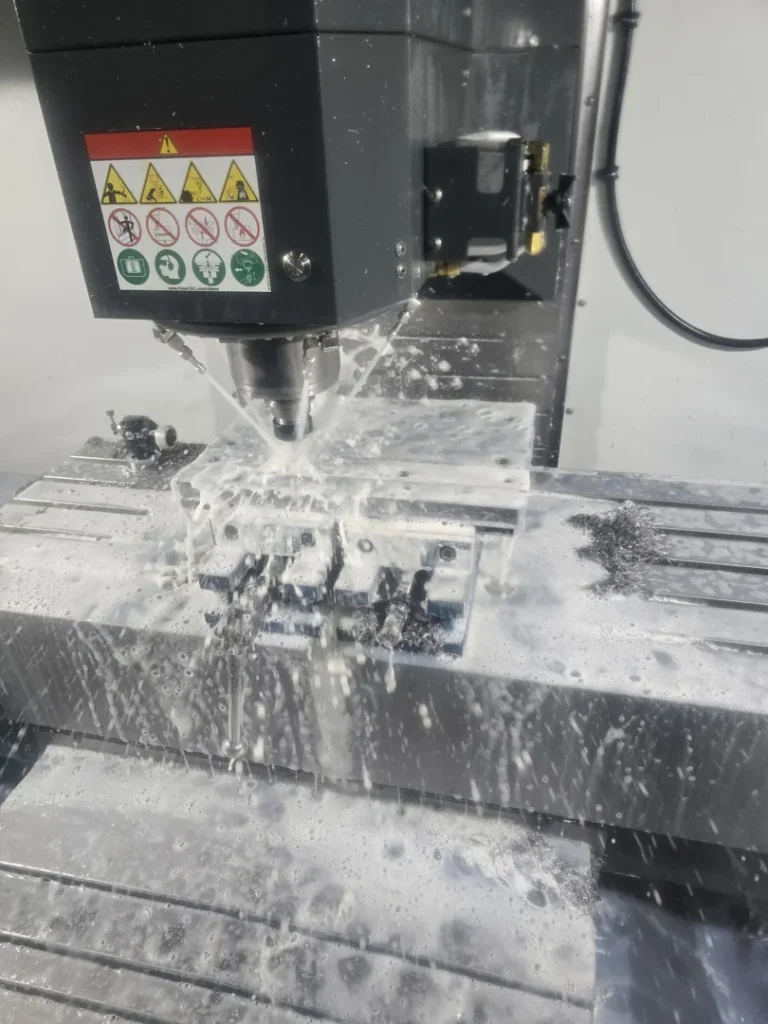
Precision CNC machining is a computer-controlled manufacturing process that removes material from a workpiece to produce parts with extremely tight tolerances — often as small as ±0.005 mm or better.
Here’s a quick breakdown:
| Feature | What It Means |
|---|---|
| What it is | Subtractive manufacturing guided by computer programs |
| How accurate | Tolerances as tight as ±0.0002″ (±0.005 mm) |
| Key processes | Milling, turning, drilling, grinding, EDM |
| Common materials | Aluminum, stainless steel, titanium, PEEK, engineering plastics |
| Who uses it | Aerospace, medical, automotive, defense, electronics |
| Main benefit | High repeatability with verified, documented quality |
If you work in tube and pipe manufacturing, you already know what happens when a component is even slightly off-spec. A single out-of-tolerance part can shut down a production line, cause weld defects, or compromise the performance of scarfing tools and bead removal systems. That’s exactly why precision machining exists — to make sure the parts you rely on actually perform as designed, every single time.
Standard CNC machining gets you close. Precision CNC machining gets you there.
The difference isn’t just tighter numbers on a drawing. It’s a controlled system of tooling, inspection, documentation, and process planning that ensures every critical dimension is verified — not assumed.
I’m Jarek Szpakowski, and at ITSE Inc. in Lake Zurich, IL, we apply precision CNC machining daily to build custom tube mill equipment, ID/OD scarfing systems, and high-tolerance components for industrial manufacturers across the U.S. In the sections ahead, we’ll walk through exactly how this process works and what to look for when you need parts that simply can’t fail.
What is Precision CNC Machining?
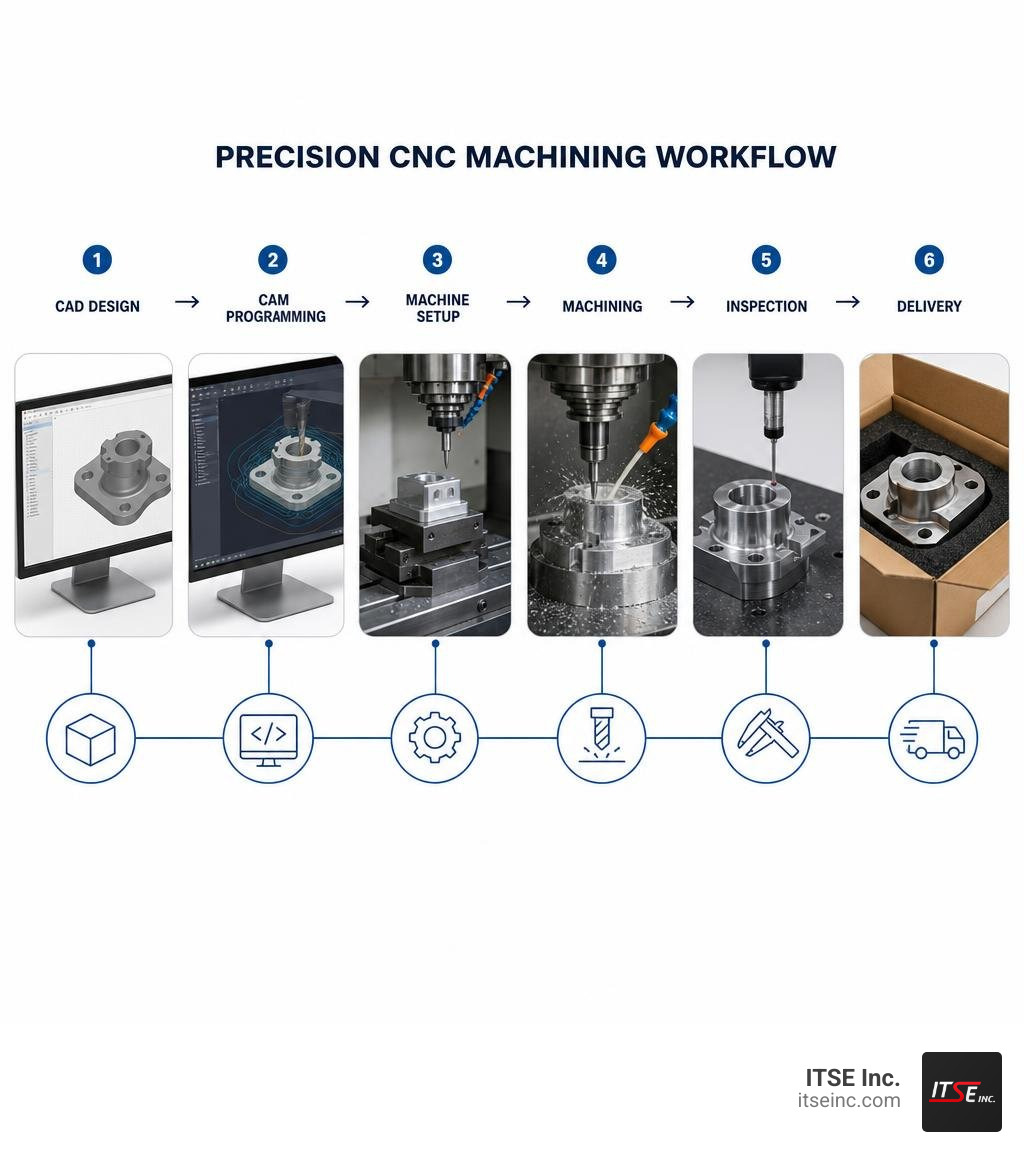
At its core, precision CNC machining is an advanced subtractive manufacturing method. Unlike additive manufacturing (like 3D printing), which builds parts layer by layer, CNC (Computer Numerical Control) machining starts with a solid block of material—often called a billet—and uses highly specialized cutting tools to shave away material until the final shape is achieved.
But what sets “precision” machining apart from standard machining? The answer lies in the level of dimensional accuracy, repeatability, and process control.
| Feature | Standard CNC Machining | Precision CNC Machining |
|---|---|---|
| Typical Tolerances | ±0.1 mm to ±0.2 mm | ±0.01 mm to ±0.005 mm (or tighter) |
| Surface Roughness (Ra) | 3.2 μm to 1.6 μm | 0.8 μm to 0.4 μm (and lower with grinding) |
| Primary Focus | General form, fit, and cost efficiency | Extreme accuracy, zero-defect performance, tight fits |
| Inspection Requirements | Standard calipers, micrometers, basic visual checks | NIST-traceable CMM, optical comparators, detailed reports |
| Waste Reduction | Moderate; higher risk of scrap on complex features | Extremely low; optimized toolpaths and simulation minimize errors |
In standard machining, a tolerance of ±0.1 mm is perfectly acceptable for brackets, structural frames, or simple enclosures. However, when you are manufacturing turbine blades, medical orthopedic implants, or high-wear tooling like our OD bead choppers, a deviation of even a few microns can lead to catastrophic failure.
By utilizing rigid machine structures, advanced thermal compensation, and highly accurate feedback loops, a high-end machine shop can achieve a repeatability of ±0.0002 inches (±0.005 mm). This means that whether we are making one custom prototype or a run of 1,000 parts, the last piece off the machine is identical to the first.
The Core Differences in Precision CNC Machining
To consistently achieve these tight tolerances, engineers must carefully manage tolerance stack-up. This occurs when multiple parts are assembled together, and the minor dimensional variations of each individual part add up to a major alignment issue.
To prevent this, we rely heavily on Geometric Dimensioning and Tolerancing (GD&T). GD&T is a standardized system of symbols and rules that tells the machinist not just what size a feature should be, but how it relates to other features on the part—such as flatness, concentricity, and runout.
Additionally, successful high-accuracy manufacturing requires a proactive approach to Design for Manufacturability (DFM). By optimizing the geometry of a part early in the design phase—such as avoiding deep, narrow pockets or specifying overly tight tolerances only where they are functionally necessary—we can significantly reduce tool wear, cycle times, and overall production costs.
For those looking to dive deeper into how these engineering principles are applied to custom manufacturing, you can find More info about CNC machining services on our dedicated capabilities page.
Key Processes and Equipment in High-Accuracy Manufacturing
Achieving nanoscale or micron-level accuracy requires a diverse toolkit. A modern precision machine shop does not rely on a single type of machine; instead, we select the optimal process—or combination of processes—based on the part’s geometry and material.
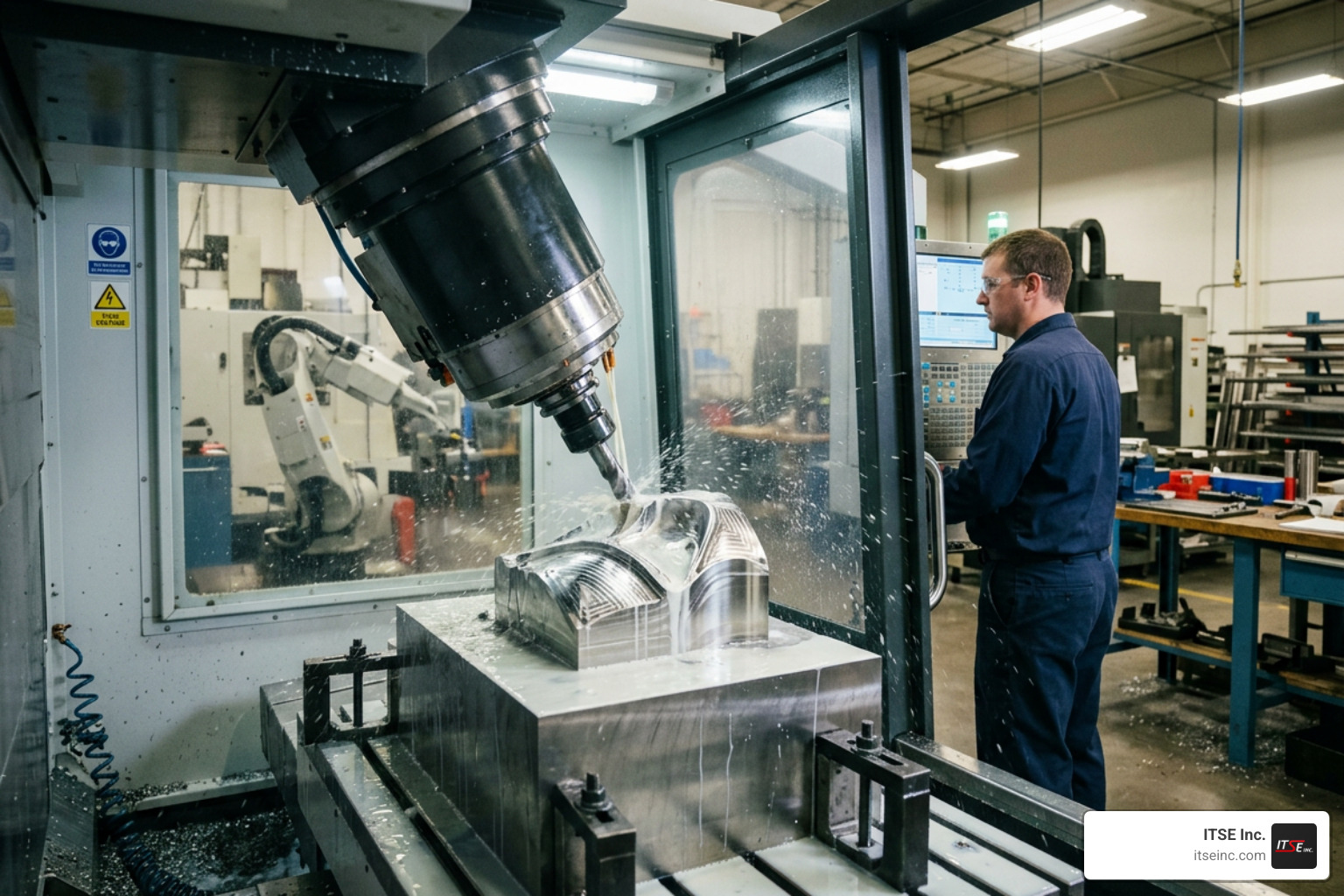
- CNC Milling: This process uses rotating cutting tools to remove material from a stationary workpiece. Standard 3-axis mills move along the X, Y, and Z axes, while advanced 4-axis and 5-axis machines add rotational axes to approach the part from virtually any angle.
- CNC Turning: Ideal for cylindrical components like shafts, rollers, and custom fittings. The workpiece rotates at high speeds (often up to several thousand RPM) while a stationary cutting tool shapes the material.
- Electrical Discharge Machining (EDM): For extremely hard materials or complex internal geometries that traditional cutting tools cannot reach, EDM uses controlled electrical sparks to erode material. This process is highly precise and exerts zero physical force on the part, preventing distortion in delicate features.
- Precision Grinding: Often used as a finishing step, grinding uses an abrasive wheel to achieve incredibly smooth surface finishes (down to Ra 0.4 μm or better) and exact dimensional sizing on hardened steels and specialty alloys.
Multi-Axis and Swiss Precision CNC Machining
When geometries become highly complex, traditional 3-axis milling requires multiple setups. Every time a machinist has to manually unclamp a part, rotate it, and reclamp it, you introduce the risk of a “datum shift”—a tiny alignment error that can ruin the part’s overall precision.
This is where 5-axis CNC machining and Swiss-style turning save the day.
With 5-axis milling, the machine can manipulate the part and the tool simultaneously. This “single-clamping” workflow allows us to machine complex, compound curves and multi-sided parts in one continuous operation, completely eliminating setup-related errors.
Meanwhile, Swiss-style lathes excel at producing small, slender, high-precision turned parts (often under 1 mm in diameter). By supporting the raw material right next to the cutting tool with a guide bushing, Swiss machines eliminate deflection, allowing us to hold incredibly tight tolerances on long, thin shafts and delicate components.
If you are based in the Chicagoland area and want to see how these advanced capabilities can streamline your production, you can Learn about precision 5-axis CNC machining services in Lake Zurich to discover how we handle complex geometries locally.
Materials and Tolerances: Achieving Micron-Level Accuracy
The choice of material plays a massive role in how tight of a tolerance a machine can hold. Different materials react differently to the heat and mechanical stress generated during cutting.
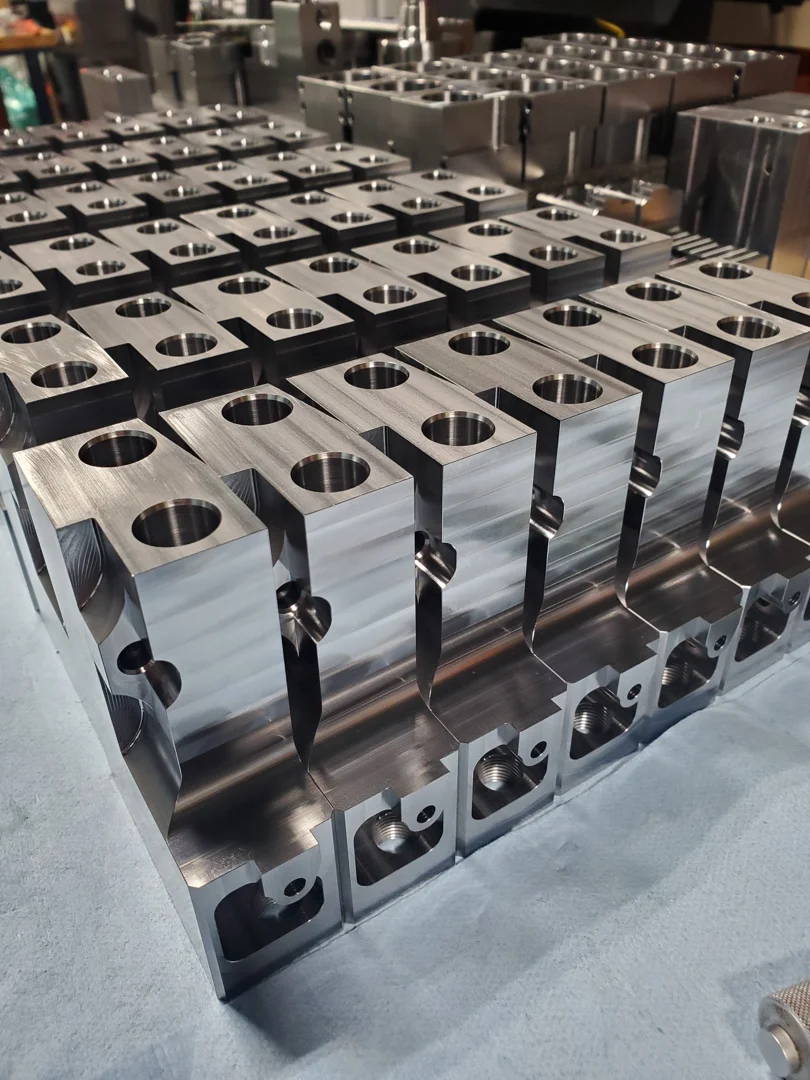
Here is a look at the most common materials processed in precision machine shops:
- Aluminum 6061 / 7075: Aluminum is highly machinable, dissipates heat well, and is excellent for rapid prototyping and lightweight structural parts. It easily holds tolerances down to ±0.005 mm.
- Stainless Steel 304 / 316L: Known for its corrosion resistance and strength. It is more difficult to machine than aluminum because it tends to work-harden, requiring rigid setups and precise coolant management.
- Titanium (Grade 5): Widely used in aerospace and medical implants due to its incredible strength-to-weight ratio and biocompatibility. Titanium generates significant heat during machining, requiring specialized tooling and slower spindle speeds.
- PEEK (Polyetheretherketone): A high-performance engineering plastic that maintains its mechanical properties at high temperatures. It is an excellent choice for medical instruments and semiconductor components where metal cannot be used.
In our Lake Zurich facility, we balance these material characteristics with the specific operational demands of your equipment. Whether we are machining high-strength tool steel for custom tube mill components or lightweight aluminum for specialized fixtures, we plan the toolpaths and cutting parameters to prevent material warping and maintain a strict ±0.005 mm tolerance where required. You can explore our complete material and machining range at ITSE Inc. Precision CNC Machining.
Quality Control, Inspection, and Metrology
In precision CNC machining, you can only claim the level of precision you are actually able to measure. A shop can have the most advanced 5-axis machines in the world, but without a robust quality control and metrology department, those capabilities mean very little.
To guarantee that every part meets your exact specifications, we implement a multi-stage inspection process:
- First Article Inspection (FAI): Before we begin a full production run, the very first part off the machine is thoroughly inspected and verified. This ensures that the CNC program, tooling setup, and material behavior are completely aligned before scaling up.
- In-Process Probing: Modern CNC machines can be equipped with on-machine probing systems. These probes measure critical dimensions mid-cut, allowing the machine to automatically compensate for tool wear or thermal expansion in real time.
- Coordinate Measuring Machines (CMM): For final verification, we rely on CMMs. These highly sensitive machines use a physical probe or optical lasers to map the 3D coordinates of a part’s surface, comparing the physical component directly to the original CAD model.
- Material Traceability: High-consequence industries require complete transparency. We maintain rigorous lot traceability, providing mill test reports (MTRs) and Certificates of Conformance (CoC) so you know exactly where your raw materials came from and how they were verified.
By maintaining strict adherence to ISO 9001:2015 quality management standards, we ensure that our manufacturing workflow is consistent, documented, and continuously improved. If you are looking for a reliable partner in the Chicagoland area – whether you are near Schaumburg, Grayslake, or Aurora – you can trust us to deliver fully documented quality. For more details on our inspection standards, visit High-Quality CNC Machining Services at ITSE Inc..
Frequently Asked Questions about Precision Machining
What are the typical lead times and cost considerations for precision CNC projects?
The cost and lead time of a precision CNC project depend on several key variables:
- Setup Costs: Programing the CAM software, selecting the tooling, and configuring the workholding fixtures takes time. For low-volume runs, these upfront setup costs represent a larger portion of the per-part price.
- Material Selection: Harder materials like titanium and Inconel require specialized, more expensive cutting tools and take longer to machine, which increases both material and labor costs.
- Tolerances: Demanding a ±0.005 mm tolerance on a non-critical feature unnecessarily increases costs. A good rule of thumb is to only specify tight tolerances where they are functionally required.
- Lead Times: A typical production run can take anywhere from 1 to 3 weeks depending on part complexity. However, simple prototypes can often be turned around in as little as 24 to 48 hours.
How does precision machining support custom and low-volume production?
Unlike traditional injection molding or casting, which require expensive and time-consuming molds, CNC machining requires no physical tooling molds. This makes it incredibly supportive of custom, low-volume, and prototype manufacturing.
We can easily take a digital CAD file, run a quick DFM analysis, program the toolpaths, and machine a single, production-intent prototype. If design changes are needed, we simply update the digital file and machine a new version. This flexibility allows engineers to refine their designs rapidly without worrying about high Minimum Order Quantities (MOQs).
What industries and applications rely most on precision CNC parts?
Because failure is simply not an option in these fields, several key industries depend heavily on high-accuracy machining:
- Aerospace: Turbine blades, fuel nozzles, and structural brackets must withstand extreme forces and temperatures while maintaining perfect dimensional accuracy.
- Medical Devices: Orthopedic implants, surgical instruments, and microfluidic components require biocompatible materials (like titanium and PEEK) machined to sterile, micron-level perfection.
- EV & Automotive: High-performance electric vehicle drivetrains, battery cooling manifolds, and complex compressor components require exact fits to maximize efficiency.
- Semiconductor & Defense: Vacuum chambers, wafer-handling components, and guidance system parts require specialized finishes and incredibly tight geometric tolerances.
Conclusion
As we look toward the future, precision CNC machining is evolving rapidly. The integration of artificial intelligence (AI) for real-time process monitoring, automated robotic loading, and advanced multi-tasking machines is allowing manufacturers to push the boundaries of speed, efficiency, and accuracy even further.
At ITSE Inc., we are proud to be part of this manufacturing evolution. From our home base in Lake Zurich, IL, we combine state-of-the-art machining capabilities with a deep understanding of the tube and pipe industry. Whether you need custom tube mill equipment, highly specialized scarfing tools, or tight-tolerance contract machining, we deliver American-made quality that you can rely on.
If you are ready to start your next project or want to learn more about how we serve the Chicagoland manufacturing community—from Aurora to Grayslake and beyond—explore our local resources. You can read about the Top Precision CNC Machining Services in Lake Zurich for Your Manufacturing Needs or directly Explore our CNC Machining Services to get a quote today. Let’s build something exceptional together!