
Why Finding the Right 5-Axis Machining Partner in Aurora, IL Matters
5-axis machining in Aurora, IL is in high demand — and choosing the wrong shop can cost you weeks of rework, failed inspections, and missed delivery windows.
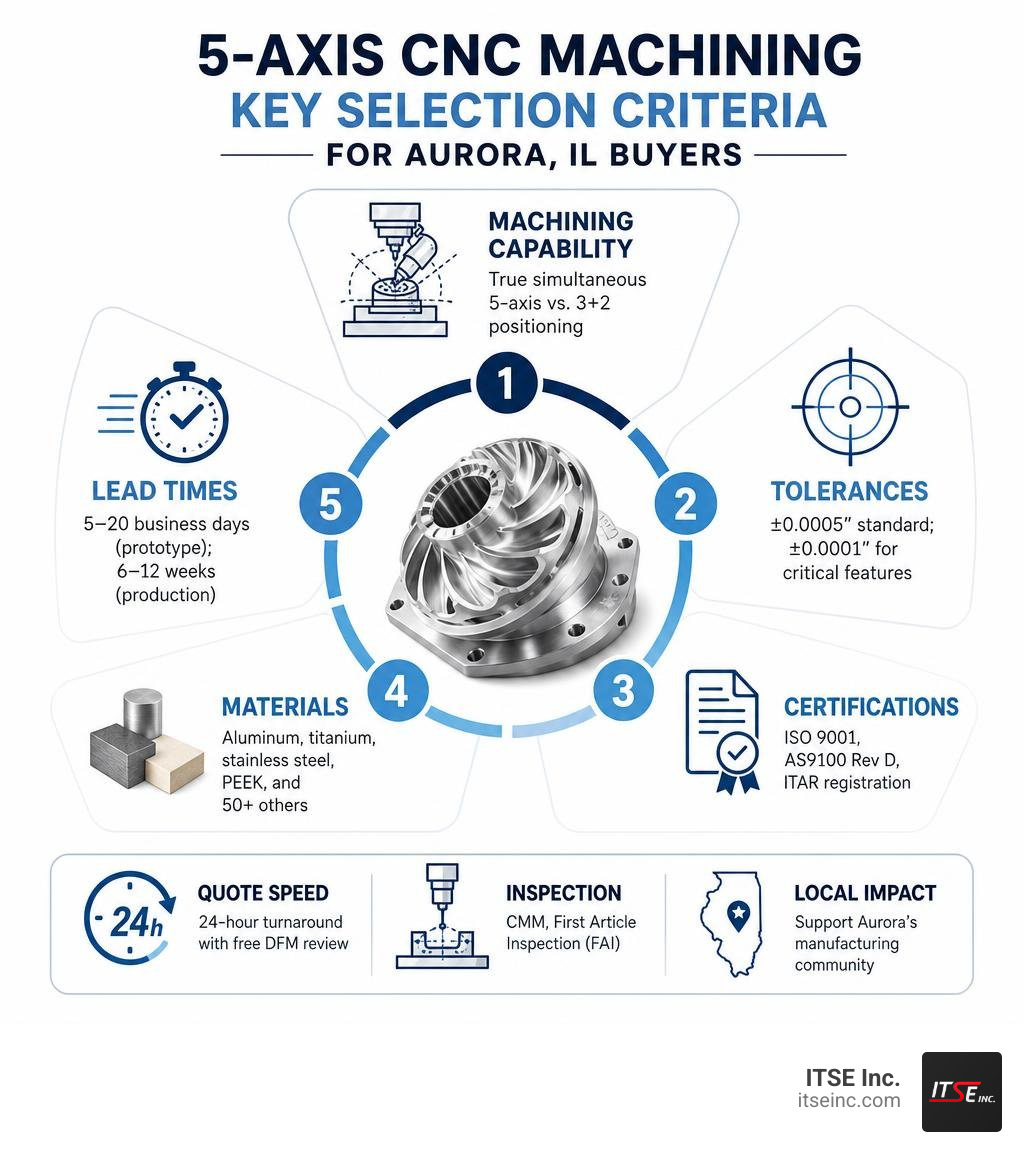
Here’s a quick overview of what to look for:
| What to Evaluate | What Matters Most |
|---|---|
| Machining capability | True simultaneous 5-axis vs. 3+2 positioning |
| Tolerances | ±0.0005″ standard; ±0.0001″ for critical features |
| Certifications | ISO 9001, AS9100 Rev D, ITAR registration |
| Lead times | 5–20 business days (prototype); 6–12 weeks (production) |
| Materials | Aluminum, titanium, stainless steel, PEEK, and 50+ others |
| Quote speed | 24-hour turnaround with free DFM review |
| Inspection | CMM, First Article Inspection (FAI) |
Aurora is Illinois’ second-largest city, with roughly 12,000 manufacturing workers and around 500 companies that regularly source precision machined parts. Major local OEMs — including Caterpillar, ABB, and Cabot Microelectronics — push suppliers to meet tight tolerances and strict quality standards. That pressure flows directly down to the machine shops serving the I-88 industrial corridor.
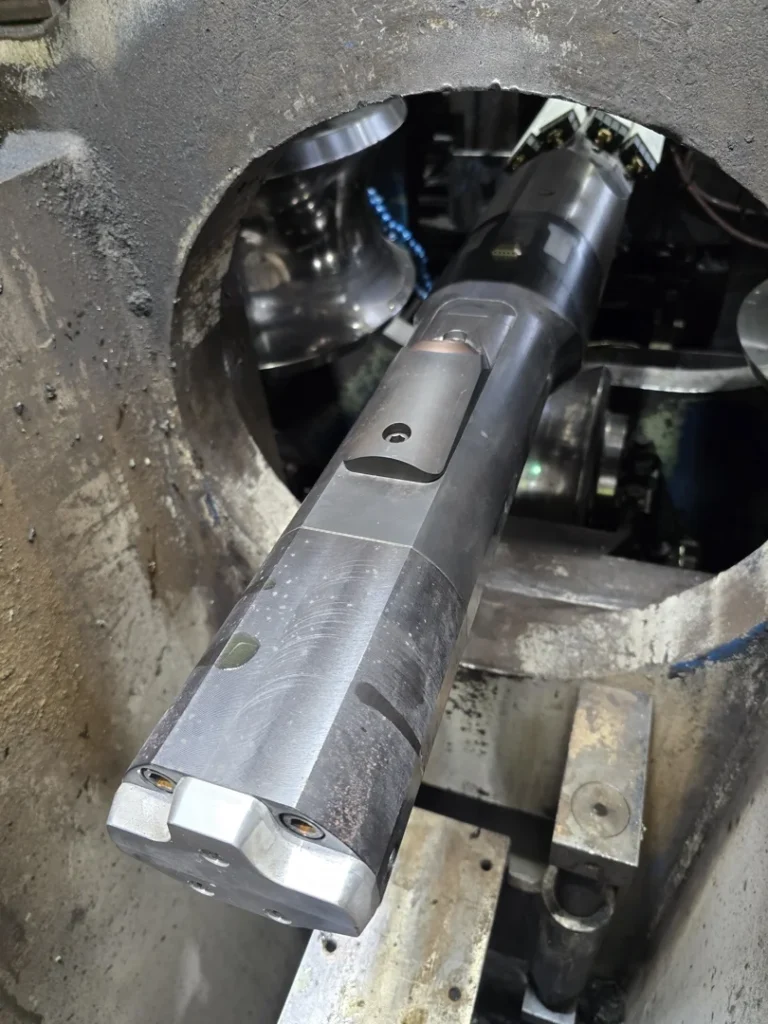
For tube and pipe manufacturers specifically, the stakes are even higher. Components like ID scarfing systems, OD bead choppers, and custom tube mill tooling require consistent geometry, repeatable tolerances, and materials that hold up under continuous production stress. A shop that can’t deliver all three isn’t a real option.
I’m Jarek Szpakowski, and at ITSE Inc. in Lake Zurich, IL, we’ve built our reputation supplying precision 5-axis machining in Aurora, IL and across the Midwest — including CNC components for tube processing, industrial automation, and OEM equipment. In this guide, I’ll walk you through exactly what to look for so you can source with confidence.
Simple guide to 5-axis machining Aurora IL terms:
Understanding 5-Axis CNC Machining vs. Traditional Methods
If you have ever tried to sculpt something complex out of blocky material, you know how frustrating it is to keep stopping, turning the piece, re-clamping it, and trying to align your tools perfectly again. Traditional 3-axis and 4-axis machining setups suffer from exactly this issue. Every time a machinist has to manually reposition a workpiece, human error creeps into the equation.
By contrast, 5-axis CNC machining introduces two additional rotational axes, allowing the cutting tool to approach the part from virtually any angle. The table below highlights how these methods compare:
| Capability | 3-Axis Machining | 4-Axis Machining | 5-Axis Machining |
|---|---|---|---|
| Axes of Motion | X, Y, Z (Linear) | X, Y, Z + A or B (1 Rotational) | X, Y, Z + A and B (or C) (2 Rotational) |
| Setup Requirements | Multiple setups required for complex parts | Fewer setups, but limited rotational angles | Single setup for highly complex geometries |
| Risk of Alignment Error | High (due to manual repositioning) | Moderate | Extremely Low |
| Ideal Geometries | Flat profiles, shallow cavities | Cylindrical parts, simple rotational cuts | Deep cavities, complex contours, undercuts |
| Surface Finish Quality | Standard (requires manual polishing) | Good | Superior (due to optimal tool positioning) |
By transitioning complex components to 5-axis machining, we eliminate the need for complicated, expensive fixtures. This drastically reduces setup times, improves geometric accuracy, and boosts overall manufacturing efficiency.
What is True Simultaneous 5-Axis Machining?
To understand true simultaneous 5-axis CNC machining, picture a synchronized dance between the cutting tool and the workpiece. In a simultaneous setup, the machine moves the cutting tool across the three linear axes (X, Y, and Z) while simultaneously rotating the workpiece or spindle head along two rotational axes (typically A and B).
This continuous movement means the cutting tool maintains the optimal angle of attack relative to the workpiece at all times. For industries requiring organic shapes, such as impellers, turbine blades, or highly contoured industrial tooling, true simultaneous motion is non-negotiable. It allows for continuous cutting paths that produce exceptionally smooth surface finishes without the “step-over” marks characteristic of lesser machines.
3+2 Positioning vs. Simultaneous 5-Axis Motion
Not every “5-axis” job requires continuous, simultaneous movement. In many cases, machine shops utilize a technique known as 3+2 positioning, sometimes referred to as “positional 5-axis” or “indexed 5-axis” machining.
In a 3+2 setup, the machine uses the two rotational axes to tilt and orient the workpiece to a specific angle. Once the part is locked in place, the rotational axes remain stationary while the cutting tool performs traditional 3-axis milling.
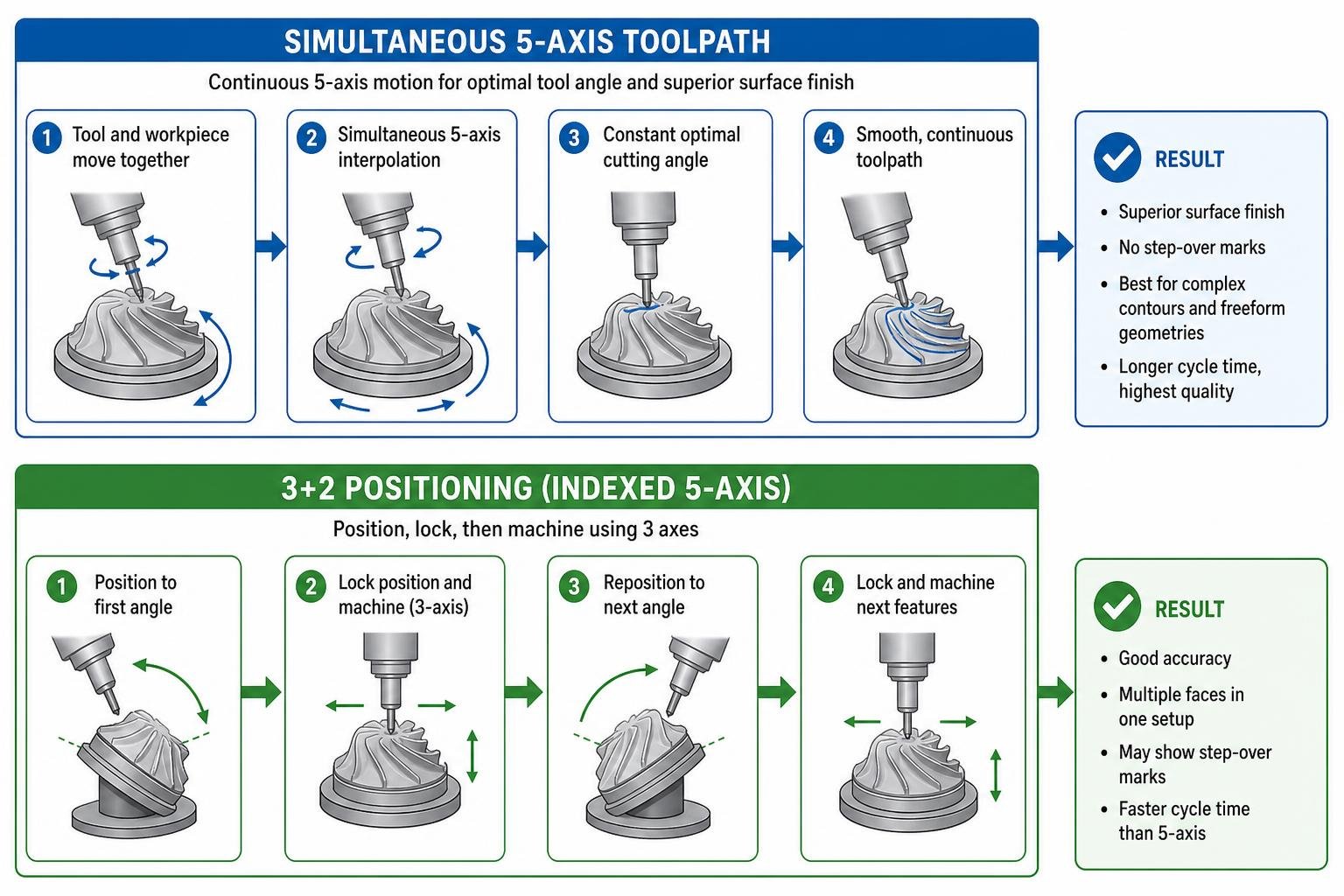
While 3+2 positioning doesn’t allow for continuous curved carving, it is incredibly useful. It allows shops to machine features on multiple faces of a part in a single setup, saving hours of manual labor and ensuring that holes, slots, and mating surfaces remain perfectly aligned. If you are weighing your project needs, check out our breakdown of 5 reasons to choose 5-axis CNC machining in Illinois to see which approach fits your budget.
Why 5-axis machining Aurora IL is Essential for Local OEMs
The Fox Valley and I-88 industrial corridors are home to some of the most demanding manufacturing supply chains in the country. From Tier-2 automotive suppliers to medical device firms and heavy industrial equipment giants, local OEMs require components that can withstand extreme environments.
Standard 3-axis mills simply cannot produce the complex internal geometries, deep cavities, and tight-tolerance mating surfaces required by modern industrial machinery. When a local player like Caterpillar builds heavy earthmoving equipment, or ABB designs high-voltage electrical components, they cannot afford a single part failure. Local machine shops providing high-speed 5-axis machining Aurora IL allow these companies to source components locally, keeping their supply chains resilient and their lead times short.
Sourcing 5-axis machining Aurora IL: Key Selection Criteria
Sourcing custom components along the I-88 corridor requires looking beyond just the lowest price. When you are evaluating potential partners for 5-axis machining Aurora IL, you need to look at their engineering depth, their quality control processes, and how they manage their regional supply chains.
Quality Certifications and Compliance Standards
Before you send over your CAD files, you must verify that the machine shop holds the correct certifications for your industry. If you are sourcing flight-critical components or defense hardware, the shop must be ITAR-registered and AS9100 Rev D certified. For general industrial equipment, medical devices, or automotive components, ISO 9001 compliance is the absolute baseline.
These certifications aren’t just pieces of paper to hang on the wall; they guarantee that the shop has a robust quality management system, full material traceability, and standardized inspection procedures. For a deeper look at vetting local partners, read our guide on How to choose the best partner for precision CNC in Elk Grove.
Lead Times, Prototyping, and Production Runs
A great machine shop should be able to support you through the entire lifecycle of your product, from the initial prototype to high-volume production runs.
- Prototypes: Typical lead times for 5-axis machined prototypes range from 5 to 20 business days. This speed is critical when you need to validate a design before committing to tooling.
- Production Runs: For ongoing production, lead times usually range from 6 to 12 weeks.
- Blanket POs: To lock in pricing and guarantee delivery windows, many Aurora procurement teams utilize blanket purchase orders with scheduled releases. This allows the machine shop to optimize their material purchasing and machine scheduling, passing those savings back to you.
For more details on managing early-stage designs, check out our resource on Prototype CNC machining.
Sourcing 5-axis machining Aurora IL for Complex Geometries
The main reason to seek out 5-axis machining Aurora IL is to tackle geometries that would be impossible to machine otherwise.
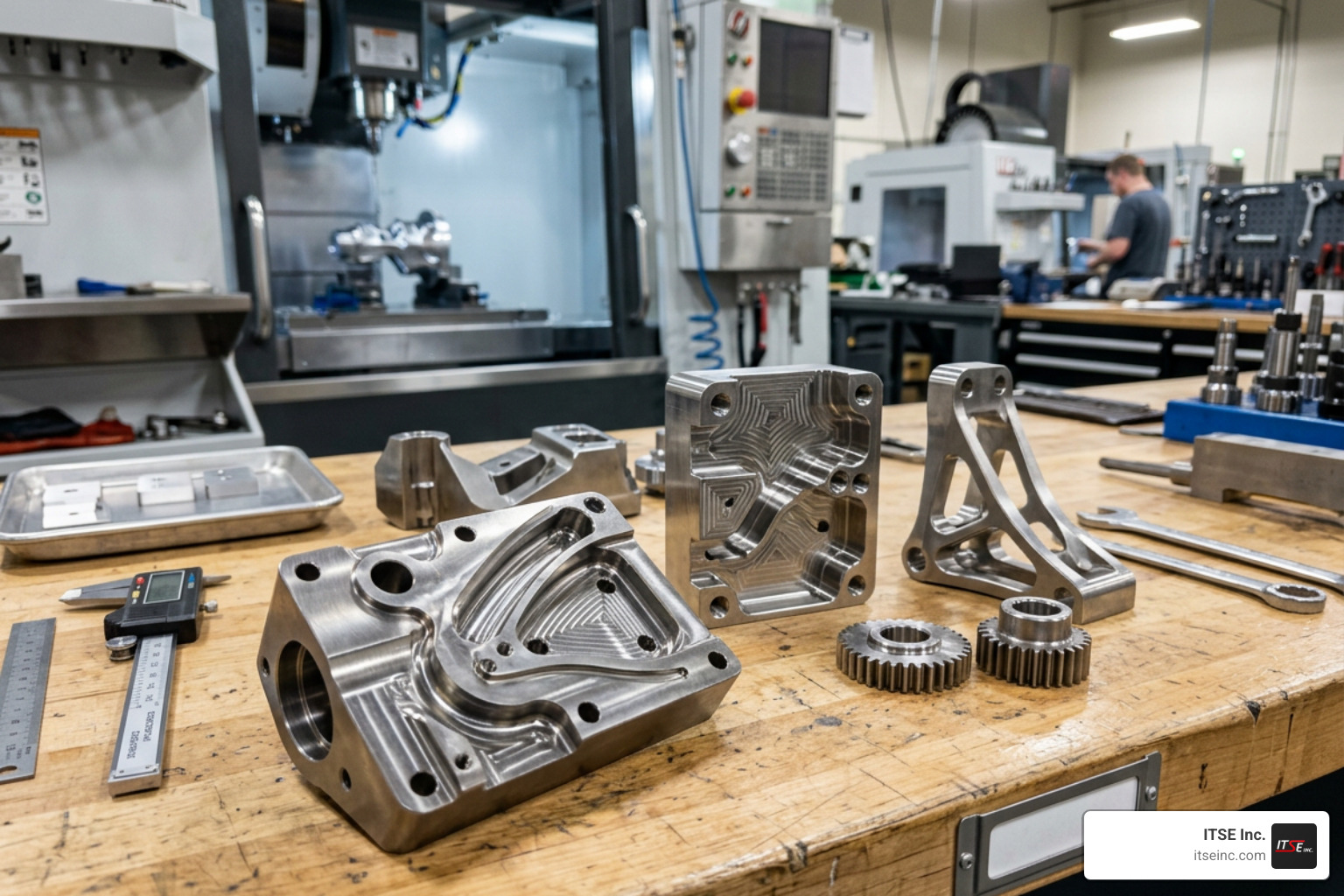
When you are designing parts with complex contoured surfaces, deep cavities, undercuts, or incredibly thin walls, 5-axis machining is the only way to go. Because the cutting tool can remain perpendicular to the cutting surface, tool deflection is minimized. This allows the machine to carve out deep pockets and fine details without the tool vibrating or snapping, resulting in unmatched precision and exceptional surface finishes.
To compare local sourcing options and find certified shops in the region, you can consult 5-Axis Machining in Aurora, IL | Illinois Quotes .
Technical Capabilities, Materials, and Tolerances
High-precision 5-axis machining is a blend of advanced software, heavy-duty German or Swiss machine tools, and experienced machinists who know how to push those systems to their limits.
Achieving Ultra-Tight Tolerances
While standard CNC shops might struggle to hold a tolerance of ±0.005″, advanced 5-axis machining centers routinely hold standard tolerances of ±0.0005″ and tight tolerances as precise as ±0.0002″ or even ±0.0001″.
This level of extreme accuracy is critical for high-performance applications, such as the custom tube mill tooling and ID scarfing assemblies we manufacture at ITSE Inc. When parts are rotating or sliding at high speeds under immense pressure, even a microscopic variation can lead to catastrophic failure. You can read more about how we push these boundaries in our guide on Precision 5-axis Lake Zurich cutting-edge tech for tight tolerances.
Material Versatility in Multi-Axis Milling
A premier 5-axis machining partner in the Chicago area should be comfortable working with a massive range of materials, including:
- Aluminum (6061-T6, 7075-T6): Excellent strength-to-weight ratio, highly machinable, ideal for structural aerospace and robotic parts.
- Stainless Steel (304, 316, 17-4 PH): Highly corrosion-resistant, perfect for food processing, marine, and medical equipment.
- Titanium (Grade 5): Extremely strong and lightweight, though notoriously difficult to machine without rigid 5-axis setups.
- Superalloys (Inconel, Hastelloy): Used in extreme heat environments, requiring heavy-duty machine dampening.
- Engineering Plastics (PEEK, Delrin, Nylon): Perfect for medical implants, electrical insulators, and low-friction wear components.
Choosing the right material is just as important as the design itself. To help you navigate these choices, refer to The buyer’s guide to CNC precision machining services.
If you are looking to browse regional suppliers with extensive material capabilities, you can visit 5 Axis CNC Machining in Illinois .
Advanced Inspection and Quality Control
Cutting a part is only half the battle; proving that it meets your specifications is the other half. High-end 5-axis shops utilize Coordinate Measuring Machines (CMM) and optical inspection systems, such as Zeiss systems, to verify every dimension of a completed part.
For critical industries, a shop should provide a full First Article Inspection (FAI) report, material certifications, and dimensional data sheets with every shipment. This level of transparency ensures that when the parts arrive at your facility in Aurora, Addison, or Elk Grove Village, they are ready to be installed immediately. Learn more about regional quality control standards at Precision CNC machining services in Lake Zurich.
Frequently Asked Questions about Multi-Axis Machining
How does 5-axis machining reduce overall production costs?
At first glance, 5-axis machining can seem more expensive because the hourly rates for the machines are higher than traditional 3-axis mills. However, when you look at the total production cost, 5-axis machining often wins.
By completing a part in a single setup, you eliminate the labor costs associated with designing, building, and assembling multiple fixtures. Furthermore, reducing manual setups dramatically cuts down on cycle times and human error, meaning fewer scrapped parts and faster turnaround times.
What is the typical cost range for 5-axis machined parts?
The cost of a 5-axis machined part can range anywhere from $200 to over $2,000 per part, depending entirely on the complexity of the design, the material selected, and the volume of the production run. For a solid introduction to how these costs are calculated, read The no-nonsense guide to understanding CNC machining.
How can procurement teams get fast DFM feedback?
The fastest way to get a project moving is to submit your design as a STEP or IGES file. Most modern machine shops can provide a detailed quote with free Design for Manufacturability (DFM) feedback within 24 hours. This feedback will flag potential issues — such as deep pockets that are too narrow for standard tooling, or internal corners that lack the proper radii — before any metal is cut.
To avoid common prototyping pitfalls during this stage, take a look at our guide on Rapid CNC prototyping and how to avoid making a mess of it.
Conclusion
Choosing the right 5-axis machining partner in Aurora, IL, comes down to finding a team that combines cutting-edge technology with real manufacturing expertise. By verifying their certifications, checking their tolerance capabilities, and ensuring they provide comprehensive DFM feedback, you can protect your project from costly delays.
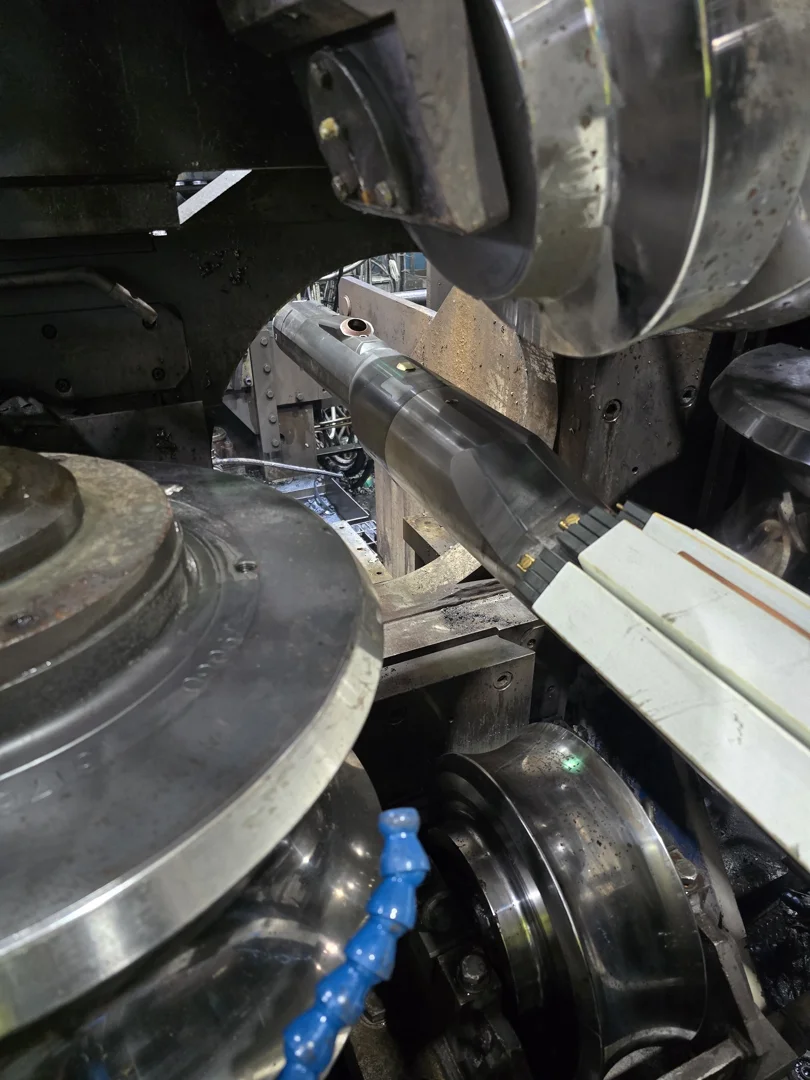
At ITSE Inc., we manufacture precision OD bead choppers, ID scarfing systems, and custom tube mill equipment for the tube and pipe industry, emphasizing US-made quality and tailored solutions. We bring this same level of uncompromising precision to all of our custom contract machining work.
If you are ready to discuss your next multi-axis project, explore our CNC machining capabilities or reach out to our team today to get started.