
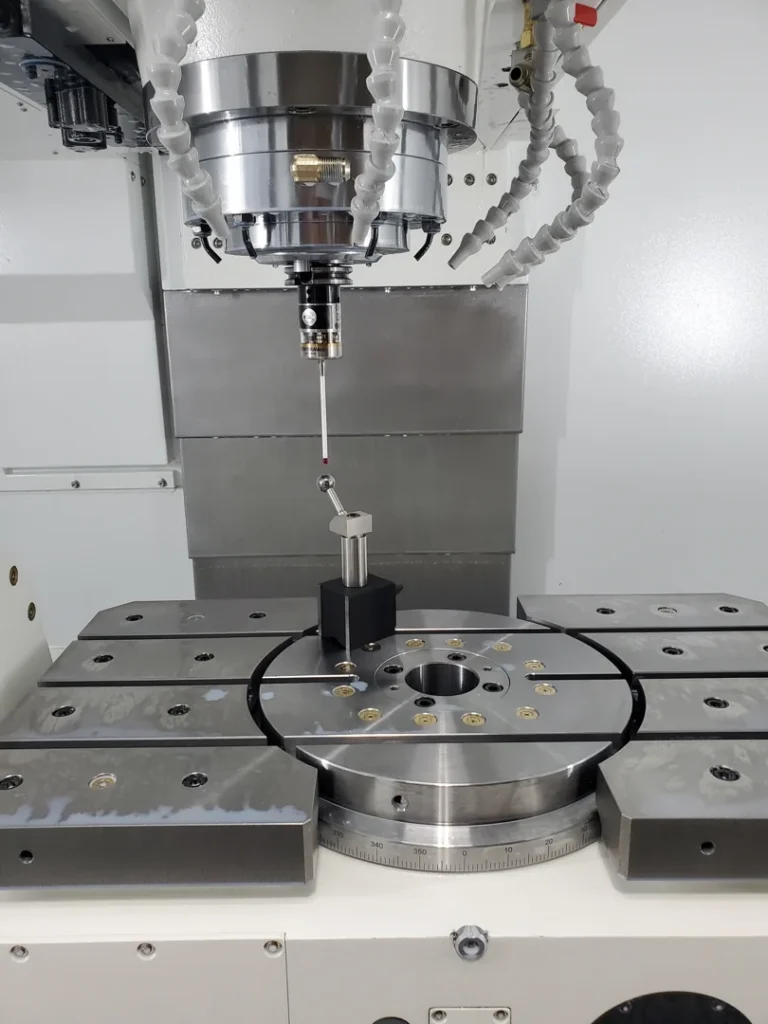
Why Choosing the Right CNC End Mill Brand Can Make or Break Your Production
A CNC end mill is one of the most important cutting tools in any machine shop — and picking the wrong brand costs you more than just money.
Quick answer: What is a CNC end mill?
- A rotating cutting tool used in CNC milling machines
- Has cutting edges on both the bottom and the sides (unlike a drill bit, which only cuts downward)
- Used for slotting, profiling, contouring, and facing operations
- Available in materials including solid carbide, high-speed steel (HSS), and coated carbide
- Common types: square end, ball nose, corner radius, roughing, and V-bit
If you work in tube and pipe manufacturing, you already know that tooling consistency is everything. One underperforming cutter on a scarfing or bead removal pass can throw off your entire production run. The same principle applies across CNC milling — the brand and type of end mill you choose directly affects surface finish, cycle time, and tool life.
Carbide end mills, for example, stay sharp up to 50 times longer than conventional cutting tools. That kind of difference shows up fast in a high-volume shop environment.
I’m Jarek Szpakowski, and at ITSE Inc. we rely on precision CNC end mill selection daily across our 5-axis machining operations and custom component work for tube mill and industrial automation customers. That hands-on experience is what shapes everything you’ll read in this guide.
Understanding the CNC End Mill and How It Differs from Other Tools
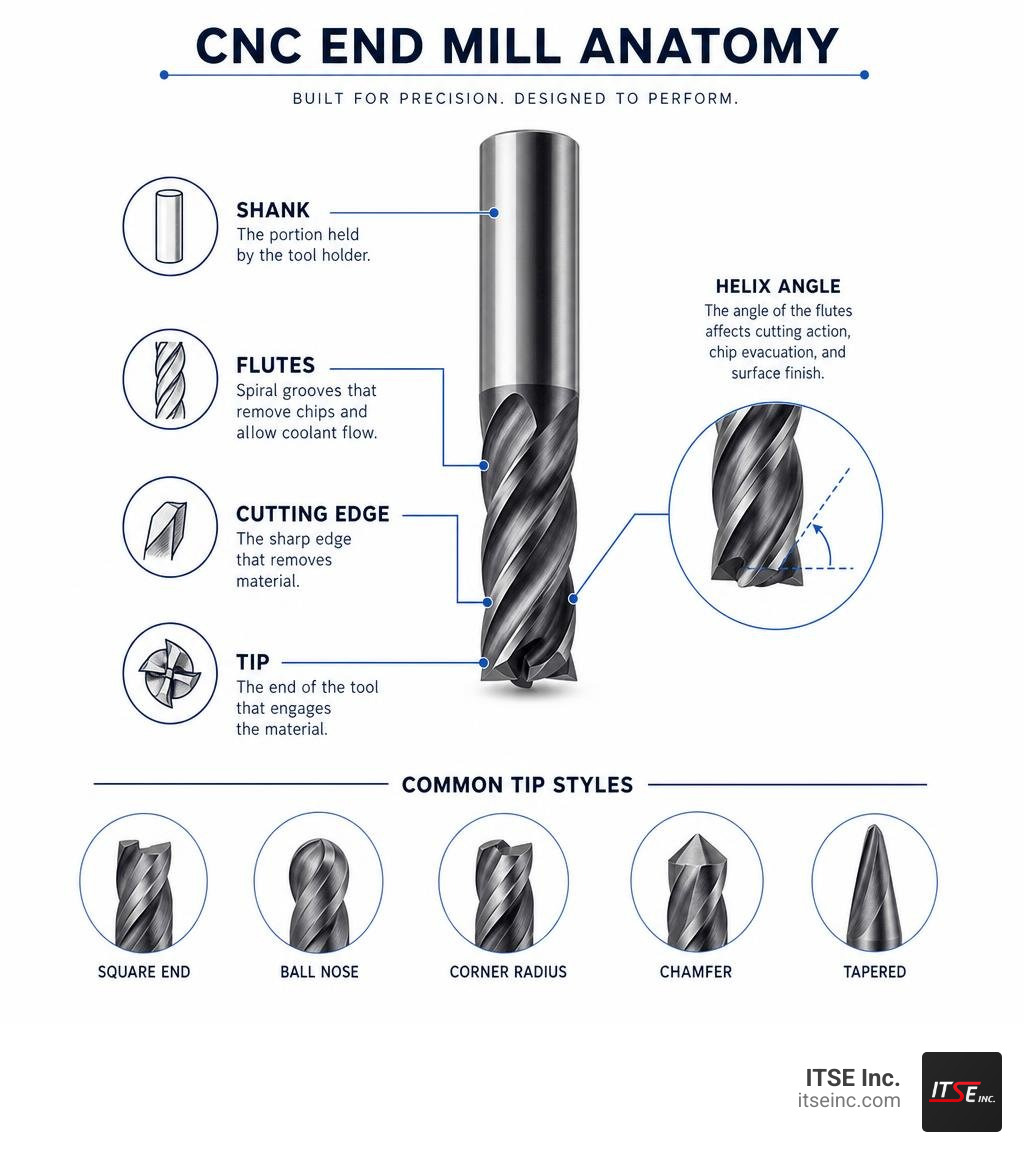
To get the most out of your machinery, it helps to understand exactly what makes a cnc end mill different from the other spinning pieces of metal in your tool crib. While it might look like a standard drill bit to the untrained eye, its engineering is entirely different.
An end mill is engineered to cut laterally (sideways) as well as axially (straight down). It features cutting edges along its periphery (the sides) and across its face (the bottom tip). This unique geometry allows machinists to perform complex operations like peripheral milling, slotting, contouring, and face milling.
To dive deeper into how these tools fit into the broader manufacturing landscape, check out The No-Nonsense Guide to Understanding CNC Machining.
Key Differences Between a CNC End Mill and a Drill Bit
Understanding the mechanical forces at play helps prevent broken tools and ruined workpieces:
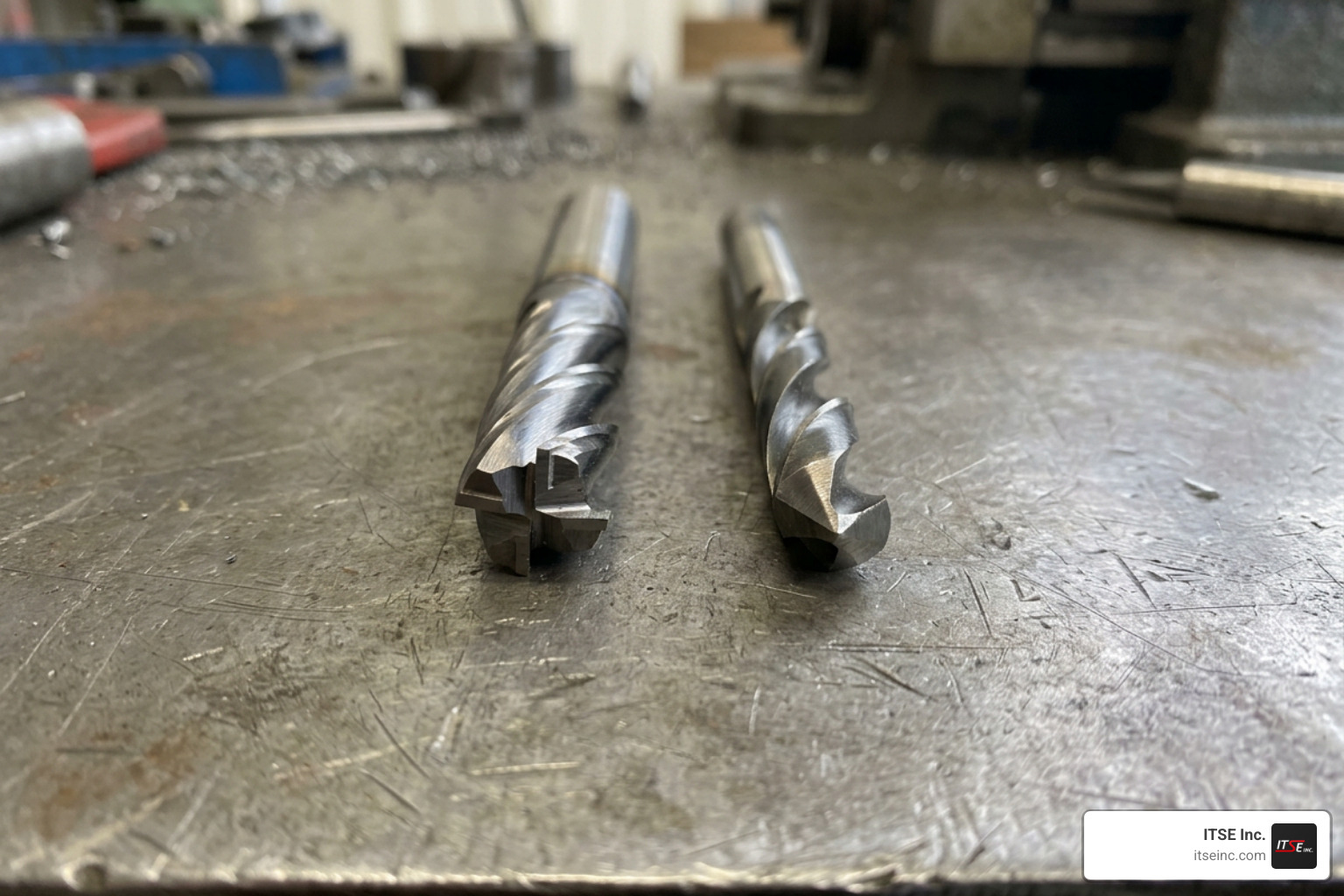
- Direction of Force: Drill bits are designed exclusively to handle axial force. They push straight down to create holes. If you try to push a drill bit sideways, it will snap. A cnc end mill, on the other hand, is built to withstand high radial forces (sideways pressure) during peripheral milling.
- Cutting Geometry: Drill bits have cutting lips only at the very tip. End mills have continuous helical flutes with sharp cutting edges wrapping around the entire body of the tool.
- Plunge Cutting vs. Hole Making: While some end mills are “center-cutting” (meaning they can plunge straight down like a drill), their primary job is to pocket, profile, and carve out complex 3D shapes once they reach depth.
How to Choose the Right CNC End Mill for Your Material
Selecting the right tool is a balancing act between material hardness, tool geometry, and cutting parameters. Materials are generally categorized by their Rockwell Hardness (HRC) rating.
When cutting softer metals like aluminum, you need wide chip pockets to prevent the sticky material from welding itself to the tool. For harder materials, such as tool steels or stainless steels up to HRC 45, you require high-rigidity tools with specialized heat-resistant coatings to prevent premature edge wear. Selecting the wrong tool-to-material match will result in immediate tool failure, poor surface finishes, or excessive machining cycle times.
Main Types of End Mills and Their Applications
Different milling tasks require different tool shapes. Using the wrong geometry for a specific feature is a quick way to drive up your scrap rate.
| End Mill Type | Primary Use Case | Key Advantages | Surface Finish Quality |
|---|---|---|---|
| Square End | Slotting, profiling, flat-bottom pockets | Sharp 90-degree corners, high material removal | Excellent on flat floors |
| Ball Nose | 3D contouring, curved surfaces | Smooth transitions on complex 3D profiles | Excellent for finishing curves |
| Corner Radius | Mold making, high-strength pocketing | Rounded corners prevent chipping, extends tool life | Great floor-to-wall radius |
Square End Mills vs. Ball Nose End Mills
Square end mills are the workhorses of the machine shop. They are designed to cut flat-bottomed pockets, slots, and vertical walls. However, their sharp 90-degree corners are prone to chipping under heavy loads.
To solve this, many high-performance designs incorporate corner radiuses or chamfers. For example, the 1/4″ Dia. Carbide End Mill, 4 Flute, TiAlN Coated, 1/4″ Smooth Shank x 1-1/4″ LOC, 0.016″ Chamfer, HSPM1 utilizes a subtle 0.016″ chamfer to protect the outer edges from chipping, drastically extending tool life in tough materials.
Ball nose end mills feature a full radius equal to half the tool’s cutting diameter. They are the go-to choice for 3D profiling and contouring complex curves. High-quality options like the GOmill™ GP • Ball Nose • 4 Flutes • Factory Standard Plain Shank • Inch use an eccentric relief design. This geometry improves cutting-edge stability and makes the tool much easier to regrind during reconditioning.
For general-purpose profiling, you can also look at the GOmill™ GP – Ball Nose – 4 Flutes – Plain Shank – Inch 5824556 – Kennametal or the dual-flute variant GOmill™ GP • Ball Nose • 2 Flutes • Plain Shank • Inch for operations requiring extra chip clearance.
Up-Cut, Down-Cut, and Single-Flute Geometries
For CNC routers and light-duty milling machines, the direction of the helical spiral determines how chips are evacuated and how the workpiece is held:
- Up-Cut End Mills: These tools pull chips upward and out of the cut. They are fantastic for bulk material removal (often called “hogging”) because they prevent chip recutting. However, they can cause slight tear-out on the top edge of materials like wood or laminated plastics.
- Down-Cut End Mills: These push chips downward. This action compresses the material, leaving a perfectly clean top edge. They are ideal for thin sheet materials, though chip evacuation is limited, meaning you cannot run them deep without risking packing.
- Single-Flute End Mills: Featuring one massive flute, these offer maximum chip evacuation space. They are highly recommended for soft, sticky materials like plastics and soft aluminum where chip packing is a constant threat. In fact, high-performance up-cut configurations are widely rated as excellent by 93% of customers for their ability to hog out material quickly without clogging.
The Science of Flutes, Helix Angles, and Coatings
The performance of a cnc end mill is governed by its micro-geometry and surface chemistry.
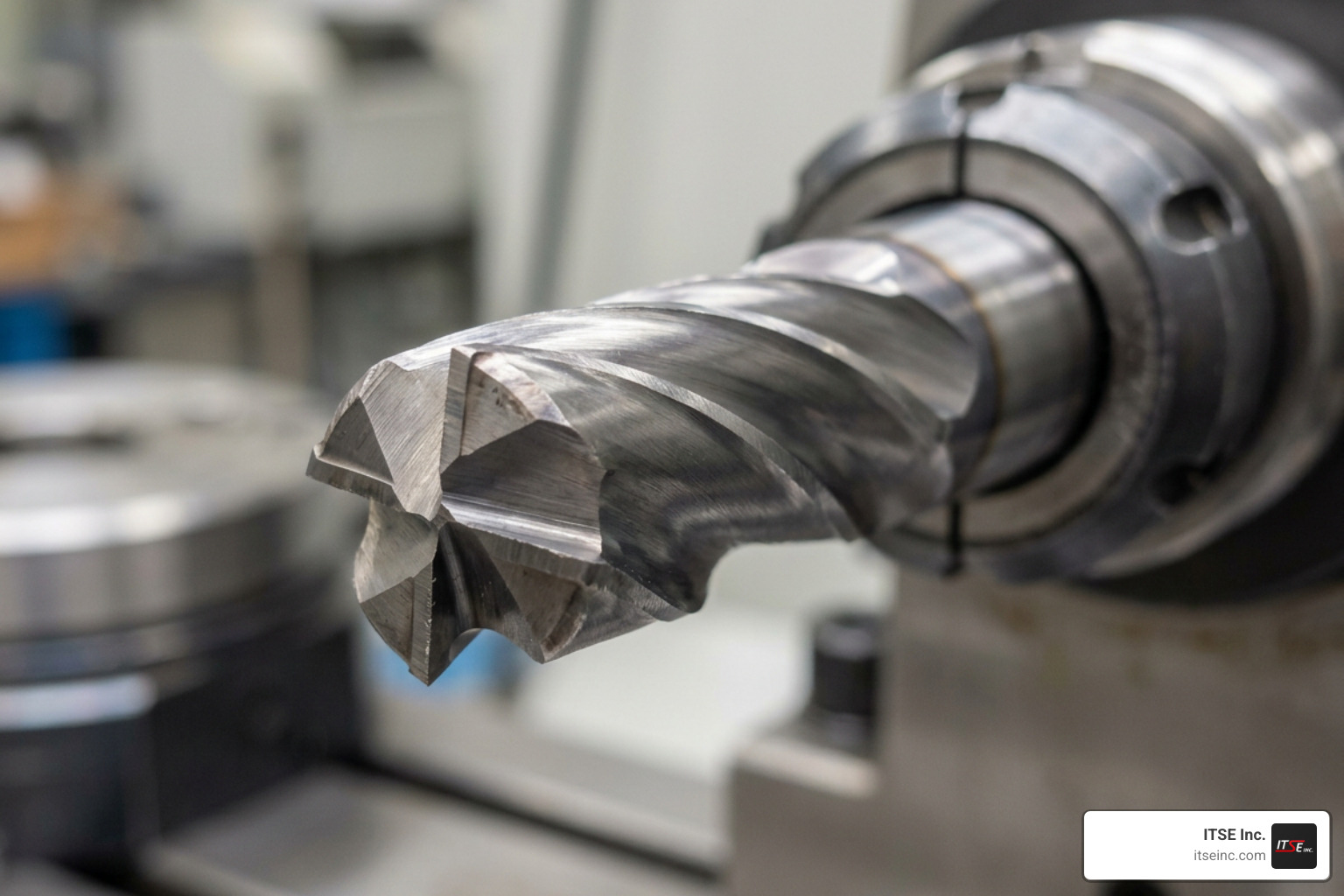
How Flute Count Impacts Rigidity and Surface Finish
The number of flutes on an end mill determines its core diameter and chip pocket size:
- Fewer Flutes (1 to 2): Provide large chip pockets. This makes them ideal for soft materials (aluminum, plastics) that produce large, ductile chips. However, the smaller core diameter reduces the tool’s overall rigidity.
- More Flutes (4 to 6+): Increase the tool’s core diameter, making it incredibly rigid. This extra strength allows for faster feed rates and produces an exceptional surface finish on harder metals. The trade-off is smaller chip pockets, which can easily clog if used in soft, gummy materials.
Helix Angles and Chip Evacuation Efficiency
The helix angle is the angle formed between the centerline of the tool and the tangent of the cutting edge.
- Low Helix Angles (approx. 30°): Provide a slower, more gradual entry into the material. They are highly stable and work well for general-purpose roughing in cast iron and steel.
- High Helix Angles (45° or higher): Shear through material with a clean, slicing action. This reduces cutting forces and lifts chips out of deep slots efficiently. High-helix designs are excellent for sticky materials like stainless steel and aluminum, though they exert more axial pulling force on the spindle.
High-Performance Coatings: TiAlN, AlTiN, and Beyond
Raw carbide is incredibly hard, but it can degrade rapidly under the extreme heat generated during high-speed machining. Coatings act as a thermal barrier.
- TiAlN (Titanium Aluminum Nitride): This is the industry-standard “workhorse” coating. It is highly versatile and handles both wet and dry machining. A General Purpose TiAlN Coated 4-Flute End Mill | Best Value for Steel up to HRC 45 – minnexon.com is a prime example. The TiAlN coating forms a protective aluminum oxide layer when exposed to heat, making it perfect for carbon steels, alloy steels, and cast iron.
- AlTiN (Aluminum Titanium Nitride): Designed for extreme heat, AlTiN thrives in dry, high-speed machining of hardened steels (HRC 55+). It requires high temperatures to activate its protective properties, so running it with flood coolant can actually shorten its life due to thermal shocking.
Optimizing Feeds, Speeds, and Tooling Costs
Running a machine shop efficiently is all about maximizing your Material Removal Rate (MRR) while keeping tooling costs under control. If you run your tools too slow, you rub the material instead of cutting it, which work-hardens the workpiece and destroys the tool. Run them too fast, and the cutting edge melts.
For shops looking to optimize their production runs, partnering with a high-end service provider can yield massive dividends. Learn more about how professional setups handle these challenges by visiting our Top Precision CNC Machining Services in Lake Zurich for Your Manufacturing Needs.
Recommended Feeds and Speeds for Common Materials
To calculate the correct parameters, you must know your target Surface Feet per Minute (SFM) and Inches Per Tooth (IPT, or “chip load”):
- For Carbon Steel (up to HRC 45): Use a 4-flute TiAlN coated end mill. Aim for an SFM of 300 to 600. Keep your Radial Depth of Cut (RDOC) tight, around 5% to 10% of the tool’s diameter, while pushing your Axial Depth of Cut (ADOC) to 1.5 to 2 times the diameter.
- For Aluminum: Use a 2-flute or 3-flute uncoated or DLC-coated (Diamond-Like Carbon) end mill. Run at high speeds (SFM of 1,000 to 3,000+) to keep the material moving and prevent chip welding.
Finding Reliable Tool Databases and Calculators
Never guess your feeds and speeds. Most premium tool manufacturers provide free, highly accurate speed and feed calculators tailored to their specific tool geometries.
Additionally, keeping your tooling costs down doesn’t always mean buying new. Tool reconditioning services can resharpen worn carbide end mills back to original factory tolerances for a fraction of the cost of a new tool. Local shops in the Chicagoland area can take advantage of regional specialists, such as the services offered in Lake Zurich, Illinois Cutting Tool Specials & Tool Reconditioning … or Schaumburg, Illinois Cutting Tool Specials & … .
Frequently Asked Questions about CNC Milling Tools
What is the difference between a router bit and an end mill?
While they look similar, industrial end mills are built to tighter tolerances and feature geometries optimized for cutting metals like steel, stainless, and titanium. Router bits are typically designed for wood, plastics, and soft composites. They run at much higher RPMs but lack the core rigidity required to handle the radial forces of metal milling.
How long do carbide end mills last compared to other materials?
Solid carbide end mills can last up to 50 times longer than high-speed steel (HSS) or traditional router bits. Carbide is exceptionally hard and retains its cutting edge at temperatures that would instantly soften HSS.
Can I use a 4-flute end mill for aluminum?
Generally, no. Aluminum produces large, gummy chips that will quickly pack into the narrow flutes of a 4-flute cutter, causing the tool to clog and snap. Stick to 2-flute or 3-flute end mills for aluminum to ensure proper chip evacuation.
Conclusion
Finding the right cnc end mill comes down to matching the tool’s geometry, core rigidity, and coating to your specific workpiece material. Whether you are running high-volume production or custom prototype work, investing in high-quality carbide tooling pays for itself in reduced cycle times and fewer broken tools.
At ITSE Inc., we apply these exact precision principles to our custom tube mill equipment, OD bead choppers, and ID scarfing systems. We pride ourselves on US-made quality and tailored engineering solutions that keep production lines running flawlessly.
If you are looking for top-tier manufacturing support in Northern Illinois, explore our Precision 5-Axis CNC Machining Services in Lake Zurich or contact us directly to learn more about our comprehensive CNC Machining capabilities.