
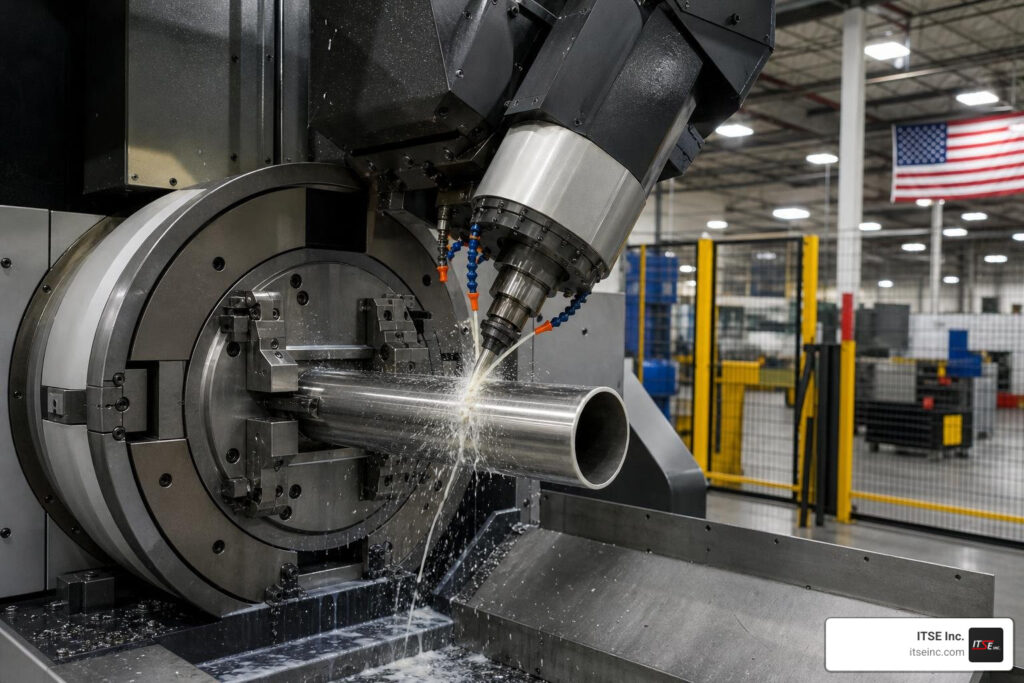
Why 5-Axis CNC Tube Equipment Is a Game-Changer for Tube Fabricators
5-axis CNC tube equipment covers a broad family of computer-controlled machines — laser cutters, plasma cutters, milling and turning centers, and tube benders — that move a tool or cutting head along five independent axes simultaneously. That extra range of motion is what separates them from simpler 3- or 4-axis systems, and it’s why they can cut complex bevels, cope tube ends, and produce multi-radius bends in a single setup without manual grinding or repositioning.
Quick answer — what to know before you buy:
| Machine Type | Best For | Key Capability |
|---|---|---|
| 5-axis fiber laser tube cutter | Precision profiling, weld prep | ±0.05–0.1 mm positioning accuracy, up to 30 m/min |
| 5-axis plasma pipe cutter | Heavy-wall structural pipe | Diameters 50–800 mm, complex bevel in one pass |
| 5-axis milling & turning center | Complex machined tube components | 12,000 RPM, mill + turn in one setup |
| 5-axis CNC tube bender | Multi-radius, multi-plane bends | Up to 150 mm OD, all-electric or hybrid drive |
| 5-axis freeform bender | Continuous curves, die-free bending | Spirals and multi-radius without dedicated dies |
If you’re a tube or pipe manufacturer dealing with inconsistent cut quality, excessive post-processing, or weld prep that doesn’t fit first time — the right 5-axis machine can eliminate most of that rework entirely.
The payoff is real. Five-axis systems cut complex intersecting joints and welding bevels in a single pass, with no manual polishing needed afterward. All-electric bending drives can cut energy costs by up to 70% versus traditional hydraulic systems. And fiber laser tube cutters can handle wall thicknesses up to 20 mm at positioning accuracies as tight as 0.05 mm — tolerances that are simply out of reach for conventional equipment.
I’m Jarek Szpakowski, and at ITSE Inc. in Lake Zurich, IL, we’ve built our reputation on precision tube mill solutions — from ID scarfing systems and OD bead choppers to 5-axis CNC tube equipment and custom CNC machined components. That hands-on manufacturing experience gives us a ground-level view of what actually works on the shop floor, and that’s what this guide is built on.
5-axis CNC tube equipment terms to remember:
Understanding 5-Axis CNC Tube Equipment and Kinematics
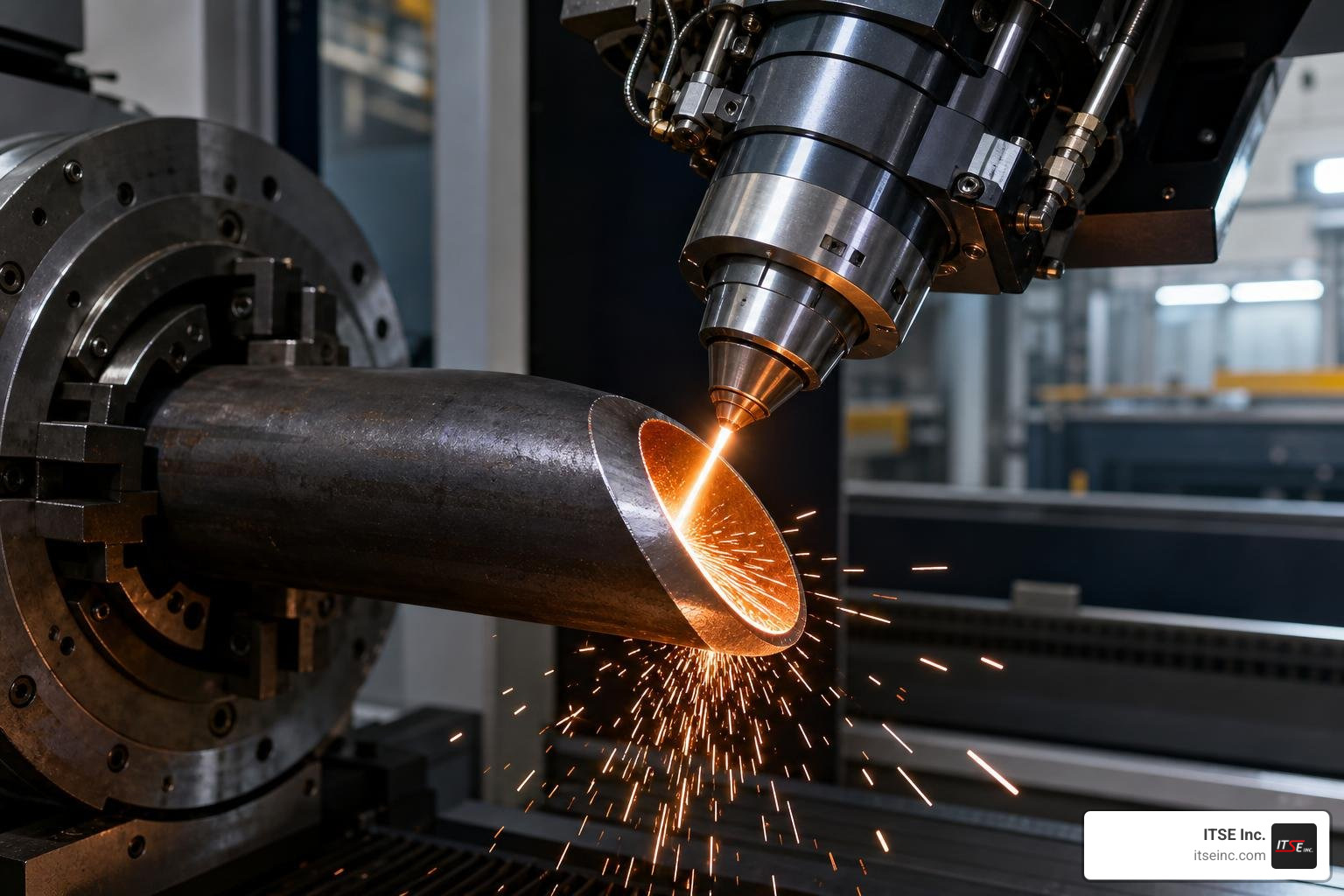
To truly appreciate what a 5-axis machine does, we have to look at how it moves. In traditional tube fabrication, a pipe is fed forward, rotated, and cut or bent. While this works for simple perpendicular cuts, it falls apart the moment you need a complex angle, an intersecting joint, or a weld prep bevel.
Traditional methods require a highly skilled operator to manually adjust the torch or tool, or worse, take the tube to a secondary grinding station. By integrating advanced kinematics, 5-axis CNC machining coordinates the movement of five separate axes in real-time. This continuous multi-axis interpolation allows the tool head to remain perfectly perpendicular or dynamically angled to the curved surface of the tube throughout the entire operation. For additional background on the control principles behind CNC systems, see this overview of numerical control.
How 5-Axis CNC Tube Equipment Differs from 3-Axis and 4-Axis Systems
Let’s break down the evolution of tube processing machinery:
- 3-Axis Systems: These machines move in three linear directions (X, Y, and Z). When applied to tubes, they can cut or mill along the top profile, but they cannot rotate the tube. If you need to cut the underside, someone has to manually unclamp, rotate, and re-clamp the workpiece. This destroys your setup precision and introduces human error.
- 4-Axis Systems: These introduce a rotational axis (often called the A or B axis) to roll the tube. While a massive improvement over 3-axis systems, the cutting head remains fixed in a vertical or horizontal orientation. It can cut holes and slots around the circumference, but it cannot tilt. This means it cannot cut bevels or create complex coped end treatments for tight-fitting weld joints.
- 5-Axis Systems: Here is where the magic happens. A 5-axis system adds a tilting axis to the cutting or milling head. With five axes moving in unison, the machine can execute complex coping end treatments and weld prep bevels in a single pass.
For fabricators in Illinois looking to scale their operations, there are clear 5 reasons to choose 5-axis CNC machining in Illinois, including the elimination of manual secondary operations and a massive reduction in setup time.
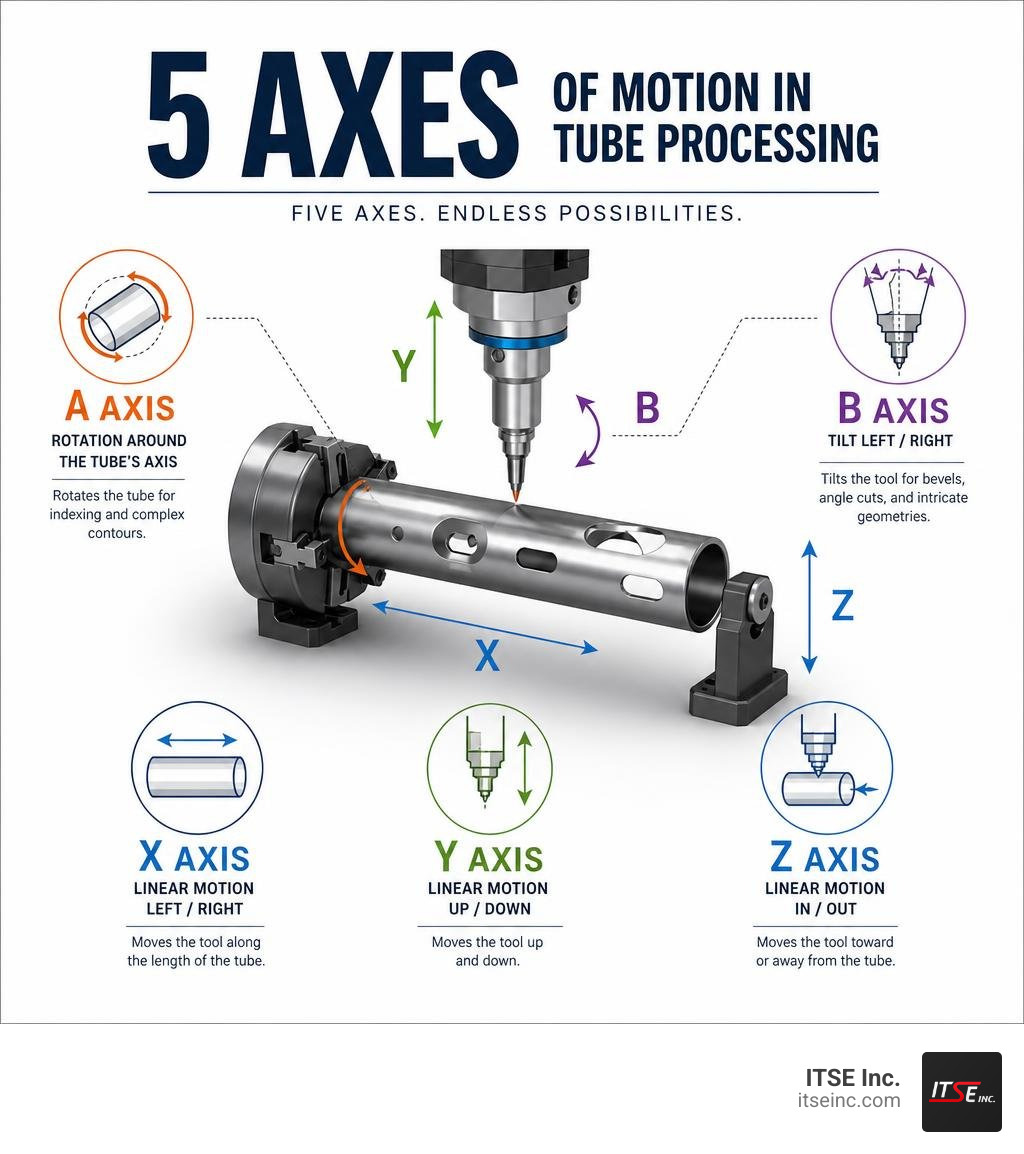
The Mechanics of 5-Axis Interpolation: X, Y, Z, A, and B Axes
How do these five axes actually coordinate in a real-world machine? Let’s look at the mechanical kinematics of a standard 5-axis CNC tube plasma or laser cutter:
- X-Axis (Axial Travel): Moves the cutting torch or tool carriage longitudinally along the length of the tube.
- Y-Axis (Tube Rotation): Rotates the tube 360 degrees using a high-precision chuck system.
- Z-Axis (Vertical Height): Controls the vertical height of the cutting torch, raising or lowering it to maintain the correct focal distance or arc voltage.
- A-Axis (Radial Swing): Tilts the cutting head radially (typically around ±55 degrees), allowing the torch to angle across the width of the tube.
- B-Axis (Axial Swing): Swivels the cutting head axially along the length of the tube (typically around ±60 degrees), allowing for steep bevel angles.
By utilizing high-performance servo motors and precision ground rails, modern machines achieve incredible positional synchronization. For instance, advanced systems running in Lake Zurich can hold tight tolerances on complex geometries, proving how Precision 5-axis Lake Zurich cutting-edge tech for tight tolerances has elevated local manufacturing capabilities in July 2026.
Primary Types of Multi-Axis Tube Machinery

Multi-axis tube machinery is not a one-size-fits-all category. Depending on whether your primary goal is cutting, shaping, milling, or bending, the mechanical configuration of the machine changes dramatically.
5-Axis CNC Tube Equipment for Laser and Plasma Cutting
For cutting operations, 5-axis systems are divided into fiber laser and plasma technologies:
- 5-Axis Fiber Laser Tube Cutters: These machines are the gold standard for high-precision, high-speed processing of thin-to-medium walled tubing. Advanced models, such as the AP-6012CNC, can handle material lengths up to 12,000 mm (nearly 40 feet) and achieve positioning accuracies of 0.05 mm to 0.1 mm. With cutting speeds up to 30 m/min, they make quick work of complex profiles, including round, square, channel steel, and H-beams.
- 5-Axis Plasma Pipe Cutters: When dealing with heavy-walled structural steel and large-diameter pipes, plasma is the undisputed king. Heavy-duty systems can process pipe diameters ranging from 50 mm to 800 mm. These machines use a tailor-welded box structure and precision-ground rails to handle heavy loads while maintaining a cutting length accuracy of ±1.5 mm and a torch positioning accuracy of ±0.2 degrees.
5-Axis Milling, Turning, and Freeform Bending Centers
When fabrication moves beyond simple cutting into complex machining or curvature forming, specialized multi-axis centers are required:
- 5-Axis Milling and Turning Centers: For parts that require both rotational machining (turning) and multi-sided profiling (milling), a combined center is incredibly efficient. Equipped with a 12,000 RPM built-in spindle and a 24 kW motor, these systems integrate a 45-degree swiveling head and a high-precision rotary table. This setup achieves a table positioning accuracy of 5 seconds and a repeatability of 2 seconds, allowing complex aerospace or medical tube brackets to be completed in a single setup.
- 5-Axis CNC Tube Benders: Traditional benders are limited to single-radius, flat-plane bends. Modern hybrid and electric 5-axis benders utilize multi-stack tooling. This allows the machine to transition between different bend radii or even switch from rotary draw bending to push bending (for large, sweeping curves) on a single part.
- 5-Axis Freeform Benders: If you want to throw out the rulebook (and the bending dies), freeform bending is the way to go. Using a movable die, a fixed die, and a push rod, these machines can form continuous, variable-radius 3D curves and spirals without requiring dedicated tooling. It is a highly flexible process that is perfect for architectural structures, custom handrails, and artistic metal designs. For heavy-duty woodworking or plastic composite molds that support tubular assemblies, some shops even integrate specialized five-axis CNC routing centers to prepare complex structural backings.
Key Benefits and Industrial Applications
Upgrading to 5-axis CNC tube equipment is a significant investment, but the return on investment (ROI) is driven by three major improvements: production efficiency, waste reduction, and unmatched precision. By consolidating multiple setups into one, shops can drastically reduce cycle times. Furthermore, advanced nesting software and movable chuck designs minimize the “tailings” (waste material at the end of a tube), saving thousands of dollars in raw material costs annually.
For regional manufacturers, partnering with a local partner is key to maintaining these high-precision standards. If you are operating in northern Illinois, utilizing Precision 5-axis CNC machining services in Lake Zurich ensures you get the quick turnaround and local engineering support needed to keep your production lines running smoothly.
Material Capabilities and Size Capacities
Modern 5-axis tube machinery is incredibly versatile, capable of processing almost any metal suitable for industrial use:
- Materials: Mild steel, stainless steel, aluminum, brass, copper, DOM, HREW, and galvanized steel.
- Wall Thicknesses: From thin-walled HVAC copper tubing (0.5 mm) up to heavy-wall structural steel (up to 20 mm for quality laser cuts, and up to 50 mm or more for heavy-duty plasma/oxy-fuel cutting).
- Tube Sizes & Profiles: Round tubes, square and rectangular profiles, flat-sided ovals, and structural shapes like channel steel, angle steel, and H-beams. High-capacity systems can easily handle profiles up to 6.75 inches square and raw stick lengths up to 24 feet (12,000 mm).
High-Precision Industries: Aerospace, Automotive, and HVAC
The unique capabilities of 5-axis tube equipment make it indispensable across several high-demand sectors:
- Aerospace & Defense: Structural airframe tubing, fuel lines, and engine mounts demand absolute precision with zero room for error. The tight tolerances achieved by high-end milling centers and laser systems are mandatory here. For ultra-precise contract manufacturing, aerospace firms often turn to specialized precision CNC machine shops to source custom components that integrate seamlessly with multi-axis assemblies.
- Automotive & Locomotive: Complex exhaust manifolds, roll cages, suspension components, and fuel lines require multi-radius, multi-plane bends. All-electric CNC tube benders with springback compensation ensure that every single part matches the CAD model perfectly, enabling rapid robotic welding downstream.
- HVAC & Refrigeration: Bending complex condenser and evaporator coils from copper and aluminum requires rapid, high-volume cycling. Pneumatic 3D benders operating at high feeding speeds (up to 800 mm/sec) allow manufacturers to keep up with intense production demands.
To support these industries, comprehensive CNC Machining Services are widely utilized throughout the Chicagoland area to provide secondary machining and finishing for complex tubular weldments.
Selection Criteria: Software, Automation, and Maintenance
Choosing the right 5-axis CNC tube equipment requires looking beyond the mechanical frame of the machine. The software driving the system, the level of automation, and the long-term maintenance requirements are what will ultimately determine your shop’s productivity.
When evaluating your options, ensure you are working with a supplier who understands the entire tube production workflow. At ITSE Inc., we design and manufacture custom equipment that integrates directly with these high-end machines, ensuring your raw tube is perfectly prepped before it ever reaches the 5-axis chuck. To understand the depth of engineering required for these systems, read our Precision CNC machining services guide.
CAD/CAM Integration and Simulation Software
A 5-axis machine is only as smart as the code you feed it. Without robust software, programming a 5-axis path can be a nightmare. Look for systems that offer:
- Direct CAD/STEP Import: The ability to load a 3D model directly into the machine’s controller (like advanced multi-axis control software) eliminates manual data entry and human programming errors.
- 3D Collision Simulation: Before the cutting head moves or the bending arm swings, the software must run a virtual simulation to check for interference between the tube, the tooling, and the machine frame. This prevents costly crashes and ruined workpieces.
- Automatic Nesting: For cutting machines, smart nesting algorithms arrange multiple parts on a single raw tube stick to maximize material yield and minimize scrap.
- Closed-Loop Correction (CMM): Advanced benders can interface directly with measuring arms (like Faro or Romer). If a test bend shows slight springback variation, the measuring arm sends the data back to the CNC controller, which automatically adjusts the bending parameters in real-time.
Cost, Lead Times, and Preventive Maintenance
Investing in 5-axis machinery requires careful planning around three key operational factors:
- Capital Investment: High-quality 5-axis plasma systems can range from entry-level portable units up to heavy-duty industrial systems costing hundreds of thousands of dollars. High-power fiber lasers and multi-stack benders represent significant capital outlays, making financing and high utilization rates critical.
- Lead Times: Due to the custom nature of these machines (often built to specific length and diameter requirements), lead times can range from 12 to 24 weeks. Planning your shop floor layout and electrical infrastructure ahead of delivery is essential.
- Preventive Maintenance: To keep these machines running at peak accuracy, a strict maintenance schedule is required. Spindles must be thermally managed and calibrated regularly. High-precision linear guides must be continuously lubricated (ideally via automatic lubrication systems) to prevent wear from metal dust and dross. Additionally, hydraulic systems on hybrid benders must have their oil filtered continuously to maintain ISO 4406 cleanliness standards.
Frequently Asked Questions about 5-Axis Tube Processing
How does 5-axis tube laser cutting compare to plasma cutting?
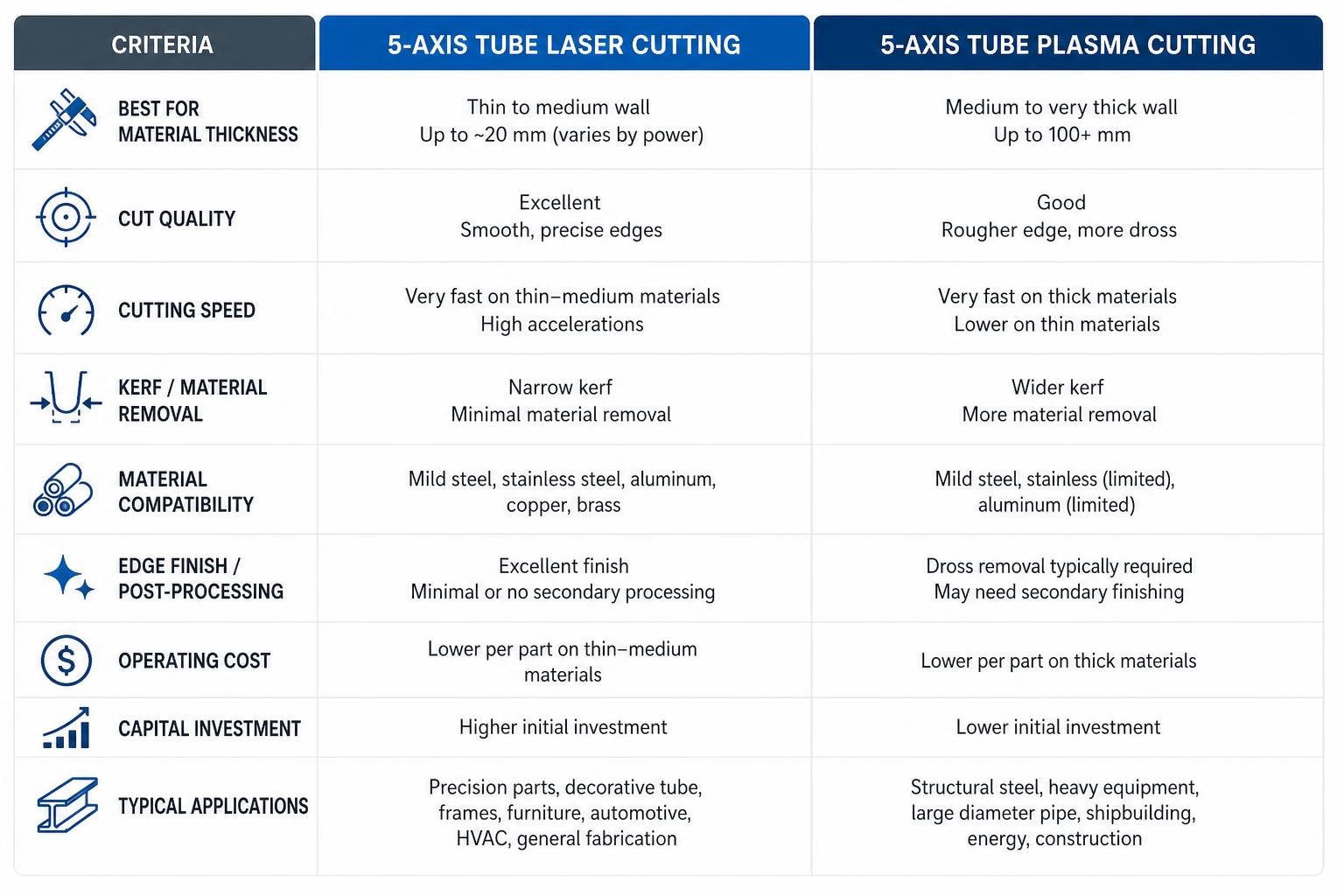
While both technologies excel at cutting metal profiles, they serve very different production niches. Fiber lasers offer unmatched precision and speed on thin-to-medium wall thicknesses, whereas plasma cutters are built for heavy-duty, thick-walled structural steel and large-diameter pipes where raw speed and lower capital cost are prioritized.
What is freeform tube bending and how does it work without dies?
Freeform bending is a technology that eliminates the need for traditional, part-specific bending dies. The process uses a fixed guide die, a movable bending die, and a push rod.
As the push rod forces the tube forward through the fixed guide, the movable die shifts radially to apply a bending moment to the tube. By continuously adjusting the position of the movable die in coordination with the feed speed, the machine can form variable-radius curves, continuous spirals, and complex 3D shapes on a single tube without stopping to change tooling.
How do mandrels and wipers prevent wrinkling during bending?
When a tube is bent, the outer wall stretches and thins, while the inner wall compresses. If the tube wall is thin relative to its diameter, this compression causes the inner wall to wrinkle like an accordion, and the outer wall to collapse.
To prevent this:
- Mandrels: A mandrel is a solid or articulated insert placed inside the tube at the point of the bend. It supports the inner walls, keeping the tube perfectly round.
- Wiper Dies: A wiper die is a specially shaped block of metal mounted on the inside of the bend, just behind the bending die. It grips the tube and prevents the metal from bunching up and wrinkling as it is drawn into the bend.
Using the correct combination of mandrels and wipers is critical for achieving high-quality, structurally sound bends on thin-walled materials.
Conclusion: The ITSE Inc. Advantage
Investing in 5-axis CNC tube equipment is a massive leap forward for any fabrication shop. But here is the secret that many machine dealers won’t tell you: your 5-axis machine is only as good as the tube you feed into it.
If your raw tubing has an inconsistent internal weld seam, or if your tube mill is leaving a heavy external bead, your high-precision 5-axis bender will slip, your mandrels will jam, and your expensive laser cutting head will lose its calibration.
That is where we come in. At ITSE Inc., based right here in Illinois, we manufacture the rugged, American-made support equipment that makes high-precision manufacturing possible. We specialize in:
- Precision OD bead chopper systems to cleanly manage external weld seams.
- Advanced ID scarfing system solutions to eliminate internal weld beads, ensuring your mandrels slide smoothly every single time.
- Tailored, custom tube mill solutions and advanced tube mill scarfing technology designed to keep your mill running with zero downtime.
Whether you are operating in Aurora, Chicago, Lake Zurich, or Elk Grove Village, our engineering team is here to help you optimize your entire production line. From raw coil processing to the final 5-axis cut, we provide the local, US-made quality and support you need to stay competitive.
Ready to eliminate setup bottlenecking and take your tube fabrication to the next level? Explore our comprehensive CNC Machining Services or contact our engineering team today to discuss how we can customize a solution for your shop floor.