
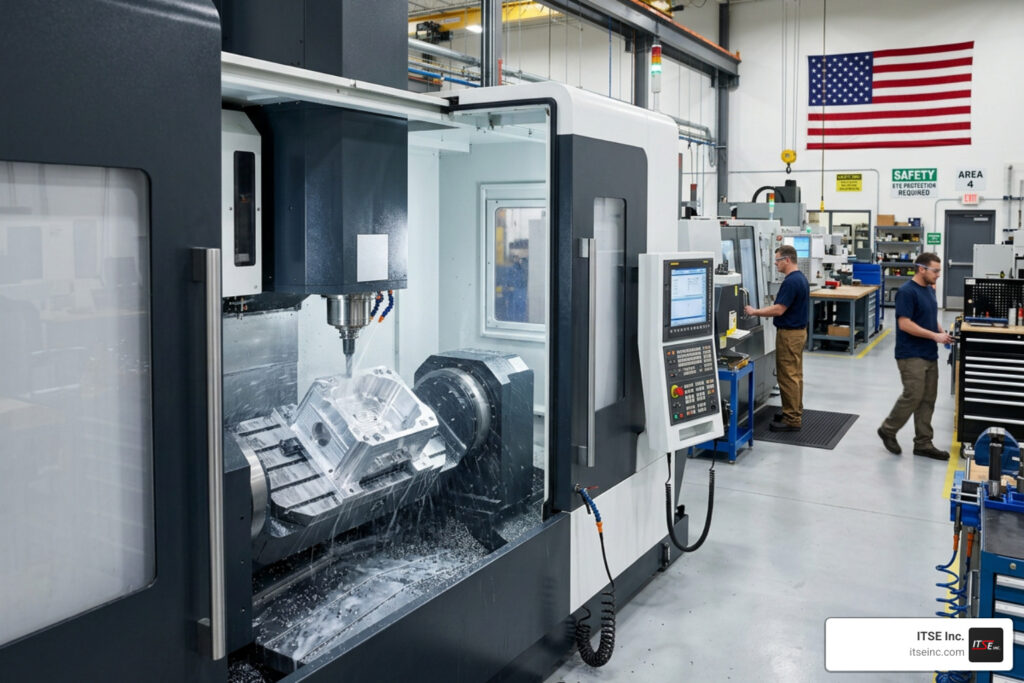
Why Finding the Right 5-Axis Machining in Chicago Heights Can Make or Break Your Production
5-axis machining in Chicago Heights is available from a growing number of precision CNC shops across the Chicagoland corridor — but not all of them are equipped to handle the complex, tight-tolerance components that demanding industries require.
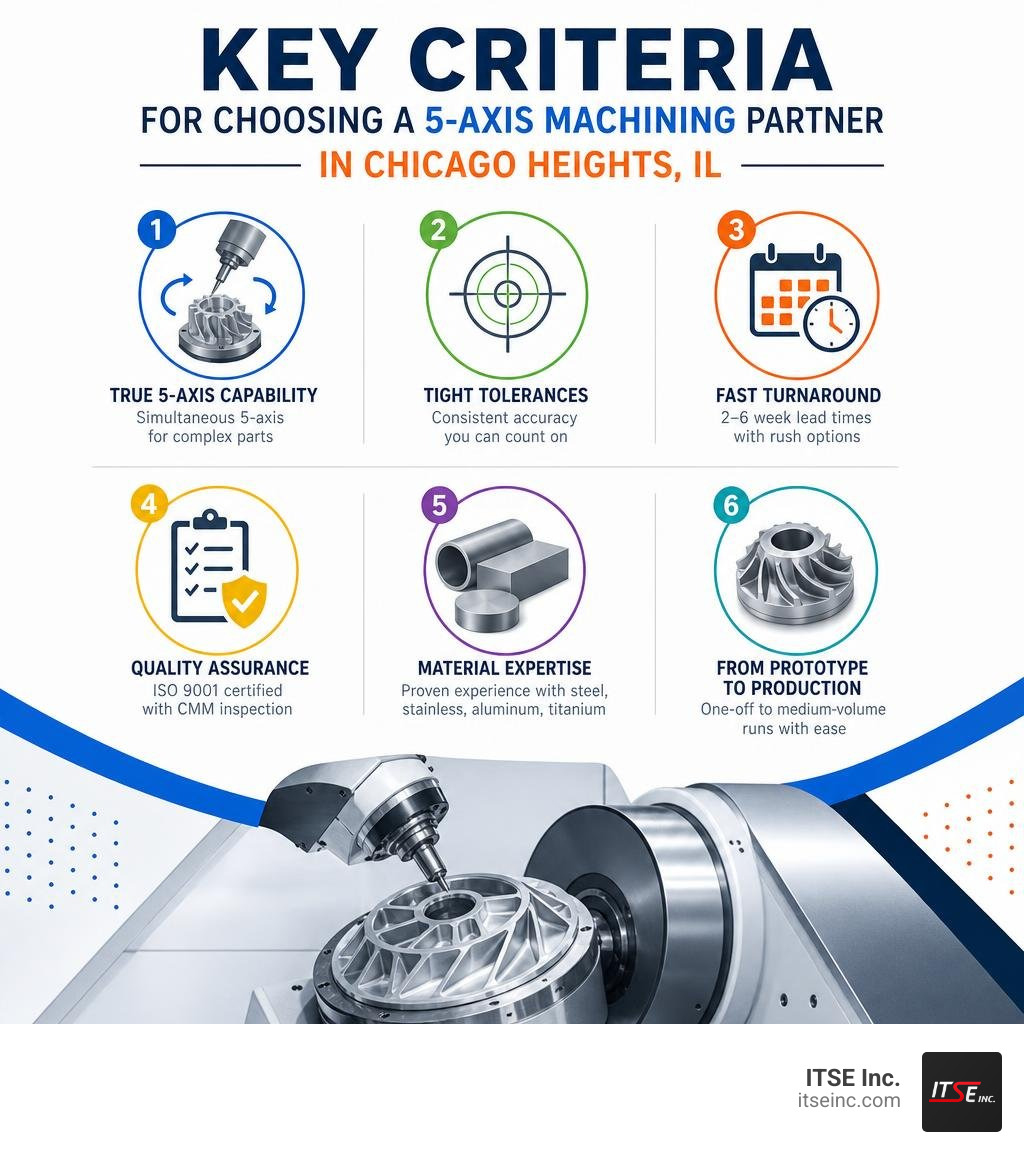
Here’s a quick look at what to know if you’re sourcing 5-axis CNC services in the Chicago Heights area:
| What You Need | What to Look For |
|---|---|
| Complex multi-surface parts | True simultaneous 5-axis capability |
| Tight tolerances | Shops achieving ±0.0005″ or better |
| Fast turnaround | 2–6 week lead times; rush options available |
| Quality assurance | ISO 9001 certification; CMM inspection |
| Difficult materials | Proven experience with steel, stainless, aluminum, titanium |
| Prototype to production | Support for one-off through medium-volume runs |
For manufacturers in industries like tube and pipe, oil and gas, packaging machinery, and industrial automation, choosing the wrong machining partner means more than a missed deadline. It means misaligned features, accumulated tolerance errors, and parts that simply don’t perform.
5-axis CNC machining solves problems that traditional 3-axis setups can’t. By adding two rotational axes — the A and B axes — to the standard X, Y, and Z linear axes, a 5-axis machine can reach virtually any surface of a part in a single setup. That eliminates the compounding dimensional errors that come from repositioning a workpiece multiple times.
The challenge is finding a shop that actually delivers on that promise — consistently, on time, and at a price that makes sense for your operation.
I’m Jarek Szpakowski, founder of ITSE Inc. in Lake Zurich, IL, where we specialize in precision CNC machining — including 5-axis machining serving Chicago Heights and the broader Chicagoland region — alongside our proprietary tube mill equipment and weld bead removal systems. Our background in high-speed tube and pipe manufacturing gives us a practical edge when tolerance and repeatability aren’t optional.
Easy 5-axis machining Chicago Heights word list:
The Rise of 5-axis machining Chicago Heights in Modern Manufacturing
Chicago Heights has long been a foundational hub of industrial activity in the Midwest. From heavy steel mills to complex chemical processing, the local manufacturing ecosystem has evolved rapidly over the decades. Today, as we navigate July 2026, the demand for hyper-precise, highly efficient component manufacturing is greater than ever.
Local supply chains are under constant pressure to reduce lead times while maintaining uncompromising quality. In this environment, traditional manufacturing methods often fall short. When you have to route a part through three different setups, you aren’t just losing time—you’re introducing opportunities for human error and structural misalignment.
This is exactly why local businesses are transitioning to multi-axis technology. By leveraging 5 Reasons to Choose 5-Axis CNC Machining in Illinois, regional manufacturers can secure a critical competitive advantage. Sourcing your parts from a local partner who understands the industrial landscape of Cook County means fewer shipping delays, easier face-to-face collaboration, and a supply chain that can react instantly to design changes.
Demystifying 5-axis machining Chicago Heights Capabilities
To truly appreciate what 5-axis machining Chicago Heights can do for your business, it helps to understand what is happening inside the machine enclosure.
Traditional CNC milling operates on three linear axes:
- X-axis: Left-to-right movement.
- Y-axis: Front-to-back movement.
- Z-axis: Up-and-down movement.
While a 3-axis machine is incredibly capable, it has a glaring limitation: the cutting tool can only approach the workpiece from the top. If you need to machine the sides, undercuts, or compound angles of a part, you have to manually stop the machine, open the doors, unclamp the workpiece, flip it, re-clamp it, and re-zero your datums.
A 5-axis machine introduces two rotational axes (typically referred to as the A-axis and B-axis, or sometimes the C-axis, depending on the machine configuration). The A-axis rotates around the X-axis, while the B-axis rotates around the Y-axis.
By allowing the cutting tool—or the workpiece itself—to tilt and rotate simultaneously, 5-axis machining enables the tool to approach the part from virtually any angle. This unlocks the ability to cut complex geometries, organic freeform curves, deep pockets, and compound angles that would be physically impossible to produce on a standard 3-axis mill.
The Physics of Single-Setup Precision
In precision manufacturing, every manual intervention is a variable. When a machinist has to touch a part to move it to a different fixture, the laws of physics work against you. Even the most skilled operator using high-end workholding can introduce micro-level deviations during a transfer.
By machining up to five faces of a part in a single setup, we dramatically reduce cycle times and eliminate the physical handling of the workpiece. But the benefits go beyond just saving time. Let’s talk about tool deflection and tool length.
On a traditional 3-axis machine, if you need to cut a deep pocket, you are forced to use a long, slender cutting tool to reach the bottom without the spindle head colliding with the workpiece. Long tools are highly susceptible to deflection—they literally bend slightly under the force of the cut. This deflection causes “chatter,” which ruins your surface finish and speeds up tool wear.
With a 5-axis setup, the machine can tilt the workpiece or the spindle. This allows us to use much shorter, highly rigid cutting tools. Because a shorter tool resists deflection, we can run at faster feed rates, achieve superior surface finishes, and hold incredibly tight dimensions without the risk of tool chatter.

Key Benefits of Multi-Axis CNC Technology for Illinois Businesses
Whether you are operating out of Chicago Heights, Lake Zurich, Aurora, or Addison, your primary business goals likely revolve around reducing lead times, cutting total manufacturing costs, and ensuring your parts work perfectly the first time. Multi-axis CNC technology directly addresses these goals.
Standard industry lead times for custom machined parts typically range from 2 to 6 weeks. However, by consolidating multiple operations into a single setup, advanced machine shops can drastically compress these timelines. In critical situations, hot or rush jobs can even be turned around in a matter of days, or supported by custom stocking programs to enable next-day JIT (Just-In-Time) delivery.
By partnering with a regional expert who utilizes Precision 5-Axis Lake Zurich Cutting-Edge Tech for Tight Tolerances, you gain access to a highly streamlined production workflow that keeps your assembly lines running smoothly.
Eliminating Datum Transfer Errors
In metrology and quality control, “datum transfer error” is the ultimate silent killer of precision parts.
Every time a workpiece is repositioned for a new machining operation, the machinist must establish a new datum reference (the “zero point” from which the machine measures all cuts). If the second setup is off by even a fraction of a thousandth of an inch, that error carries over. By the time you reach a third or fourth setup, these micro-errors compound, resulting in a finished part that may look correct to the naked eye but fails to meet the specified Geometric Dimensioning and Tolerancing (GD&T) requirements.
This is especially critical for complex components like those used in high-speed tube mills, packaging machinery, or medical devices. 5-axis machining eliminates this compounding error entirely. Because the part remains clamped in a single, continuous grip while the machine articulates around it, there is zero datum transfer. The spatial relationship between every hole, slot, pocket, and contour is maintained with mathematical perfection.
Achieving Tight Tolerances and Superior Surface Finishes
At ITSE Inc., we know that a component is only as good as its surface finish and dimensional accuracy. For example, standard high-precision CNC milling can comfortably achieve tolerances as tight as ±0.0005 inches, while precision CNC turning can hold tolerances down to ±0.0001 inches. Specialized 5-axis setups can push these limits even further, achieving tolerances as tight as ±0.005 mm (approx. ±0.0002 inches) for highly critical aerospace and medical geometries.
But how does 5-axis machining improve the actual surface roughness (Ra)?
It all comes down to cutting tool contact. When machining a curved or contoured surface on a 3-axis mill, the machine must use a ball-nose end mill to make hundreds of tiny, overlapping passes (often called “scalloping”). This is a slow process that leaves a textured, ridged surface requiring extensive manual polishing or secondary finishing.
In contrast, a simultaneous 5-axis machine can continuously tilt the tool so that the cutting edge remains perfectly perpendicular to the contoured surface. This allows us to use the side or bottom of the tool to sweep across the material, achieving a near-mirror surface finish (often holding a standard Ra 0.8μm or even Ra 0.4μm on precision passes) directly off the machine. This eliminates the need for labor-intensive hand-deburring or secondary grinding.
Technical Capabilities: 3+2 Positional vs. True Simultaneous 5-Axis Machining
When sourcing 5-axis machining Chicago Heights, it is important to understand that not all 5-axis work is programmed or executed the same way. There is a fundamental technical distinction between “3+2 positional” machining and “true simultaneous” 5-axis machining.
| Feature | 3+2 Positional Machining | True Simultaneous 5-Axis Machining |
|---|---|---|
| Axis Movement | Rotational axes tilt and lock; cutting is done on 3 linear axes. | All 5 axes (3 linear, 2 rotational) move dynamically at the same time. |
| Best Suited For | Multi-face structural parts, deep pockets, and compound angles. | Complex contoured surfaces, organic freeform shapes, and impellers. |
| Programming Complexity | Moderate; can often be programmed using standard CAM packages. | Very high; requires advanced CAM software (e.g., Mastercam, Hypermill) and collision avoidance. |
| Toolpath Dynamics | Intermittent; tool stops cutting during rotational indexing. | Continuous; smooth, uninterrupted tool movement across the part. |
3+2 Positional Machining
Often referred to as “indexical” or “multi-face” machining, 3+2 positional machining is a highly effective way to handle complex, blocky parts.
In a 3+2 setup, the machine uses its rotational axes (A and B) to tilt the workpiece to a specific compound angle. Once the part is in position, the rotational axes lock securely into place. The machine then performs standard 3-axis milling. If another face needs to be machined, the tool retracts, the table rotates and tilts to the new angle, locks again, and the cutting resumes.
This method is incredibly cost-effective because it provides the setup-reduction benefits of 5-axis machining without the extreme programming complexity of simultaneous motion. It is the ideal choice for structural brackets, manifolds, and parts with features on multiple flat faces.
True Simultaneous 5-Axis Motion
True simultaneous 5-axis machining is where the real magic happens. In this mode, all five axes—X, Y, Z, A, and B—move dynamically and continuously at the same time.
As the cutting tool moves across the workpiece, the machine constantly adjusts the tilt and rotation of the table or spindle head to maintain the optimal cutting angle. This continuous motion is absolutely required for manufacturing parts with organic, freeform geometries, such as:
- Turbine blades and aerospace impellers
- Patient-specific medical implants (like hip cups or spinal cages)
- Highly complex automotive mold dies
Programming simultaneous 5-axis toolpaths requires highly specialized CAM software and experienced programmers who can carefully simulate the toolpaths to prevent catastrophic machine collisions. If your business requires this level of geometric complexity, you need to ensure your machining partner has the true simultaneous capabilities outlined in our 5-Axis CNC Machining services.
How to Select a 5-Axis Machining Partner in the Chicagoland Area
Choosing a manufacturing partner is about more than just comparing hourly rates on a spreadsheet. It is about finding a team that integrates seamlessly with your engineering department, respects your deadlines, and stands behind the quality of every single part that leaves their dock.
When evaluating a potential machine shop in the Chicago Heights, Lake Zurich, or broader Chicagoland area, keep these critical sourcing criteria in mind:
- Engineering-First Approach: Do they offer Design for Manufacturability (DFM) support? A great shop won’t just blindly cut your CAD file; they will review your design to see if slight modifications can reduce cycle times or material waste.
- In-House Automation: Look for shops that utilize pallet changers or automated workpiece changers. This allows for unattended (“lights-out”) machining, which keeps production moving overnight and significantly lowers your per-part cost.
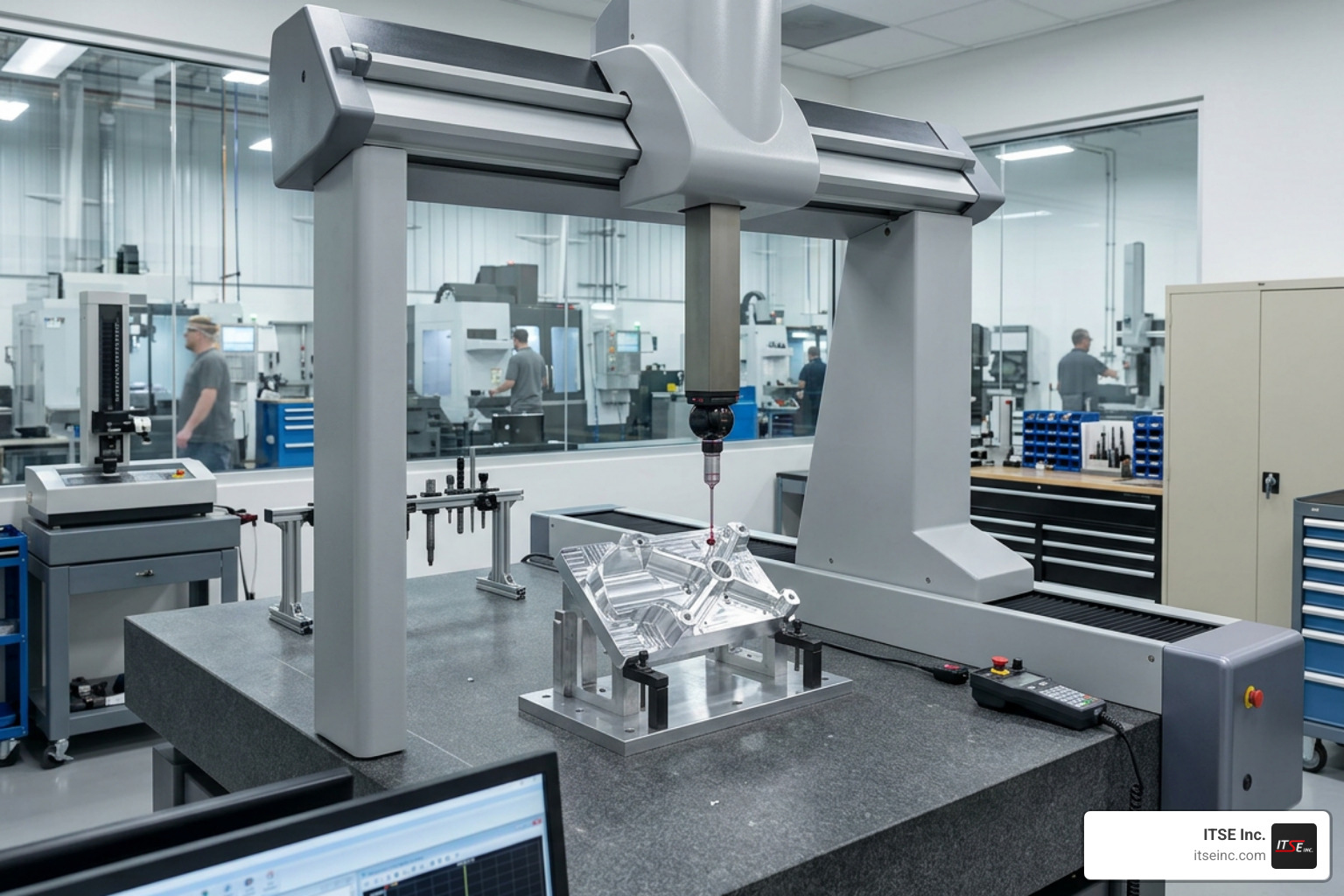
- Metrology & Inspection: Advanced machining is useless without the ability to verify it. The shop should have climate-controlled inspection labs equipped with Coordinate Measuring Machines (CMM) and digital scanning probes to provide detailed inspection reports.
Sourcing the Best 5-axis machining Chicago Heights Services
Geographic proximity is a major asset in modern supply chain management. Sourcing your precision parts from within the local Illinois manufacturing corridor—spanning Addison, Aurora, Carol Stream, Des Plaines, Glendale Heights, Elk Grove Village, and Lake Zurich—allows for rapid prototyping, easier quality audits, and drastically reduced shipping costs.
At ITSE Inc., we serve Chicago Heights and the surrounding communities with high-precision manufacturing solutions tailored to your exact needs. Our state-of-the-art facility is equipped to handle everything from initial prototype development to medium-volume production runs.
If you want to see how we combine local convenience with world-class technical execution, explore our Precision 5-Axis CNC Machining Services in Lake Zurich.
Material Expertise and Quality Certifications
A machine shop’s capabilities are heavily defined by the materials they can successfully process. Different materials present unique physical challenges:
- Aluminum Alloys (6061, 7075): Highly machinable but prone to thermal deformation if clamping forces and heat generation aren’t carefully managed.
- Stainless Steel (304, 316, 17-4 PH): Tough and work-hardening; requires rigid setups, optimized coolant delivery, and precise feed rates to prevent rapid tool wear.
- Exotic Alloys (Titanium, Inconel, Hastelloy): Extremely heat-resistant and strong; requires specialized multi-axis toolpath strategies and rigid spindles to handle the high cutting forces.
- High-Performance Polymers (PEEK, Delrin, Nylon): Requires sharp tooling and controlled temperatures to prevent melting or burring.
Make sure your chosen shop has a robust Quality Management System (QMS) in place. Look for certifications like ISO 9001:2015 (the gold standard for manufacturing quality) or alignment with AS9100 standards for aerospace and defense work. These certifications guarantee that the shop maintains strict material traceability, calibrated inspection equipment, and standardized operating procedures.
Frequently Asked Questions About Multi-Axis CNC Machining
What tolerances can be achieved with 5-axis CNC machining?
With advanced 5-axis CNC machining, we can routinely achieve precision tolerances as tight as ±0.005 mm (approx. ±0.0002 inches) on complex features. For standard high-precision milling, holding tolerances of ±0.0005 inches is highly achievable across a wide range of materials. To learn more about our complete range of dimensional capabilities, check out our core guide on CNC Machining.
What is the difference between 3+2 and true simultaneous 5-axis machining?
The primary difference lies in whether the rotational axes move during the cutting process. In 3+2 positional machining, the machine tilts and locks the workpiece at a specific angle, then cuts using only the three linear axes (X, Y, Z). In true simultaneous 5-axis machining, all five axes move continuously and dynamically at the same time, allowing the cutting tool to follow complex, curved surfaces smoothly.
How does 5-axis machining reduce lead times?
5-axis machining reduces lead times by consolidating multiple manufacturing operations into a single setup. Instead of designing, building, and loading multiple custom fixtures for a 3-axis mill, a 5-axis machine can process up to five sides of a part in one go. This eliminates setup downtime, reduces human handling, and allows us to move from raw CAD files to finished parts much faster.
Conclusion
Finding the right partner for 5-axis machining in Chicago Heights doesn’t have to be a stressful guessing game. By focusing on shops that offer true single-setup capabilities, advanced metrology, and deep material expertise, you can secure a reliable supply chain that delivers perfect parts, on time, every time.
At ITSE Inc., we bring a unique perspective to precision manufacturing. In addition to our custom CNC machining services, we design and manufacture precision OD bead choppers, ID scarfing systems, and custom tube mill equipment for the tube and pipe industry. We understand the high-speed, high-stress environments your machinery operates in, and we build every component to withstand those demands.
All of our engineering and machining is proudly completed right here in Illinois, ensuring world-class, US-made quality and tailored solutions for your business.
Ready to eliminate setup errors, reduce your lead times, and optimize your part designs? Get a quote for precision CNC machining services from the team at ITSE Inc. today!