
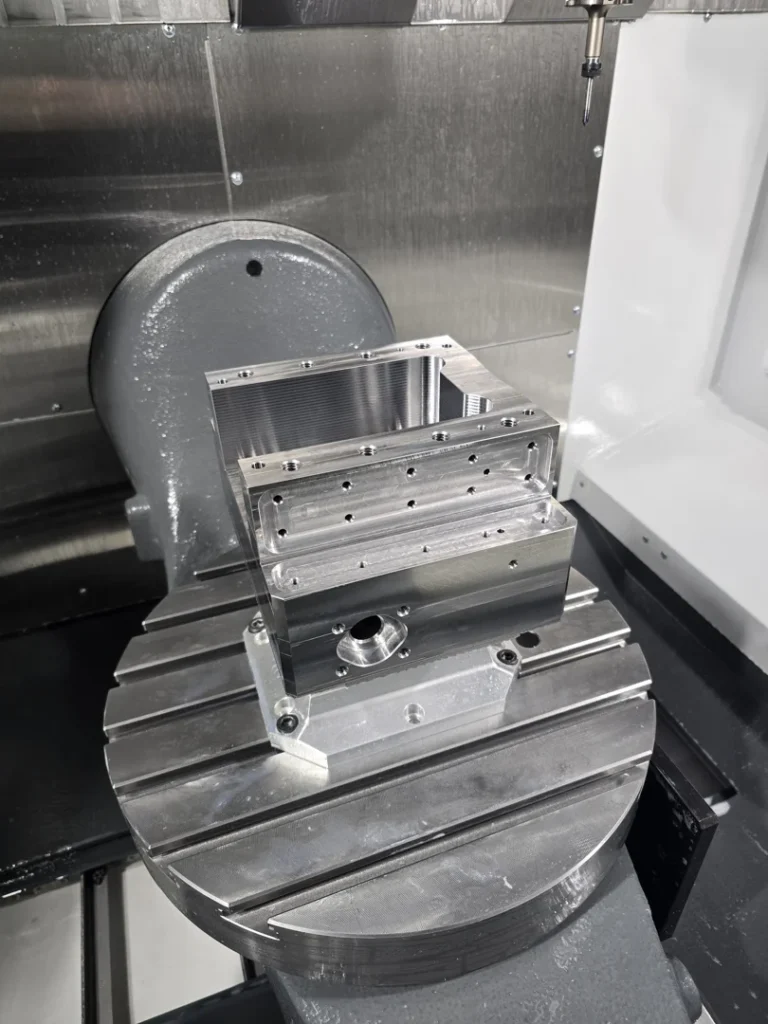
Why Oak Brook Manufacturers Are Turning to 5-Axis Machining
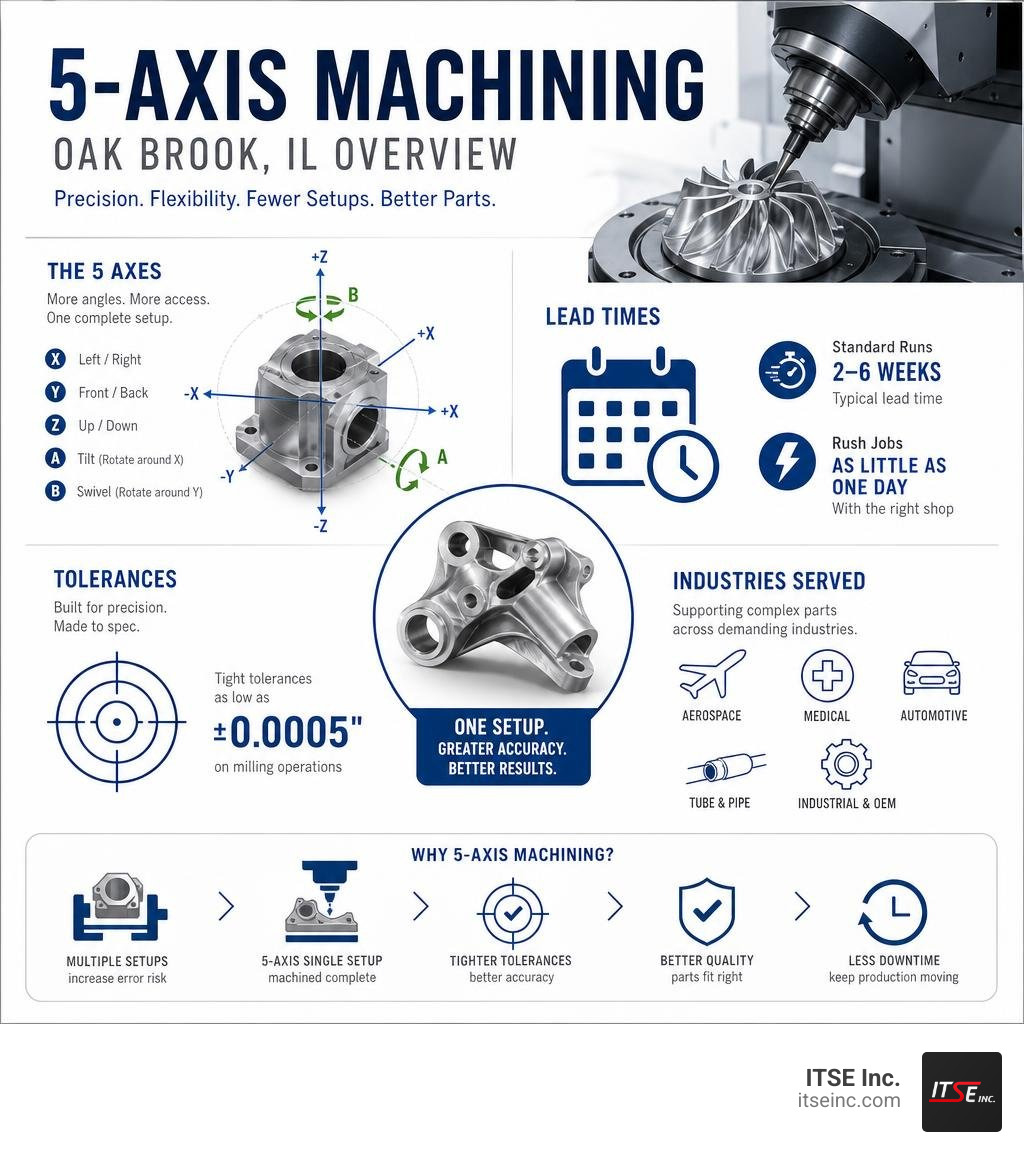
If you need 5-axis machining in Oak Brook, IL, here’s what you should know right away:
- Local access: Several precision CNC shops in the greater Oak Brook and Chicago metro area offer 5-axis capabilities, with nearby options in Lake Zurich and the broader DuPage County region.
- Best for: Complex geometries, tight tolerances, aerospace, medical, automotive, and tube and pipe components.
- Typical lead times: 2–6 weeks for standard runs; rush jobs can be completed in as little as one day with the right shop.
- Key advantage: 5-axis machining cuts multiple setups down to one, reducing errors and improving part accuracy.
- Tolerances: Top shops hold tolerances as tight as ±0.0005″ on milling operations.
For tube and pipe manufacturers in particular, inconsistent part quality often traces back to one root cause: too many setups, too many chances for error. When a component moves between fixtures, small alignment errors stack up. By the time the part is finished, it may be out of spec — and you might not catch it until it’s already causing problems on your line.
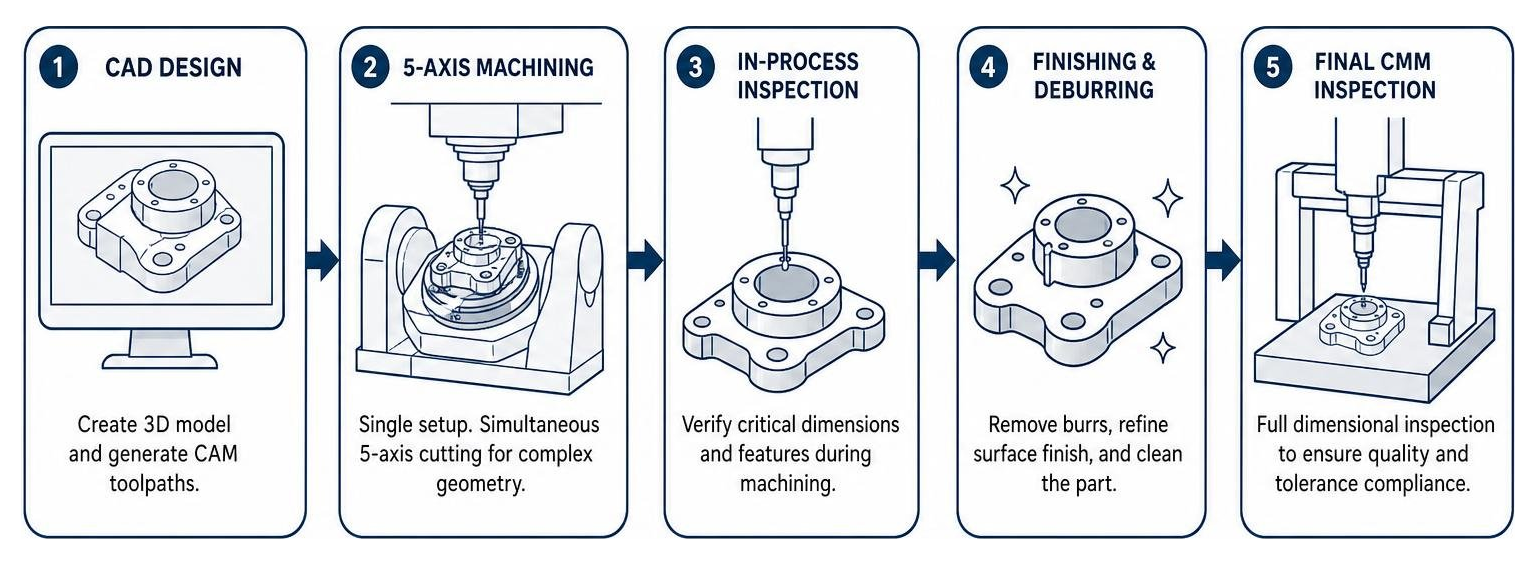
That’s exactly where 5-axis CNC machining changes the game. Instead of repositioning your part three or four times, a skilled 5-axis shop machines it complete in a single setup. The result is tighter tolerances, better surface finishes, and parts that actually fit the first time.
The Chicago metro area — including Oak Brook and surrounding DuPage County — is home to a strong manufacturing base. But not every local shop has true 5-axis capability, and even fewer combine it with the industry-specific experience that demanding applications require.
I’m Jarek Szpakowski, founder of ITSE Inc. in Lake Zurich, IL, where we specialize in precision CNC machining — including 5-axis machining near Oak Brook, IL — alongside our US-made tube mill equipment, ID scarfing systems, and OD bead choppers. With decades of hands-on experience serving tube and pipe manufacturers and industrial OEMs, I’ll walk you through everything you need to know to find the right 5-axis partner for your next project.
Understanding Multi-Axis Technology: 3-Axis vs. 4-Axis vs. 5-Axis
To understand why 5-axis machining is such a leap forward, it helps to look at how we got here. Traditional machining relies on three linear axes. While 3-axis and 4-axis machines are workhorses for simpler parts, they quickly show their limitations when geometries get complicated.
Here is a quick breakdown of how these technologies compare:
| Feature / Capability | 3-Axis CNC Machining | 4-Axis CNC Machining | 5-Axis CNC Machining |
|---|---|---|---|
| Linear Axes | X, Y, Z | X, Y, Z | X, Y, Z |
| Rotary Axes | None | 1 Rotary Axis (usually A-axis) | 2 Rotary Axes (usually A and B, or A and C) |
| Ideal For | Flat parts, brackets, simple pockets | Cylindrical parts, slots on curved surfaces | Complex geometries, impellers, compound angles |
| Required Setups | Multiple (often 3 to 6 setups) | Medium (2 to 4 setups) | Single setup (1 setup for up to 5 sides) |
| Datum Transfer Error | High risk (compounding errors) | Moderate risk | Near zero (single datum reference) |
| Tool Length Needed | Longer (increases vibration) | Medium | Shorter (increases rigidity and accuracy) |
When you use a standard 3-axis machine for a complex part, the machinist must manually flip and re-clamp the workpiece for almost every new face that needs cutting. Every time the part is touched, unclamped, and re-clamped, a tiny amount of alignment error is introduced. In the manufacturing world, we call this datum transfer error.
If your tolerance is ±0.0005 inches, and you transfer the part three times, those microscopic setup errors compound. Before you know it, your finished component is scrap. 5-axis machining virtually eliminates this issue by holding the part in a single, continuous grip while the machine accesses up to five sides of the workpiece.
To explore how these different setups fit into a complete production strategy, you can read more info about our CNC services.
The Mechanics of 5-axis machining Oak Brook IL
So, how does a 5-axis machine actually move?
Like any standard CNC milling machine, a 5-axis machine moves along the three classic linear axes:
- X-axis: Left to right
- Y-axis: Front to back
- Z-axis: Up and down
What makes 5-axis machining in Oak Brook, IL so powerful is the addition of two rotational axes. Typically, these are the A-axis (which rotates around the X-axis) and the B-axis (which rotates around the Y-axis), or sometimes a C-axis (which rotates around the Z-axis).
Instead of the cutting tool only pointing straight down, the machine can tilt the tool, tilt the workpiece table, or tilt both simultaneously. This continuous, synchronized motion allows the cutting tool to maintain an optimal angle to the workpiece surface at all times. It is like the difference between drawing on a globe with a stiff, vertical pencil versus cradling the globe in your hands and rotating it naturally as you draw.
For local engineering teams looking to implement these advanced configurations, you can find more info about multi-axis capabilities on our dedicated Lake Zurich capability page.
3+2 Positional vs. True Simultaneous 5-Axis Machining
It is important to know that not all “5-axis” machining is the same. There are two distinct methods used in modern machine shops:
- 3+2 Positional Machining (Indexed 5-Axis): In this setup, the machine uses its two rotational axes to tilt the workpiece or the spindle to a specific, compound angle. Once in place, the rotational axes lock solid, and the actual cutting is done using only the three linear (X, Y, Z) axes. Think of it as a series of 3-axis operations performed at different angles. This is incredibly efficient for structural parts with features on multiple faces, as it eliminates manual setups.
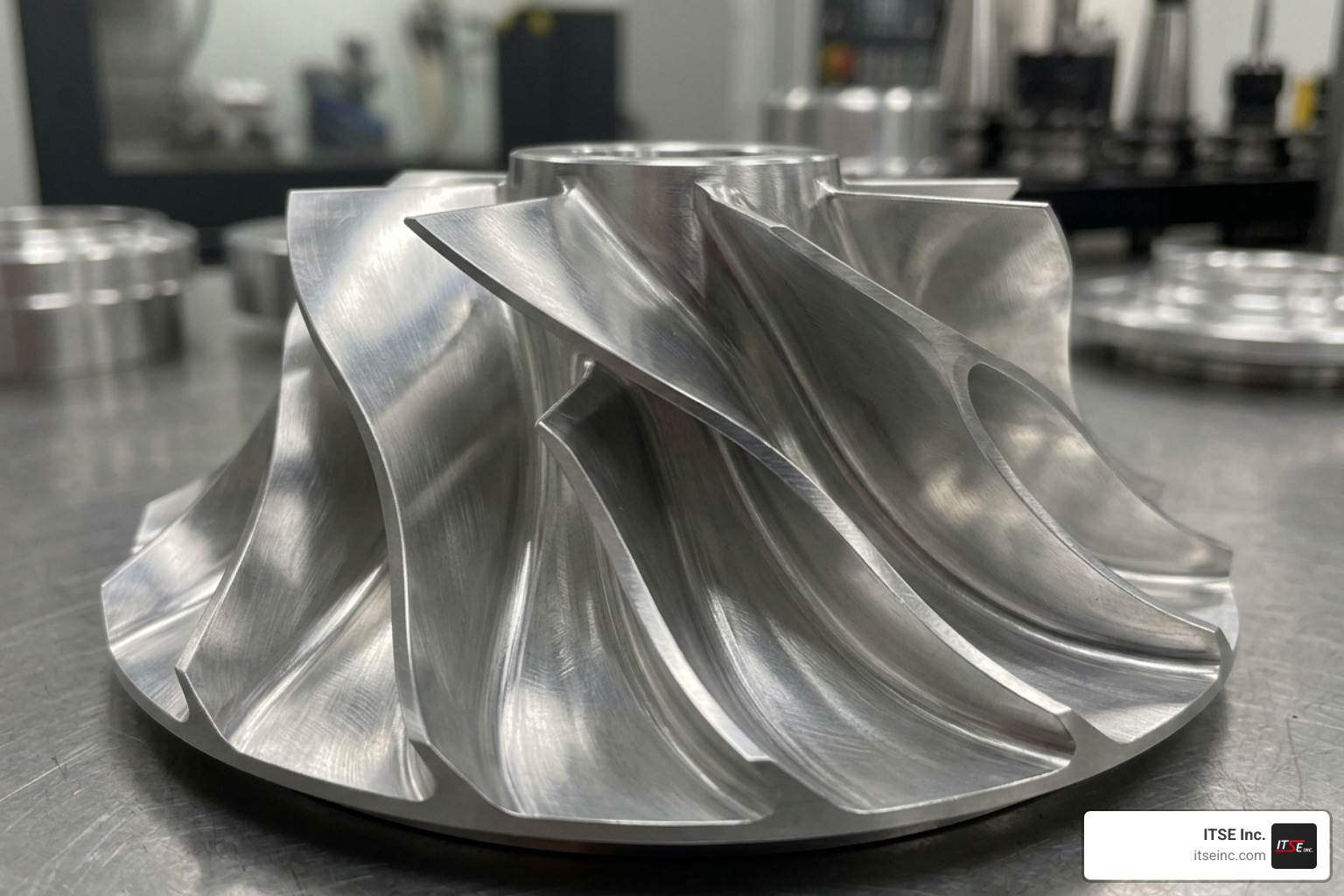
- True Simultaneous 5-Axis Machining: Here, all five axes (three linear and two rotational) move at the exact same time. The tool sweeps across compound curves and freeform surfaces in a single, fluid motion. This is the only viable method for machining complex, organic shapes like turbine blades, impellers, and highly contoured medical implants.
One of the biggest practical benefits of simultaneous 5-axis machining is vibration reduction. Because the tool can tilt, we can use much shorter cutting tools. Long tools on 3-axis machines tend to bend, vibrate, and chatter, which ruins the surface finish and wears out the tool quickly. Shorter tools are more rigid, allowing us to cut faster, hold tighter tolerances, and deliver a beautiful, smooth surface finish.
Why Local Manufacturers Choose 5-axis machining Oak Brook IL
In 2026, manufacturing is all about speed, agility, and keeping supply chains tight. For businesses operating in Oak Brook, Addison, Schaumburg, and the surrounding DuPage County area, sourcing precision parts locally is no longer just a convenience—it is a strategic necessity.
When you work with a local multi-axis machining partner, you gain several distinct advantages:
- Zero Shipping Delays: You do not have to worry about cargo ships, customs delays, or cross-country freight bottlenecks. Your parts are made right here in the Chicago metropolitan area.
- Face-to-Face Collaboration: If a design issue pops up during the Design for Manufacturability (DFM) review, we can jump on a quick call or you can drive over to our facility to look at the physical prototype. Try doing that with an overseas supplier!
- Rapid Prototyping: Local proximity means we can turn around first-article prototypes in days rather than weeks, helping you get your products to market faster.
At ITSE Inc., we serve manufacturers across the entire region—from Aurora and Des Plaines to Elk Grove Village and Lake Zurich. We know the local industrial landscape, and we understand the unique pressure that local OEMs face to keep their lines running without interruption.
Key Industries in Oak Brook Utilizing Multi-Axis Machining
While 5-axis machining can benefit almost any complex metal or plastic part, several industries in the Oak Brook area rely on it daily:
- Aerospace & Defense: From structural brackets with complex weight-reduction pockets to engine components, the aerospace sector demands extreme precision (often holding tolerances to ±0.0005″ or tighter) and complete material traceability.
- Medical Devices: Surgical instruments, joint replacements, and orthopedic implants feature organic, contoured shapes that require true simultaneous 5-axis milling to match the complex curves of the human body.
- Automotive & EV: The shift toward electric vehicles has created a massive demand for lightweight, complex aluminum housings, battery enclosures, and prototype motor components.
- Tube and Pipe Manufacturing: This is our home turf. The tooling used in modern tube mills—such as custom roll tooling, ID scarfing rings, and OD bead chopper blades—requires incredibly precise contours to ensure the steel tubes are formed and finished perfectly. 5-axis machining allows us to craft these heavy-duty, wear-resistant tools to exact specifications.
If you want to see how we apply this high-level precision to our specialized industrial products, check out more info about our products.
Material Versatility: From Aluminum to Exotic Alloys
A common misconception is that 5-axis machines are only for soft metals like aluminum. In reality, modern multi-axis centers can handle a vast range of materials, provided the shop has the rigidity, spindle torque, and tooling expertise to cut them.
- Aluminum Alloys (6061-T6, 7075-T6): The gold standard for aerospace, automotive, and rapid prototyping. It machines beautifully, is highly cost-effective, and 5-axis capabilities allow for incredibly thin walls and deep pockets without warping.
- Stainless Steel (304, 316, 17-4 PH): Highly favored in the medical, food processing, and marine industries for its corrosion resistance. 5-axis machining keeps the tool at an ideal cutting angle, reducing the work-hardening that often plagues stainless steel machining.
- Titanium Alloys (Ti-6Al-4V Grade 5): Prized in aerospace and medical implants for its incredible strength-to-weight ratio and biocompatibility. Titanium is notoriously difficult to machine because it does not conduct heat well, but 5-axis motion helps distribute heat and reduces tool wear.
- Inconel (718, 625): A nickel-based superalloy used in extreme-temperature environments like jet engines and high-pressure gas systems. It requires rigid machines, slow cutting speeds, and precise toolpaths—capabilities that are native to high-end 5-axis centers.
- Engineering Plastics (PEEK, Delrin, Nylon): Used for electrical insulators, medical prototypes, and wear components. Precision clamping and low-heat cutting strategies on 5-axis machines prevent these plastics from flexing or melting during the machining process.
Maximizing Efficiency: Lead Times, Costs, and Design Guidelines
Let’s talk about the practical side of manufacturing: time and money.
When you are planning a 5-axis machining project in Oak Brook, IL, understanding how design choices affect lead times and cost is crucial. While 5-axis machining centers represent a significant technology investment, they often prove to be the most cost-effective path for complex parts when you look at the total production cycle.
Consider this: a typical machine shop using older, single-axis methods might have a 1-in-10 late delivery rate due to complex setups and manual handling errors. By eliminating those extra setups, a modern 5-axis shop slashes the touch-time of your parts, keeping lead times predictable and reliable.
To get a clear sense of how we structure our production schedules and help you avoid costly delays, you can find more info about our CNC services.
Design for Manufacturability (DFM) for 5-axis machining Oak Brook IL
To get the most out of your 5-axis budget, keep these core design guidelines in mind when working in SolidWorks or your preferred CAD software:
- Mind the Wall Thickness: For aluminum parts, try to keep minimum wall thicknesses above 0.5mm (0.020″). For steels and hard alloys, aim for 0.8mm (0.031″) or thicker. Thin walls can flex under cutting pressure, even with the optimized tool angles of a 5-axis machine.
- Keep Inside Corners Generous: Avoid designing sharp 90-degree internal corners. Always specify an inside corner radius that is slightly larger than the radius of the cutting tool you plan to use. This prevents tool chatter and allows the machine to sweep smoothly through corners.
- Consolidate Your Datums: Try to reference your critical dimensions from a single, primary datum structure. Because 5-axis machining allows us to cut almost the entire part in one grip, keeping your Geometric Dimensioning and Tolerancing (GD&T) tied to a single datum reference frame ensures maximum accuracy.
- Ensure Tool Clearance: Just because a 5-axis machine can tilt doesn’t mean the spindle can fit into impossibly tight spaces. Always check for spindle clearance when designing deep pockets or compound-angle features.
Quality Certifications and Standards
When sourcing high-precision parts, especially for regulated fields like medical devices or aerospace, paper trails and quality assurance are just as important as the physical metal.
A reliable 5-axis machining provider should back up their work with robust quality systems:
- ISO 9001: This standard ensures that the shop has documented, repeatable processes for everything from quoting and material sourcing to machining and final inspection.
- CMM Inspection: Coordinate Measuring Machines (CMMs) use highly sensitive probes to verify that the finished part matches your 3D CAD model down to the micron.
- Material Traceability: For critical components, you should always receive material test reports (MTRs) and certificates of conformance to prove that your titanium or aerospace-grade aluminum is exactly what you paid for.
Frequently Asked Questions about 5-Axis Machining
What is the typical lead time for a 5-axis machining project in Oak Brook?
For most standard production runs of moderate complexity, lead times range between 2 to 6 weeks. However, if you have an urgent line-down situation or a critical prototype deadline, many local shops can offer “hot/rush” jobs with lead times as short as 24 to 48 hours. Some shops also offer stocking or Kanban programs to keep finished parts on the shelf for immediate JIT (Just-In-Time) delivery.
How does 5-axis machining reduce overall production costs?
While the hourly rate for a 5-axis machine is higher than a 3-axis machine, it saves you money by:
- Reducing setups: Cutting labor costs and eliminating the need to design and build expensive, custom fixtures for multiple operations.
- Shorter cycle times: Allowing the cutting tool to operate at its most efficient speed and feed rate.
- Preventing scrap: Minimizing manual handling errors, which dramatically improves your first-pass yield.
What tolerances can be achieved with 5-axis CNC milling?
On high-end 5-axis machining centers, a skilled team can comfortably hold tolerances as tight as ±0.005mm (approx. ±0.0002″) on critical positional features. In addition, because the cutting tool maintains optimal contact with the material, we can achieve incredibly smooth surface finishes—often down to Ra 0.4μm without the need for secondary hand-polishing.
Conclusion
When you are manufacturing high-value, high-complexity parts, you cannot afford to settle for unpredictable quality or missed deadlines. Choosing 5-axis machining in Oak Brook, IL gives you the geometric freedom, tight tolerances, and rapid lead times you need to stay competitive.
At ITSE Inc., we combine advanced multi-axis machining capabilities with a deep, specialized focus on the tube and pipe industry. Whether you need custom tube mill equipment, high-precision OD bead choppers, ID scarfing systems, or a one-off complex prototype, we are dedicated to delivering US-made quality and tailored solutions from our Lake Zurich facility.
Ready to eliminate setup errors and get your production line running smoothly? Get a quote for precision CNC machining today, and let’s discuss how we can bring your most challenging designs to life.