
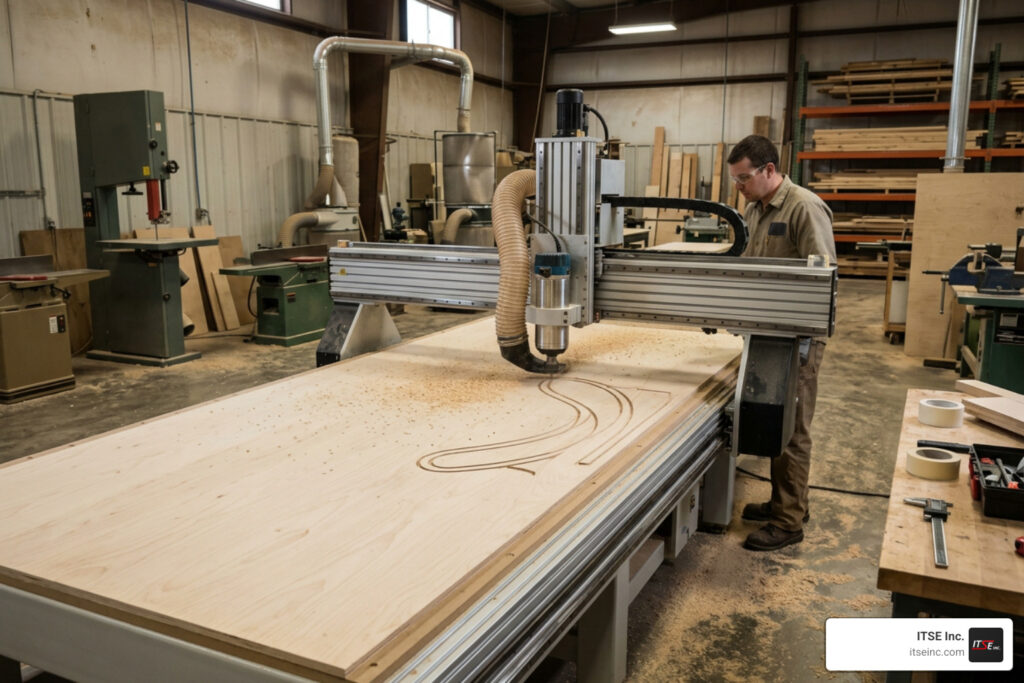
Why Choosing the Right CNC Wood Router Table Can Make or Break Your Shop
A CNC wood router table is one of the most important equipment decisions you’ll make for your production operation. Get it right, and you unlock consistent precision, faster output, and less wasted material. Get it wrong, and you’re stuck with a machine that doesn’t fit your workflow, your space, or your budget.
Quick answer — what to look for in a CNC wood router table:
| Factor | What to Consider |
|---|---|
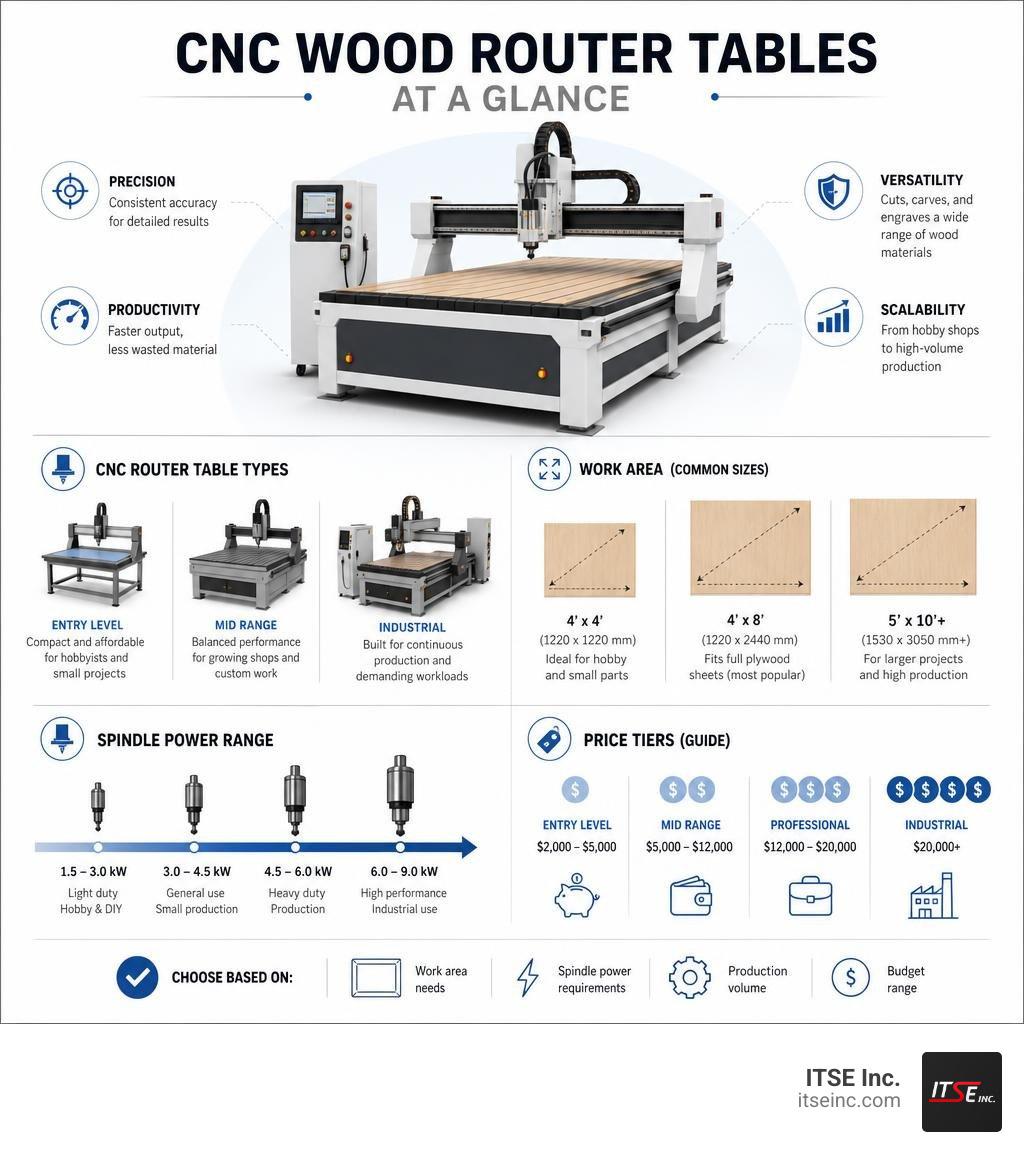
| Work area | 4×8 ft (1325 model) handles full plywood sheets; smaller for hobby use |
| Spindle power | 3.5–9 kW for production; lower for hobbyist work |
| Drive system | Servo = fastest and most accurate; stepper = lower cost |
| Control software | VCarve, Fusion 360, or ArtCAM are common choices |
| Vacuum or T-slot table | Vacuum suits production; T-slot suits varied workpiece shapes |
| Budget range | Entry-level starts ~$2,000; industrial systems reach $20,000+ |
| ATC (Auto Tool Changer) | Essential for high-volume shops; optional for small operations |
The global CNC machine market is on track to hit $117.5 billion by 2027, and CNC routers are a fast-growing piece of that. Woodworking shops, cabinet makers, sign makers, and furniture manufacturers are all moving toward computer-controlled routing — because the gap in precision and speed between manual and CNC methods is simply too large to ignore.
But the market is crowded, and the specs can get overwhelming fast.
This guide cuts through the noise. Whether you’re running a tube and pipe fabrication shop exploring new precision machining capabilities, or managing a woodworking operation looking to automate, we’ll walk you through every decision point clearly.
I’m Jarek Szpakowski, and at ITSE Inc. we work daily with precision CNC equipment — including the kind of high-tolerance machining demands that make understanding a CNC wood router table’s capabilities and limitations second nature. That hands-on experience with CNC systems, tolerances, and production workflows is exactly what informed this guide.
Understanding the CNC Wood Router Table vs. Traditional Alternatives
To understand why shops across the Chicago area — from Lake Zurich to Elk Grove Village — are investing in these systems, we have to look at how they differ from manual methods.
A traditional router table is a stationary power tool where a manual router is mounted upside down. You, the operator, must physically push the wood against a fence and over a spinning bit. It requires immense skill, leaves zero room for distraction, and carries inherent safety risks.
A CNC wood router table, on the other hand, is a computer-controlled system. The workpiece remains securely clamped or vacuum-sealed to a flat bed while a high-speed spindle moves across three axes (X, Y, and Z) to cut, carve, or drill.
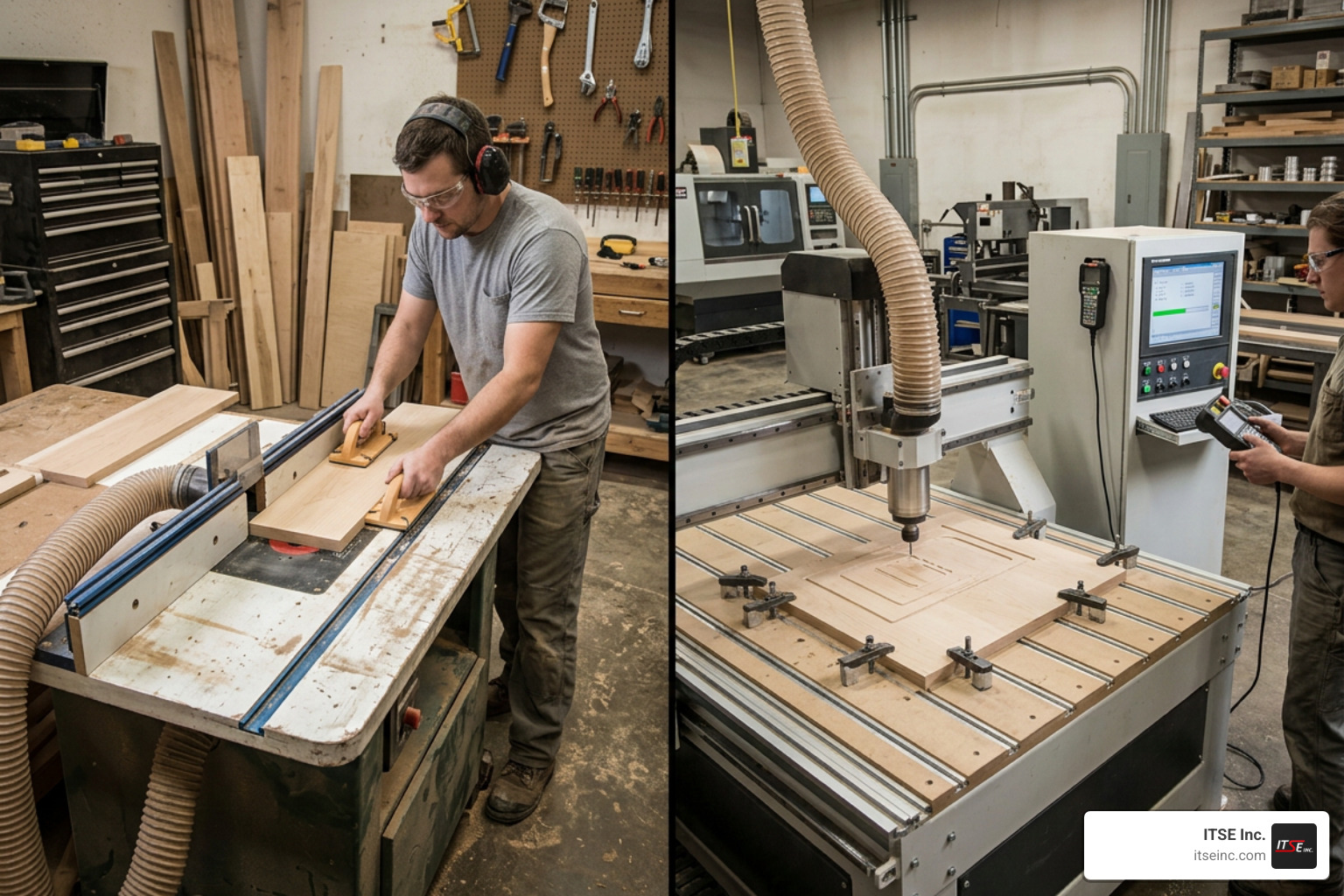
By moving the operator away from the spinning cutter and handing control over to digital G-code, you gain incredible repeatability. If you need to cut 100 identical cabinet panels, the first and the hundredth will be identical down to a thousandth of an inch. This level of automated precision is why modern facilities rely heavily on industrial CNC Machining to scale up their production.
Key Components of a CNC Wood Router Table
To make an informed purchase, you need to understand the anatomy of these machines:
- The Spindle: The “engine” of the router. It holds and spins the cutting bit. High-end industrial models typically use a 3.5 kW to 9.0 kW spindle. Cooling methods include water-cooled (superior thermal regulation for 24/7 runtimes) and air-cooled (low-maintenance and ideal for dusty woodshops).
- The Table (Bed): This is where the magic happens. Budget machines use a T-slot aluminum bed where you manually clamp your workpiece. Industrial setups feature a zoned vacuum table that uses high-power pumps to suck the sheet flat against the table instantly.
- The Drive System: This moves the gantry. High-speed systems like the 1325 CNC Wood Router 4×8 Vacuum Table Industrial Machine use helical rack-and-pinion drives for smoother motion and higher weight capacity, paired with either stepper motors or closed-loop servo motors.
- The Gantry and Linear Rails: The gantry is the bridge that spans the width of the table. It rides on heavy-duty linear guide rails (like HIWIN or PMI) to ensure frictionless, vibration-free movement.
Productivity and Precision Benefits
If you’re still relying on manual routing, band saws, and handheld drills, you’re losing hours of productive time to setup and sanding. A CNC router table solves these bottlenecks by delivering:
- Nesting Efficiency: Smart CAM software lays out your parts to squeeze every last square inch out of a sheet of plywood, drastically reducing material waste.
- Unmatched Repeatability: High-end servo-driven systems can achieve repeatability tolerances of ±0.002″, ensuring flawless fits every single time.
- Labor Savings: Instead of a skilled carpenter spending hours cutting out intricate shapes, a single operator can load a sheet, press start, and walk away to work on other high-value tasks.
For shops demanding extreme mechanical precision beyond wood, utilizing specialized Precision 5-Axis CNC Machining Services in Lake Zurich represents the absolute peak of tight-tolerance manufacturing.
Material Compatibility and Applications
While “wood” is in the name, a modern cnc wood router table is incredibly versatile. It is designed to process everything from soft foams to non-ferrous metals. Understanding what your machine can cut dictates the tooling and spindle power you will need.
For businesses looking to expand their capabilities, having a machine that handles multiple substrates opens up new revenue streams in cabinet making, sign production, and architectural millwork. If you need highly specialized components, you can also partner with regional experts offering Top Precision CNC Machining Services in Lake Zurich for Your Manufacturing Needs to handle complex, high-tolerance parts.
Wood and Composite Processing
Woodworking remains the primary application for these tables. Common materials include:
- Hardwoods & Softwoods: Maple, cherry, oak, pine, and walnut for furniture and custom carvings.
- Plywood & MDF: The bread and butter of cabinet shops. MDF cuts beautifully on a CNC, making it ideal for painted doors and 3D architectural wall panels.
- Melamine & Phenolic: Used heavily in commercial cabinetry and cleanroom furniture.
If you are just starting a home-based business or looking for a hobbyist machine, an Entry-Level 4×8 feet 1325 CNC Wood Router Machine for Hobby offers a cost-effective way to process full-sized sheets without pre-cutting them on a table saw.
Non-Wood Materials and Advanced Applications
Beyond wood, a rigid CNC router can easily process:
- Plastics & Acrylics: Vital for sign making, light boxes, and point-of-purchase displays.
- Aluminium & Brass: Soft metals can be carved, engraved, or profile-cut using appropriate feed rates, mist coolants, and specialized single-flute carbide bits.
- Composites & Foams: Carbon fiber, PVC foam board, and packaging materials.
For DIYers and smaller workshops looking to bridge the gap between desktop engraving and industrial production, the Twotrees TTC-H40 Large CNC Router Machine for Cutting and Engraving provides a generous 1000 x 1000 mm work area capable of engraving wood, acrylics, and soft metals.
Key Selection Criteria for CNC Machinery
Choosing the right machine requires balancing your production goals with your physical space and budget.
| Machine Class | Typical Footprint | Power Requirements | Frame Construction | Best For |
|---|---|---|---|---|
| Entry-Level / Hobby | 2’x3′ to 4’x4′ | 110V / 220V Single-Phase | Aluminum extrusion or light steel | Hobbyists, sign makers, small craft shops |
| Mid-Range / Small Shop | 4’x4′ to 4’x8′ | 220V Single-Phase | Welded steel frame | Custom furniture makers, small cabinet shops |
| Industrial / Production | 4’x8′ to 6’x12’+ | 380V 3-Phase (220V custom) | Heavy-duty stress-relieved steel | 24/7 cabinet shops, commercial fabricators |
How to Choose the Right CNC Wood Router Table for Your Shop
Ask yourself these four questions before signing a purchase order:
- What is my largest workpiece? If you plan to make cabinets, you need a machine that can hold a standard 4′ x 8′ sheet. A machine with a cutting bed of at least 49″ x 97″ (often designated as a 1325 model) is the industry standard.
- Do I need an Automatic Tool Changer (ATC)? If your parts require drilling, pocketing, and profiling, manual tool changes will kill your productivity. An ATC system, like the 2025 Affordable ATC CNC Wood Router Table Kit 1325, can swap tools in under 5 seconds, reducing labor costs by over 60%.
- How will I hold the material down? Clamping individual pieces takes time. If you process sheet goods, a vacuum table is practically mandatory. If you carve irregular solid wood blocks, a hybrid table with both T-slots and vacuum zones offers the best of both worlds.
- What are my speed requirements? Stepper motors are highly precise but slower (cutting speeds around 250–400 IPM). Closed-loop servo systems can cut at up to 600–1,200 IPM with zero risk of losing steps if the tool encounters a hard knot in the wood.
Budgeting, Lead Times, and Machine Classes
Investing in a CNC router is a major financial decision. Entry-level 4’x8′ tables can start as low as $2,000 for basic kits, but they require significant assembly and lack the rigidity for fast production.
Mid-range, turnkey American-supported systems typically range from $3,750 to $12,000. For instance, brands like Premier Plasma offer router tables in this bracket with fast lead times of 6 to 9 days and solid multi-year warranties. High-end industrial nesting systems with automatic loading/unloading, 9 kW ATC spindles, and heavy-duty frames easily cost between $12,000 and $25,000+.
If a brand-new industrial machine is out of your current budget, checking listings for Used CNC Routers For Sale is an excellent way to acquire a heavy-duty, commercial-grade machine at a fraction of the cost of new hardware.
Software, Safety, and Maintenance Protocols
A CNC router is only as good as the instructions you give it and the care you provide. Operating one safely and keeping it running smoothly requires a solid understanding of software, safety equipment, and routine maintenance.
Software and Control Systems
The digital workflow follows three distinct steps:
- CAD (Computer-Aided Design): Where you draw your parts (e.g., AutoCAD, SolidWorks, or Illustrator).
- CAM (Computer-Aided Manufacturing): Where you apply toolpaths, select bits, and set feed speeds (e.g., Vectric VCarve Pro, Fusion 360, or ArtCAM).
- Control Software: The program that reads the G-code and physically moves the machine (e.g., Mach3, GRBL, or proprietary industrial platforms like LNC).
For high-volume operations, choosing a multi-functional machine like the WFMC2 Series CNC Router with Rotary Axis & ATC allows you to seamlessly manage complex panel cutting, 3D carving, and horizontal boring from a single, integrated control interface.
Safety Considerations and Best Practices
A CNC router spindle spins at up to 24,000 RPM. Because it is automated, it moves with immense force.
- Never Leave the Machine Unattended: The friction of a dull bit cutting wood can easily spark a fire.
- Use Proper Dust Collection: Fine wood dust is explosive and highly toxic. Ensure your machine has a dust shroud connected to a dedicated collector.
- Keep Your Distance: Modern industrial machines feature automatic loading and unloading systems, like the Loading&unloading CNC Wood Router Table, which physically separate the operator from the cutting zone during operation.
- Verify Toolpaths: Always run a 3D preview in your CAM software before sending G-code to the machine to prevent costly gantry crashes.
Maintenance and Support Options
To ensure your machine lasts for over a decade, you must perform regular preventative maintenance:
- Daily: Blow off wood chips from the linear rails and ball screws. Check the spindle cooling fluid levels.
- Weekly: Clean and lubricate the linear guide rails with lightweight machine oil. Clean the collet and spindle shaft to prevent rust and runout.
- Monthly: Check the belt tension, squareness of the gantry, and tighten any loose bolts caused by machine vibration.
Choosing a brand with reliable support is crucial. Industrial-grade tables, such as the Baileigh Cnc Wood Router Table, are backed by dedicated technical support teams, ensuring that if a sensor fails or you experience a software glitch, your shop isn’t left dealing with expensive downtime.
Frequently Asked Questions about CNC Wood Routers
What is the difference between a CNC router and a CNC mill?
While they seem similar, they are built for entirely different tasks. A CNC router uses a high-speed spindle (typically 6,000 to 24,000 RPM) to cut softer materials like wood, plastics, and light aluminum at high feed speeds. A CNC mill uses a lower-RPM, high-torque spindle mounted on an ultra-rigid cast-iron frame designed to cut hard metals (like steel and titanium) at slower speeds with extreme precision.
What size CNC router table do I need for cabinet making?
For professional cabinet making, you need a minimum cutting area of 49″ x 97″ (a 4×8 table). This allows you to lay down standard 4′ x 8′ plywood or MDF sheets directly onto the vacuum bed. A smaller 4′ x 4′ machine will require you to pre-cut your sheets on a table saw, which wastes time and increases labor costs.
Do I need a separate dust collector for my CNC wood router?
Yes. While most CNC routers come with a dust shroud that surrounds the spindle bit, they do not include the actual vacuum extraction unit. For small hobbyist machines, a heavy-duty 2 to 3 HP shop vacuum may suffice. For production-scale wood routing, you will need a dedicated industrial dust collector rated between 1,000 and 4,000 CFM to safely extract the massive volume of chips and fine dust generated during continuous cutting.
Conclusion
Choosing a cnc wood router table doesn’t have to be overwhelming. By identifying your primary materials, choosing the right table size, and selecting a spindle and drive system that matches your production volume, you can confidently invest in a machine that will grow your business for years to come.
At ITSE Inc., we understand that precision, reliability, and robust engineering are the cornerstones of any successful manufacturing shop. Whether you are cutting custom wood components in your local workshop or utilizing our specialized industrial CNC Machining services for high-tolerance tube mill and metal fabrication needs, we are here to support your manufacturing journey with American-made quality and tailored engineering solutions.