
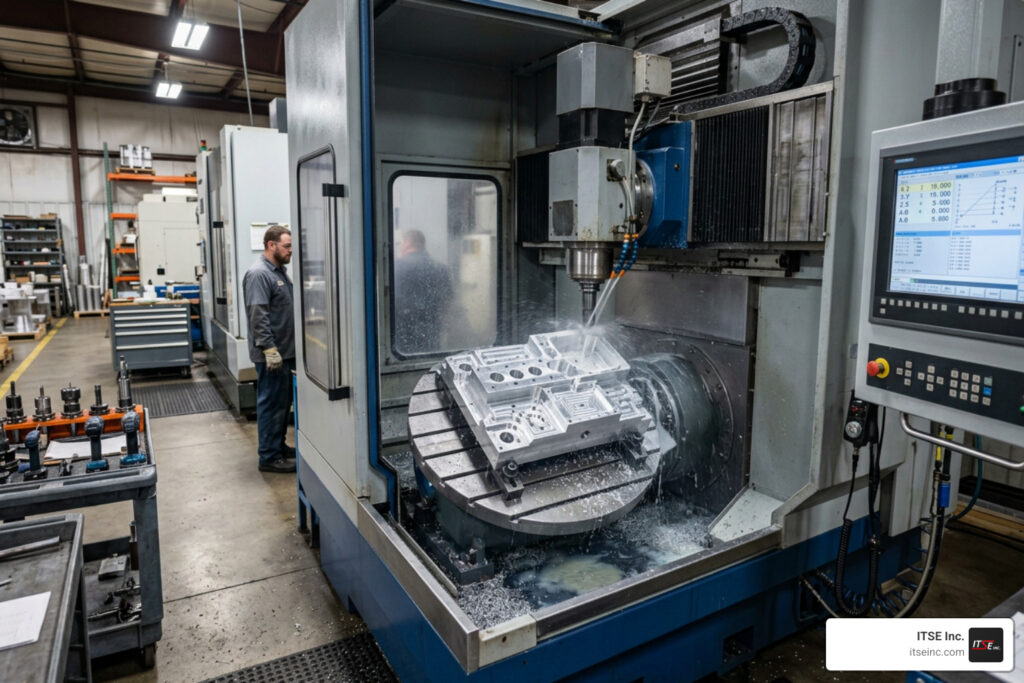
Why 5-Axis CNC in Lake Zurich Is the Right Call for Complex Precision Parts
When your tube or pipe production line needs a replacement wear part, a custom fixture, or a complex multi-surface component, standard 3-axis machining often falls short. Features that wrap around a part — or sit at angles no single setup can reach — force shops to reposition the workpiece multiple times. Every reposition is a chance for error.
5-axis CNC machining solves this. The cutting tool moves along five axes at once, reaching nearly any surface of a part in a single setup. That means tighter tolerances, fewer alignment errors, and faster turnaround — exactly what high-demand manufacturing environments require.
The Lake Zurich area has a strong cluster of precision CNC capabilities built for handling complex industrial components. Whether you need a one-off prototype or a medium production run of custom parts, local expertise is available to meet your needs.
I’m Jarek Szpakowski, and at ITSE Inc. — located right here in Lake Zurich, IL — we’ve spent years combining 5-axis CNC Lake Zurich machining capabilities with deep expertise in tube mill equipment, ID/OD scarfing systems, and custom industrial components. If you’re sourcing precision machined parts or specialized tube processing machinery from a U.S.-based manufacturer, that’s exactly what we do.
Understanding 5-Axis CNC Machining vs. 3-Axis and 4-Axis
To appreciate why multi-axis milling has taken over modern manufacturing, it helps to understand how cutting tools actually interact with raw material. At its core, CNC (Computer Numerical Control) machining is subtractive manufacturing: we start with a solid block of metal or plastic and carve away everything that doesn’t look like your finished part. How we carve it, however, depends entirely on how many directions the machine can move.
What is 5-Axis CNC Machining?
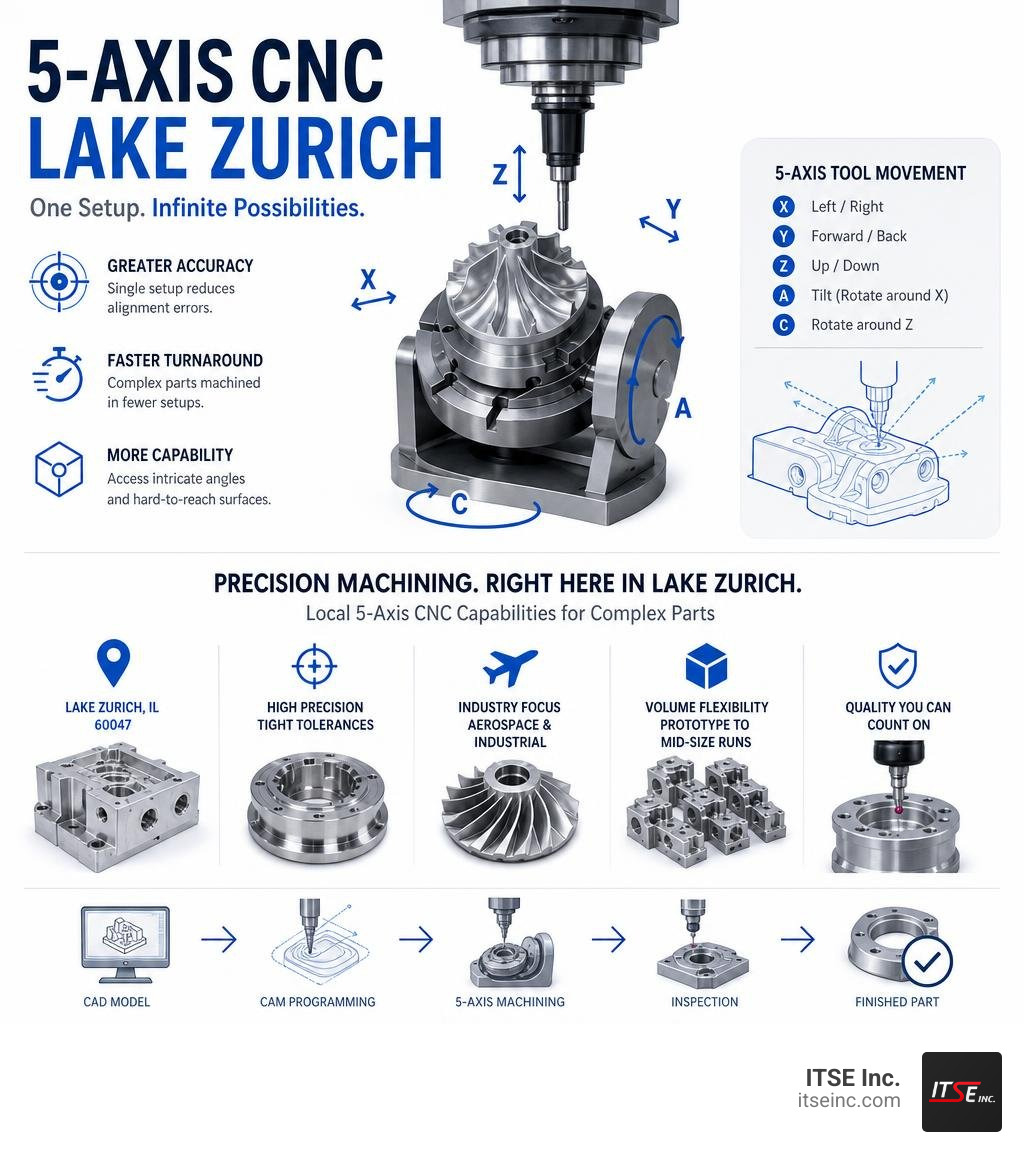
In a standard machining environment, we talk about linear movement along three primary axes:
- X-axis: Left-to-right movement.
- Y-axis: Front-to-back movement.
- Z-axis: Up-and-down movement (usually the direction of the spindle/cutting tool).
A traditional 3-axis mill can move the tool along these three lines simultaneously. This is great for flat parts, brackets, and simple pockets. However, if you need a hole drilled at a 45-degree angle on the side of the part, a 3-axis machine cannot reach it without someone manually stopping the machine, unclamping the part, tilting it, clamping it back down, and recalibrating the starting coordinates.
In contrast, 5-axis CNC machining introduces two rotational axes (commonly referred to as the A and B, or A and C axes).
- A-axis: Rotation around the X-axis.
- B-axis: Rotation around the Y-axis.
- C-axis: Rotation around the Z-axis.
In a true simultaneous 5-axis machine, the computer controller commands the cutting tool to move along the X, Y, and Z linear paths while the machine’s table or spindle head rotates along two of these rotational axes at the exact same time. This creates a highly dynamic, fluid cutting motion. The tool can maintain a perfect perpendicular or optimal lead angle relative to the surface of the workpiece, even when carving complex 3D contours, deep pockets, or dramatic undercuts.
How 5-Axis Differs from 3-Axis and 4-Axis Milling
Adding axes isn’t just about showing off complex machine kinematics; it directly impacts how parts are engineered, how long they take to produce, and how accurate they are.
A 4-axis machine typically adds a single rotational axis (usually the A-axis, allowing the part to spin like a pig on a spit). This is incredibly helpful for cylindrical parts, engraving text around a shaft, or cutting simple slots on multiple sides of a block. But it still struggles with compound angles–features that are tilted in more than one direction.
When we jump to 5-axis machining, we eliminate these physical limitations. Let’s break down how these three configurations stack up:
| Feature / Metric | 3-Axis Machining | 4-Axis Machining | 5-Axis Machining |
|---|---|---|---|
| Tool Movement | Linear X, Y, Z | Linear X, Y, Z + 1 Rotational Axis (A) | Linear X, Y, Z + 2 Rotational Axes (A, B, or C) |
| Typical Setups Required | Multiple (often 3 to 6 setups) | Medium (often 2 to 4 setups) | Single Setup (often 1 or 2 setups max) |
| Part Geometries | Flat, simple pockets, vertical features | Cylindrical parts, multi-sided indexing | Complex 3D contours, undercuts, angled holes |
| Risk of Human Error | High (due to manual repositioning) | Medium (some manual handling) | Minimal (computer-controlled multi-side access) |
| Surface Finish Quality | Standard (requires stepped passes) | Improved on rotational surfaces | Superior (constant tool contact angle) |
By utilizing advanced CNC Machining processes, local manufacturers can bypass the manual labor and high error rates associated with older, multi-setup approaches. Instead of building five different custom fixtures to hold a part at five different angles, a single 5-axis setup allows the cutting tool to dance around the workpiece, finishing almost every surface in one continuous operation.
Key Advantages of 5-Axis CNC Lake Zurich Services
For businesses operating in and around the Chicago suburbs, choosing a local partner for 5-axis CNC Lake Zurich services offers competitive advantages that extend far beyond simple proximity. When your production floor in Lake Zurich or Addison is waiting on a critical custom component, shipping delays and miscommunications with overseas vendors are the last things you want to deal with.
Single-Setup Efficiency and Accuracy
The most significant benefit of 5-axis machining is the concept of “Done-in-One.”
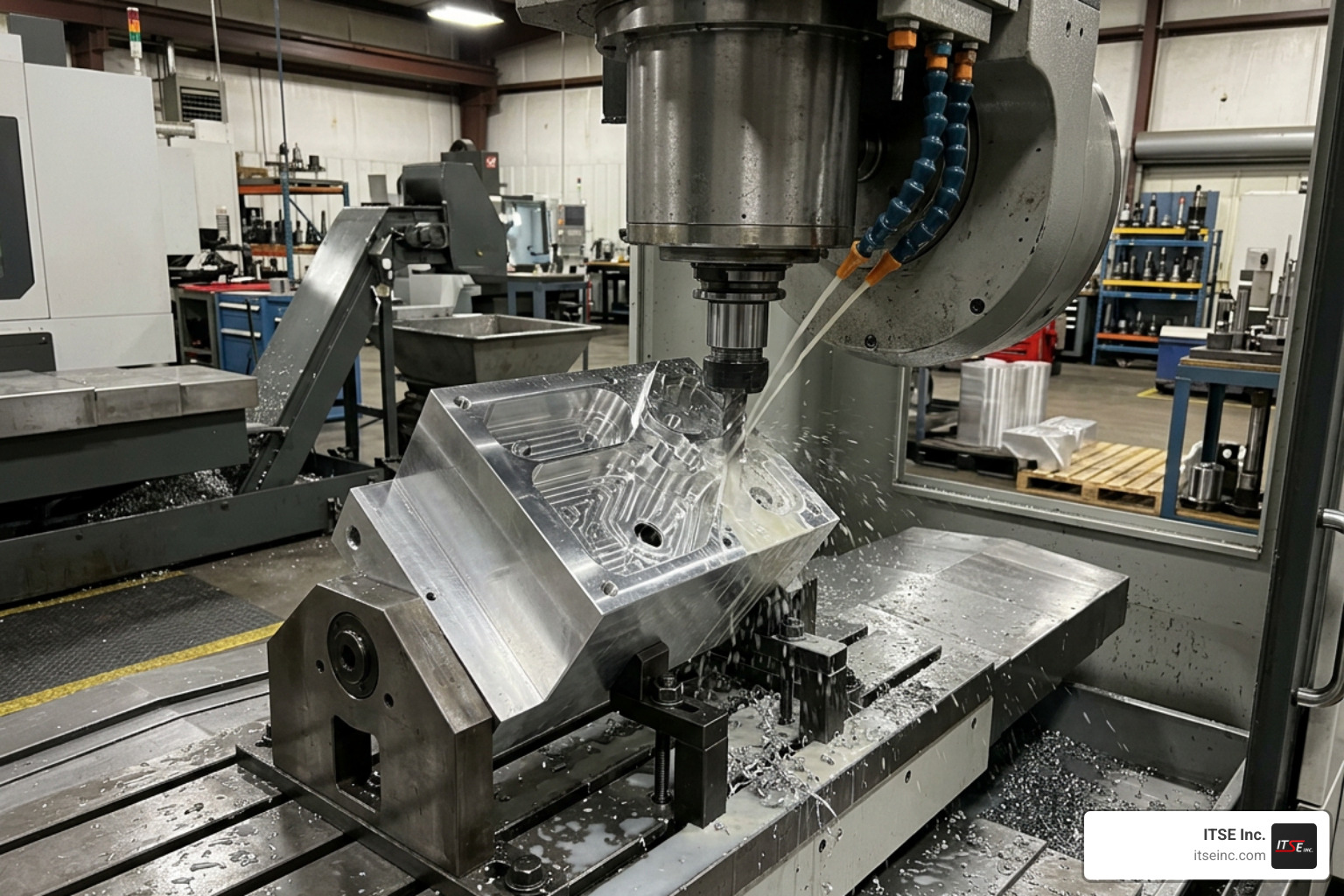
Every time a machinist has to open the machine doors, unclamp a part, rotate it, and clamp it back down into a new fixture, minor positioning errors creep in. A speck of metal dust, a fraction of a millimeter of physical misalignment, or slightly uneven clamping pressure can cause the features machined in the second setup to be slightly out of alignment with the features machined in the first.
By accessing five sides of a part in a single setup:
- We eliminate positioning errors: Because the part doesn’t leave the chuck or fixture, the spatial relationship between every single hole, slot, and face remains mathematically perfect.
- We slash cycle times: Instead of waiting for a machine operator to manually flip parts and re-zero the machine coordinates, the spindle keeps spinning, and the tool keeps cutting.
- We reduce tooling wear: 5-axis programming allows the cutting tool to stay at its optimal cutting angle. This prevents the tip of the tool from rubbing against the material, which generates heat and dulls the tool prematurely. Instead, the machine uses the sturdier side of the cutting flutes, extending tool life and saving on manufacturing costs.
Complex Geometries and Tight Tolerances
For industrial equipment operating under massive mechanical loads — such as the custom tube mill components we build — precision isn’t a luxury; it is a safety and operational requirement.
When working with complex surfaces, holding tolerances down to 5 microns (.0002”) is incredibly difficult on older machines. 5-axis machining makes this level of precision repeatable. By tilting the tool or the part dynamically, we can use shorter, more rigid cutting tools. Shorter tools suffer from far less deflection (the tiny bending of the tool caused by cutting forces) and vibration. The result is an incredibly smooth surface finish that often eliminates the need for manual polishing or secondary grinding operations.
If you are designing high-performance parts that require this level of accuracy, utilizing local Precision 5-Axis CNC Machining Services in Lake Zurich ensures you get parts that fit perfectly on the first try, reducing assembly headaches and field failures.
Industrial Applications and Materials in Lake Zurich Manufacturing
The manufacturing ecosystem of northern Illinois is incredibly diverse. From high-speed packaging lines in Schaumburg to heavy industrial equipment in Aurora, the demand for high-performance components is constant.
Industries Benefiting from 5-Axis CNC Lake Zurich Shops
Multi-axis milling isn’t just for aerospace giants. Today, a wide variety of local sectors rely on 5-axis capabilities to keep their operations running smoothly:
- Tube and Pipe Manufacturing: Custom wear components, high-speed OD bead choppers, ID scarfing tool holders, and precision guiding rolls require highly complex internal channels and curved contours to guide and cut metal tubes without marking them.
- Packaging and Industrial Machinery: High-speed filling lines, labeling equipment, and automated sorting systems rely on custom cams, feed screws, and complex manifolds that can only be efficiently produced using multi-axis milling.
- Aerospace and Defense: Lightweight structural brackets, turbine components, and housing units with complex thin-walled pockets that require high strength-to-weight ratios.
- Medical and Dental Devices: Orthopedic implants, bone screws, and surgical instruments that feature organic, ergonomic shapes and require absolute geometrical perfection.
- Power Distribution and Energy: Specialized connection blocks, complex valve bodies, and high-pressure fittings used in demanding oil, gas, and electrical distribution networks.
Compatible Materials for Multi-Axis Milling
Because 5-axis machines are rigid and highly controllable, they can handle an incredibly wide spectrum of materials. Depending on your application, a local shop can machine everything from lightweight plastics to hard, wear-resistant tool steels:
- Aluminum (6061, 7075): The gold standard for lightweight structural parts, prototype enclosures, and custom fixtures.
- Stainless Steel (304, 316, 17-4 PH): Essential for food processing, packaging machinery, and marine applications where corrosion resistance is critical.
- Tool Steel (D2, A2, O1): Used heavily for wear-resistant components, custom cutting dies, and heavy-duty industrial tooling.
- Exotic Alloys (Inconel, Titanium, Hastelloy): High-strength, heat-resistant metals used in aerospace, defense, and high-performance chemical processing.
- High-Density Plastics (Delrin, PTFE, PEEK): Ideal for clean-room environments, electrical insulators, and low-friction wear pads.
If you are unsure which material is best suited for your specific mechanical environment, reviewing our guide on Top Precision CNC Machining Services in Lake Zurich for Your Manufacturing Needs can help clarify your options based on stress, temperature, and environmental exposure.
Choosing the Right Partner for 5-Axis CNC Lake Zurich Projects
Selecting a manufacturing partner is about more than just finding the lowest price per part. It is about finding a team that understands your industry, respects your lead times, and has the engineering depth to solve problems before they reach the shop floor.
What to Consider in a 5-Axis CNC Lake Zurich Machine Shop
When evaluating local machine shops in the Lake Zurich, Elk Grove Village, or Carol Stream areas, keep these key factors in mind:
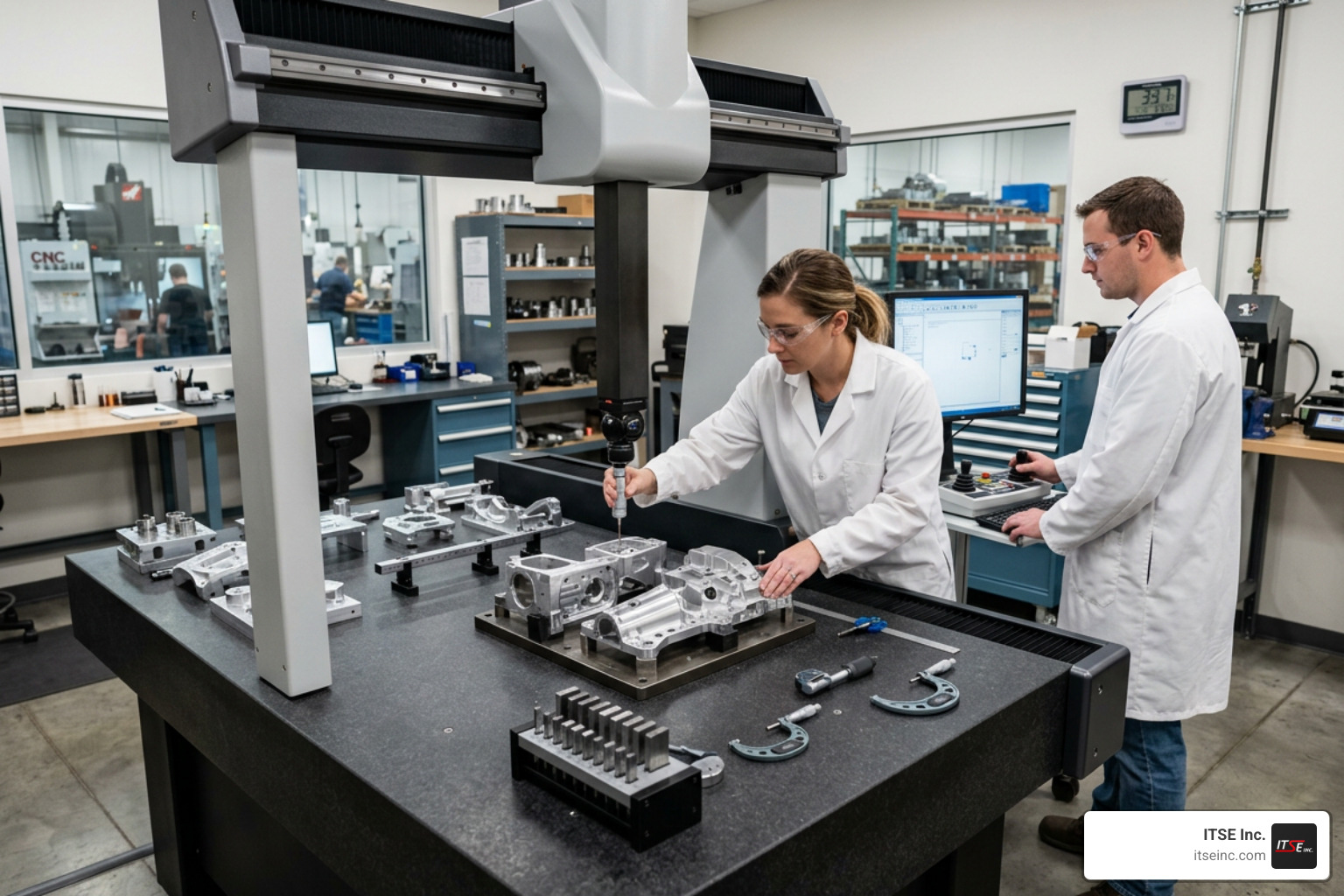
- Quality Standards and Certifications: Does the shop operate under a strict quality management system? While formal ISO 9001:2015 or AS9100 registration is excellent, look for shops that actively practice rigorous quality control, inspecting parts at every stage of production with calibrated Coordinate Measuring Machines (CMMs) and optical comparators.
- Software and Programming Capabilities: 5-axis machines are only as smart as the CAM (Computer-Aided Manufacturing) software driving them. Ensure your partner uses modern programming suites and employs experienced programmers who know how to optimize tool paths to avoid collisions and minimize cycle times.
- Local Collaboration: Can you visit the shop, show them your physical assembly, and talk directly to the engineer who will be programming the job? This level of direct communication is priceless and is something you simply cannot get with national brokers or overseas suppliers.
Prototyping vs. Production Run Capabilities
Every product development cycle starts with a prototype. You need a single, first-article part to verify your design, test clearances, and ensure everything functions as intended. However, once that design is validated, you may need a low-to-medium production run to support your assembly line.
A great local partner should be flexible enough to handle both ends of this spectrum:
- Rapid Prototyping: Short-lead-time, one-off parts machined directly from your CAD files so you can iterate quickly.
- Production Runs: Scaled manufacturing where automated unloading, optimized fixturing, and streamlined tool paths keep the cost-per-part low.
At ITSE Inc., we focus on this exact sweet spot. We specialize in prototype, one-off, and small-to-medium production runs, ensuring that our customers get the personalized attention their projects deserve without being forced into massive minimum order quantities. You can explore our full range of standard and custom manufactured Products to see the caliber of work we regularly deliver.
Design-for-Manufacturability (DFM) and Reverse Engineering
The best way to save money on a CNC machined part is to design it with the machining process in mind. This is known as Design-for-Manufacturability (DFM).
When you share your SolidWorks files or 2D technical drawings with us, our engineering team doesn’t just plug them into the machine. We review the design to see if we can:
- Optimize pocket depths to prevent the need for specialized, long-reach tooling.
- Standardize internal corner radii so we can use standard end mills.
- Minimize raw material waste through smart stock selection.
But what if you don’t have a CAD file? What if you have a broken, worn-out guide roll or a custom bracket from a European machine built in 1985, and the original manufacturer went out of business decades ago?
That is where reverse engineering comes in. You can bring us your physical part—even if it is worn, cracked, or missing pieces. Our team will take precise physical measurements, reconstruct the geometry in SolidWorks, correct any wear-induced deviations, and machine a brand-new, high-quality replacement part that fits perfectly. To learn more about our engineering philosophy and how we approach these complex mechanical challenges, visit our About page.
Frequently Asked Questions about Multi-Axis Machining
What materials can be machined with 5-axis CNC?
Almost any machinable metal or plastic can be processed on a 5-axis mill. This includes lightweight materials like aluminum, brass, and copper; tough industrial materials like stainless steel and tool steel; high-performance exotic alloys such as titanium and Inconel; and structural plastics like Delrin, PEEK, and polycarbonate.
How does 5-axis machining reduce lead times?
By machining up to five sides of a part in a single setup, we eliminate the time spent designing, building, and loading multiple custom fixtures. It also removes the bottleneck of manual part flips and re-zeroing coordinates. The machine spends less time sitting idle and more time cutting metal, resulting in a much faster turnaround for your order.
Can you reverse engineer a part without CAD drawings?
Absolutely. If you have a physical component, our engineering team can use advanced metrology tools to measure its dimensions, model the part in SolidWorks, and generate the necessary G-code to machine an exact replacement. This is highly beneficial for maintaining legacy packaging machinery, steel mills, and custom tube processing equipment.
Conclusion
When you are sourcing 5-axis CNC Lake Zurich services, you aren’t just buying machine time; you are investing in a partnership that keeps your production lines moving. From eliminating positioning errors and reducing lead times to mastering the most complex geometries, multi-axis milling is the ultimate tool for modern industrial manufacturing.
At ITSE Inc., we combine this advanced multi-axis machining capability with decades of hands-on expertise building custom tube mill equipment, OD bead choppers, and ID scarfing systems. We understand the tight tolerances, heavy wear, and rapid response times that industrial operations demand.
Whether you need to reverse engineer a worn legacy part, run a batch of high-precision prototypes, or design a custom component from scratch, our Lake Zurich-based team is ready to help.
Ready to bring your next project to life? Contact us today to discuss your design, or head over to our main CNC Machining Services page to request a detailed quote. Let’s build something exceptional together.