
Why CNC Precision Machining Is the Backbone of Modern Manufacturing
CNC precision machining is a subtractive manufacturing process that uses computer-controlled cutting tools to remove material from a workpiece — achieving tolerances as tight as ±0.001 mm and surface finishes as smooth as Ra 0.2.
If you’re evaluating precision machining options, here’s a quick-reference summary:
| Factor | What to Know |
|---|---|
| Tolerances | ±0.001 mm (milling), ±0.005 mm (turning) |
| Surface Finish | As low as Ra 0.2 µm |
| Key Processes | Milling, turning, grinding, EDM, 5-axis |
| Common Materials | Aluminum, titanium, stainless steel, PEEK |
| Top Industries | Aerospace, medical, automotive, tube & pipe |
| Quality Standards | ISO 9001:2015, ISO 13485, AS9100 |
When a single out-of-tolerance part can ground an aircraft — or compromise a medical implant — the difference between standard machining and precision machining isn’t just technical. It’s critical.
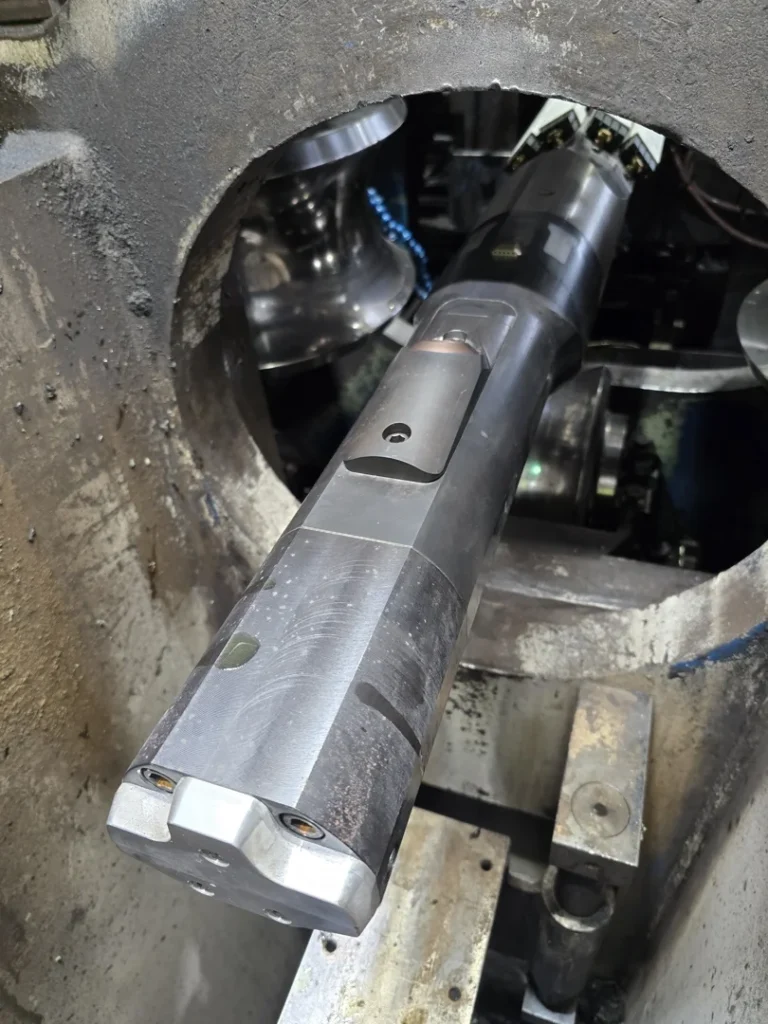
For tube and pipe manufacturers, that same principle applies to weld bead removal and scarfing systems. Inconsistent machining tolerances in ID/OD tooling lead directly to inconsistent product quality on the line.
I’m Jarek Szpakowski, and at ITSE Inc. in Lake Zurich, IL, I’ve built a career around applying CNC precision machining to solve real production challenges — from custom scarfing systems to 5-axis prototype components for industrial OEMs. This guide pulls from that hands-on experience to help you evaluate your precision machining options with confidence.
Understanding CNC Precision Machining vs. Standard Machining
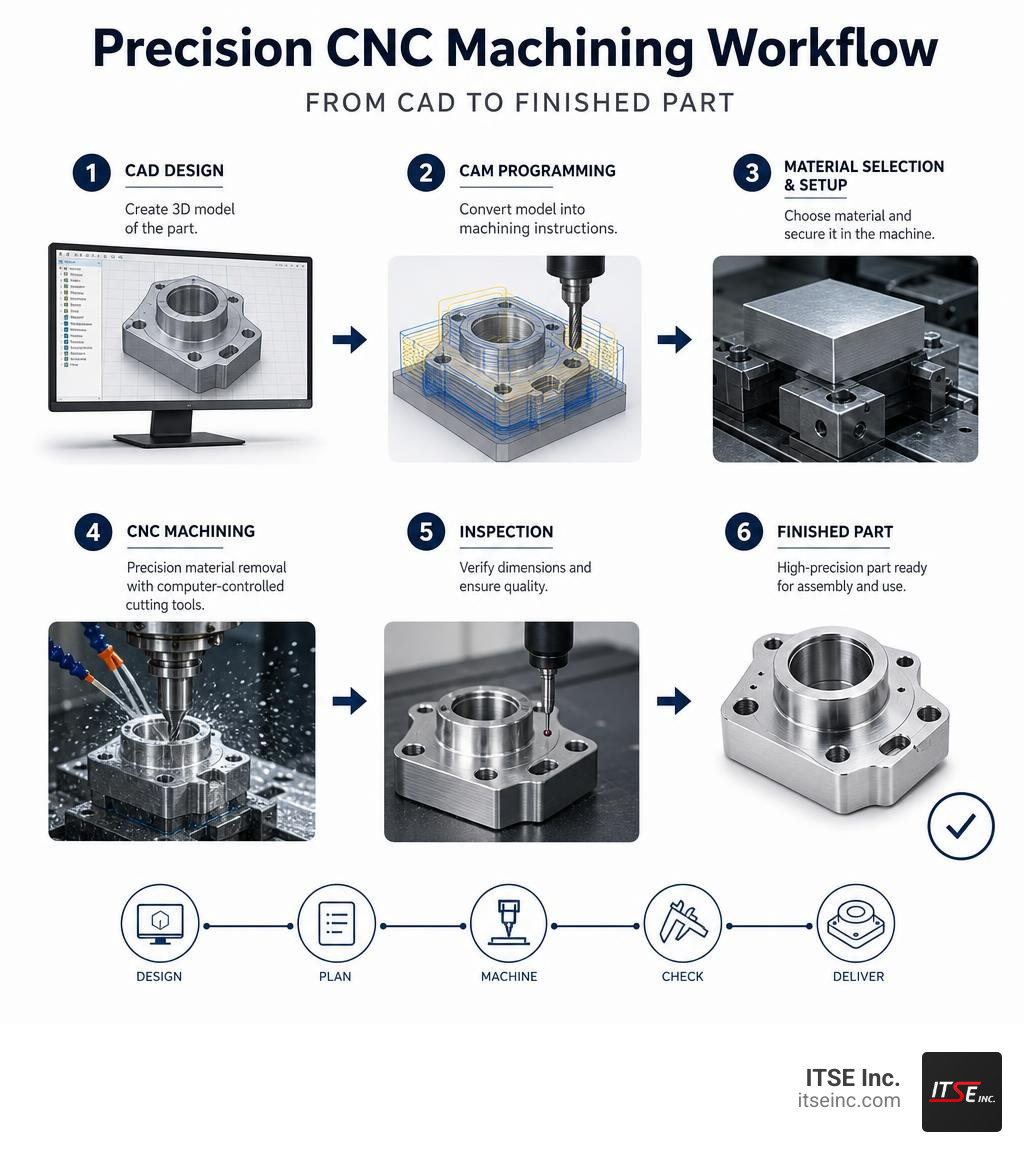
To the untrained eye, all CNC (Computer Numerical Control) machines look somewhat similar. They are large, enclosed metal boxes filled with coolants, spinning spindles, and flying chips. However, what happens inside those enclosures can vary dramatically.
Standard CNC machining is highly efficient for general parts where a tolerance of ±0.127 mm (±0.005 inches) is perfectly acceptable. If you are making a simple bracket to hold a utility shelf, standard machining gets the job done quickly and cost-effectively.
But when we enter the realm of cnc precision machining, we are no longer just cutting metal; we are managing physics at a microscopic level. Precision machining is reserved for parts with tolerances tighter than ±0.05 mm (±0.002 inches), often pushing down to ±0.005 mm or even ±0.001 mm.
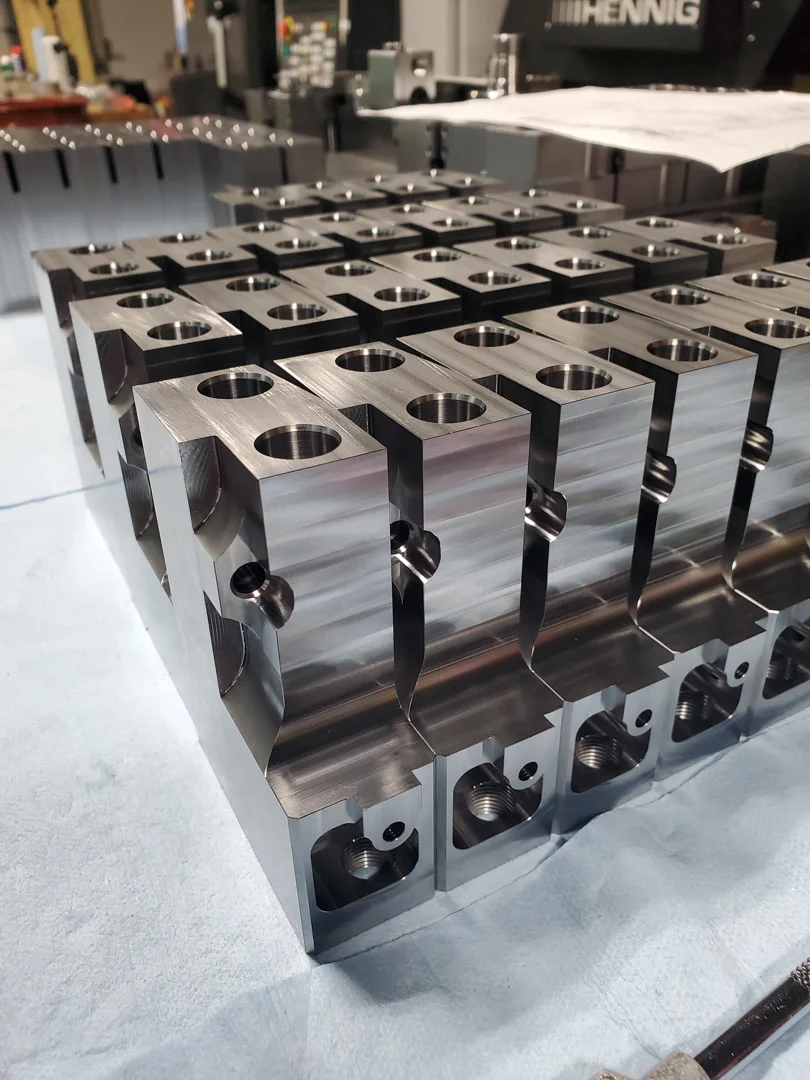
Achieving this level of dimensional accuracy requires a completely optimized workflow. It is not just about having a high-end machine; it requires:
- Advanced G-code optimization to minimize toolpath rounding errors.
- Thermally stable environments to prevent the metal from expanding or contracting during the cut.
- High-rigidity workholding to eliminate microscopic vibrations (chatter).
- Specialized tooling, such as diamond-coated or solid carbide cutters, rather than standard high-speed steel.
When we design and manufacture custom tube mill equipment here in Lake Zurich, we rely on these exact principles. If our OD bead choppers or ID scarfing systems drift by even a fraction of a millimeter, it ruins the weld profile on miles of industrial tubing. That is why understanding the boundary between “standard” and “precision” is the first step to successful sourcing.
Defining Precision Tolerances and Surface Finishes
To put these numbers into perspective, a single human hair is roughly 75 microns (0.075 mm) in diameter. When we talk about micron-level precision, we are splitting that hair into seventy-five individual slices.
- Precision CNC Milling: Typically achieves tolerances of ±0.005 mm as standard, with specialized setups reaching ±0.001 mm.
- Precision CNC Turning: Consistently holds tolerances of ±0.005 mm on critical diameters.
- Surface Roughness (Ra): Measured in micrometers (µm). Standard machining usually yields a surface finish of Ra 3.2. Precision turning and grinding processes can easily push this down to Ra 0.8 to 0.2 µm, creating mirror-like finishes that reduce friction and wear.
If you are sourcing parts in northern Illinois, working with a specialized local shop in Grayslake or utilizing precision machine shops in Lake Zurich ensures your components meet these demanding metrics without tolerance drift.
Key Equipment Used in CNC Precision Machining
To hit these demanding specs, manufacturers rely on an arsenal of advanced machinery:
- 5-Axis CNC Mills: Unlike traditional 3-axis machines that move along the X, Y, and Z axes, 5-axis machines rotate on two additional axes (A and B). This allows the cutting tool to approach the workpiece from any angle, enabling complex geometries and eliminating the need for multiple setups.
- CNC Turning Centers & Swiss Lathes: Swiss-style turning is particularly unique because the material moves along the Z-axis while the tool remains stationary, supported by a guide bushing. This is ideal for long, slender parts (like medical bone screws or delicate pins) that would otherwise bend under tool pressure.
- Precision Grinding Machines: When milling and turning cannot reach the desired surface finish, CNC grinding steps in. It uses abrasive wheels to remove minuscule amounts of material, achieving surface finishes of Ra 0.8 to 3.2 µm with extreme dimensional consistency.
- Electrical Discharge Machines (EDM): Using electrical sparks to erode material rather than physical cutting edges, EDM is perfect for machining hardened metals (like titanium or tungsten) without inducing thermal or mechanical stress.
Materials and Advanced Subtractive Processes
Selecting the right material is a balancing act between the mechanical requirements of the finished part and its machinability. Some metals are incredibly strong but generate massive amounts of heat during cutting, which can destroy tools and warp the workpiece.
Here is a quick look at how common materials behave under precision cutting conditions:
| Material | Machinability | Thermal Stability | Common Applications |
|---|---|---|---|
| Aluminum 6061 | Excellent | Moderate | Aerospace brackets, custom fixtures, prototype housings |
| Stainless Steel 316 | Moderate | Good | Medical implants, marine hardware, chemical processing |
| Titanium Alloys | Poor (Generates high heat) | Excellent | Aerospace turbine blades, orthopedic implants |
| PEEK (Plastic) | Good | Moderate | Semiconductor nests, biocompatible medical components |
| POM (Acetal/Delrin) | Excellent | Poor | High-precision gears, bushings, electrical insulators |
Common Metals and Engineering Plastics
In our work crafting rugged tube mill equipment, we deal with a wide range of materials. Aluminum 6061 is the workhorse of the industry; it machines quickly, resists corrosion, and is highly cost-effective.
For high-stress environments, however, titanium alloys and stainless steel are essential. Titanium has an incredible strength-to-weight ratio and excellent thermal stability, but it requires slow cutting speeds and high-pressure coolant to prevent work hardening.
On the plastics side, engineering polymers like PEEK (Polyetheretherketone) and POM (Polyoxymethylene, or Acetal) have replaced metals in many precision applications. PEEK offers incredible chemical resistance and remains stable at high temperatures, making it a favorite for semiconductor and medical devices. POM, on the other hand, is incredibly easy to machine to tight tolerances because it doesn’t chip or burr easily, making it perfect for custom sliding mechanisms and gears.
Advanced CNC Processes: Multi-Axis Milling and Precision Turning
Multi-axis milling has completely changed how we think about part design. In the past, a complex part had to be broken down into multiple simpler components and bolted together, or repositioned manually across five different setups. Every time a human hand touches a part to re-clamp it in a fixture, you introduce “tolerance stack-up” — tiny alignment errors that quickly add up to a scrapped part.
By utilizing Precision 5-Axis CNC Machining Services in Lake Zurich, we can machine almost every face of a complex component in a single, continuous setup. The machine maintains a single datum point, ensuring that holes, slots, and complex 3D profiles are perfectly concentric and aligned.
Quality Assurance and Partner Selection
You can have the most advanced 5-axis mill in the world, but without a rigorous quality assurance program, you are just making expensive scrap metal faster.
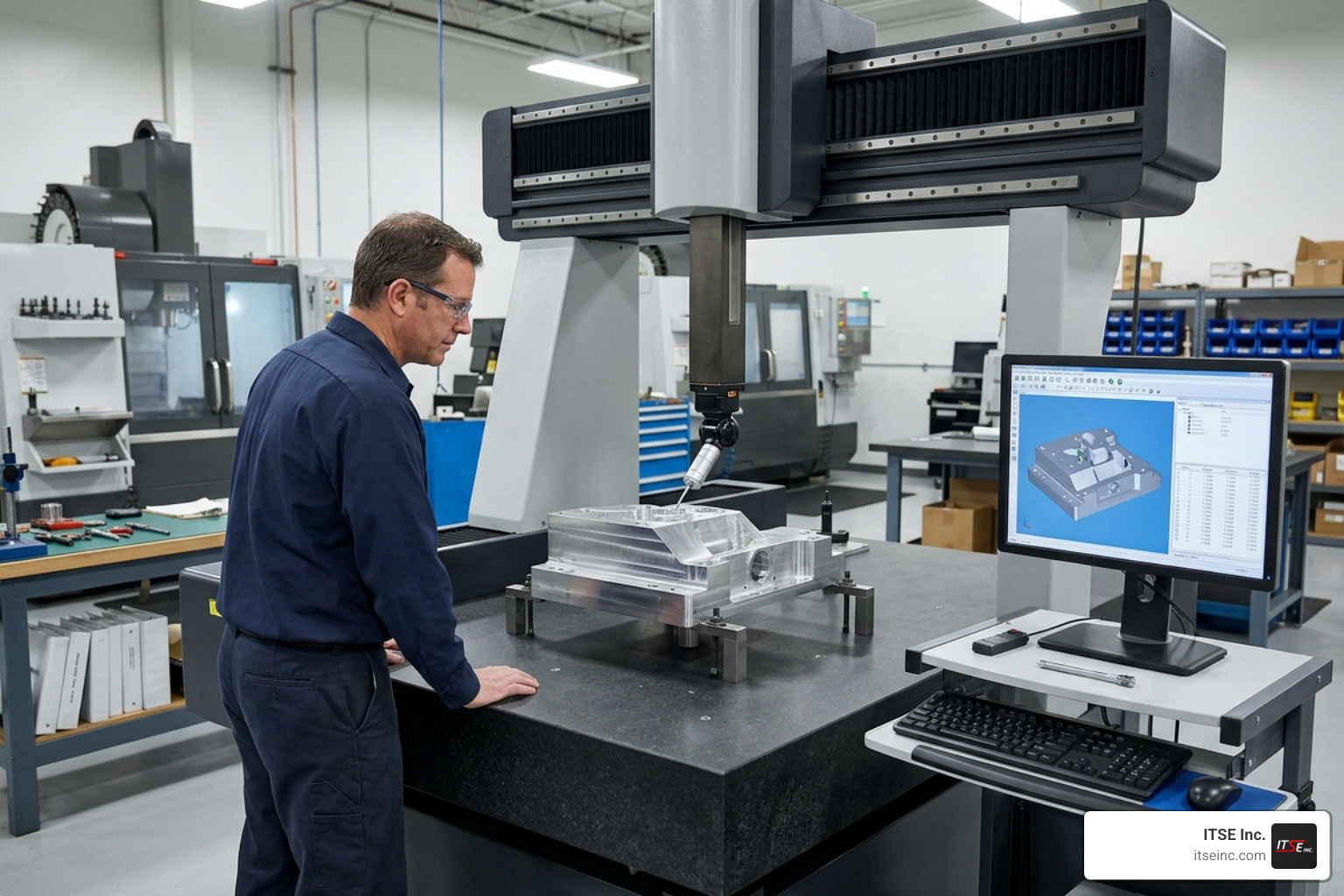
In precision manufacturing, quality control isn’t something that happens only at the end of the production run. It is integrated into every step of the workflow.
How to Choose a CNC Precision Machining Partner
If you are looking to source high-accuracy components in the Chicago metropolitan area — whether you are located near Schaumburg or looking for Top Precision CNC Machining Services in Lake Zurich — you should evaluate potential partners on the following criteria:
- Design for Manufacturability (DFM) Support: A great machining partner won’t just blindly cut whatever CAD file you send them. They should review your design early to identify deep pockets, excessively thin walls, or unnecessarily tight tolerances that will drive up costs.
- In-House Metrology: Do they have a dedicated, temperature-controlled inspection room? A coordinate measuring machine (CMM) is vital for verifying parts down to the micron.
- Prototyping to Production Scalability: Can they handle a single-piece prototype to prove out your design, and then seamlessly scale up to batch production?
- Industry-Specific Experience: If you are in the aerospace or medical device sector, you need a partner who understands the strict documentation, material traceability, and testing requirements of your industry.
Quality Control Standards and Certifications
When evaluating a machine shop, look for these key quality standards:
- ISO 9001:2015: This is the baseline standard for quality management systems. It ensures the shop has consistent, documented processes for everything from sourcing raw materials to handling customer complaints.
- AS9100: The aerospace standard. If a shop holds this, it means their quality control, testing, and traceability protocols are robust enough to meet aviation standards.
- ISO 13485: The medical device standard, emphasizing cleanliness, bio-compatibility, and absolute traceability of every material lot.
Frequently Asked Questions about Precision Machining
What is the difference between CNC machining and precision machining?
While standard CNC machining uses computer programs to automate material removal, precision machining focuses on achieving incredibly tight tolerances (typically ±0.005 mm or tighter) and highly polished surface finishes. Precision machining requires specialized tooling, high-end multi-axis machinery, and temperature-controlled environments to eliminate microscopic variations.
What tolerances can precision CNC milling and turning achieve?
Precision CNC milling can achieve tolerances as tight as ±0.001 mm under optimal conditions, though most high-precision shops routinely work within ±0.005 mm. Precision CNC turning can consistently hold tolerances of ±0.005 mm, and post-machining grinding processes can refine surface finishes down to Ra 0.2 µm.
Why is 5-axis CNC machining preferred for complex parts?
5-axis machining allows the cutting tool to approach the workpiece from five different angles simultaneously. This eliminates the need for multiple fixtures and manual setups, which drastically reduces human error and tolerance stack-up. It also allows for shorter cutting tools, reducing vibration and yielding superior surface finishes.
Conclusion: Partnering with a Local Manufacturing Expert
In high-accuracy manufacturing, precision isn’t just a goal — it is a requirement. Whether you are designing complex aerospace components, delicate medical instruments, or rugged tooling for industrial tube mills, the quality of your finished product depends entirely on the precision of its individual parts.
At ITSE Inc., we apply these exact standards of cnc precision machining to everything we build. From our custom ID/OD scarfing systems to our precision OD bead choppers, we design and manufacture our equipment right here in Lake Zurich, IL, ensuring American-made quality and tailored engineering solutions.
If you are ready to discuss your next precision project, need expert engineering feedback, or want to learn more about our custom manufacturing capabilities, explore our CNC Machining Services and let’s build something exceptional together.