
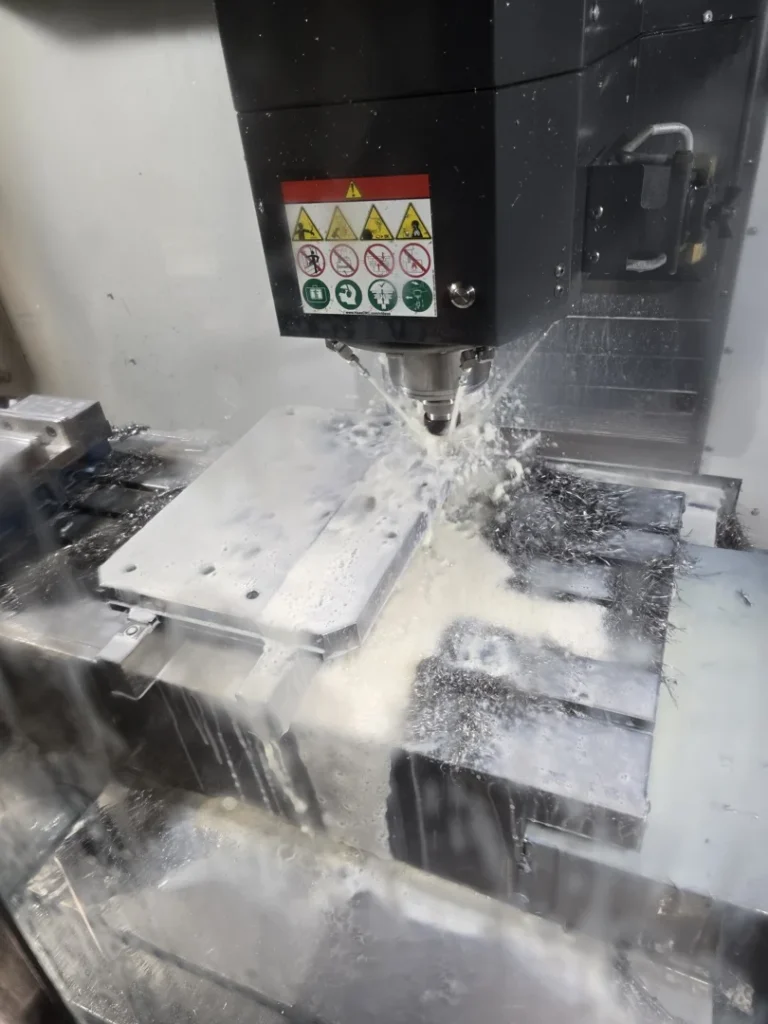
Why 5-Axis CNC Machining in Illinois Is a Smart Move for Precision Manufacturers
5-axis CNC machining in Illinois gives manufacturers the ability to cut complex parts in a single setup — with tighter tolerances, better surface finishes, and faster turnaround than traditional 3-axis methods.
If you’re evaluating multi-axis machining for your operation, here’s a quick snapshot of what it delivers:
| Benefit | What It Means for You |
|---|---|
| Fewer setups | 70-80% reduction in fixture changes and repositioning |
| Faster cycle times | 40-60% reduction vs. traditional 3-axis processes |
| Better tool life | 25-40% longer tool longevity from optimal cutting angles |
| Tighter tolerances | ±0.0002″ repeatability on complex geometries |
| Faster ROI | Typically achieved within 18-36 months |
Illinois is one of the most productive manufacturing states in the country. Its advanced industrial base, motivated workforce, and favorable energy costs make it an ideal environment for precision machining operations that demand consistency and speed.
For tube and pipe manufacturers especially, the shift to 5-axis machining can mean the difference between parts that meet spec every time and costly rework cycles that slow down production.
I’m Jarek Szpakowski, founder of ITSE Inc. in Lake Zurich, IL — a precision CNC shop with hands-on experience delivering 5-axis CNC machining in Illinois for demanding industrial applications, including custom tube mill equipment and OD/ID scarfing systems. In the sections below, I’ll walk you through exactly why 5-axis machining is worth your attention and how to make the right choice for your shop.
What is 5-Axis CNC Machining and How Does It Work?
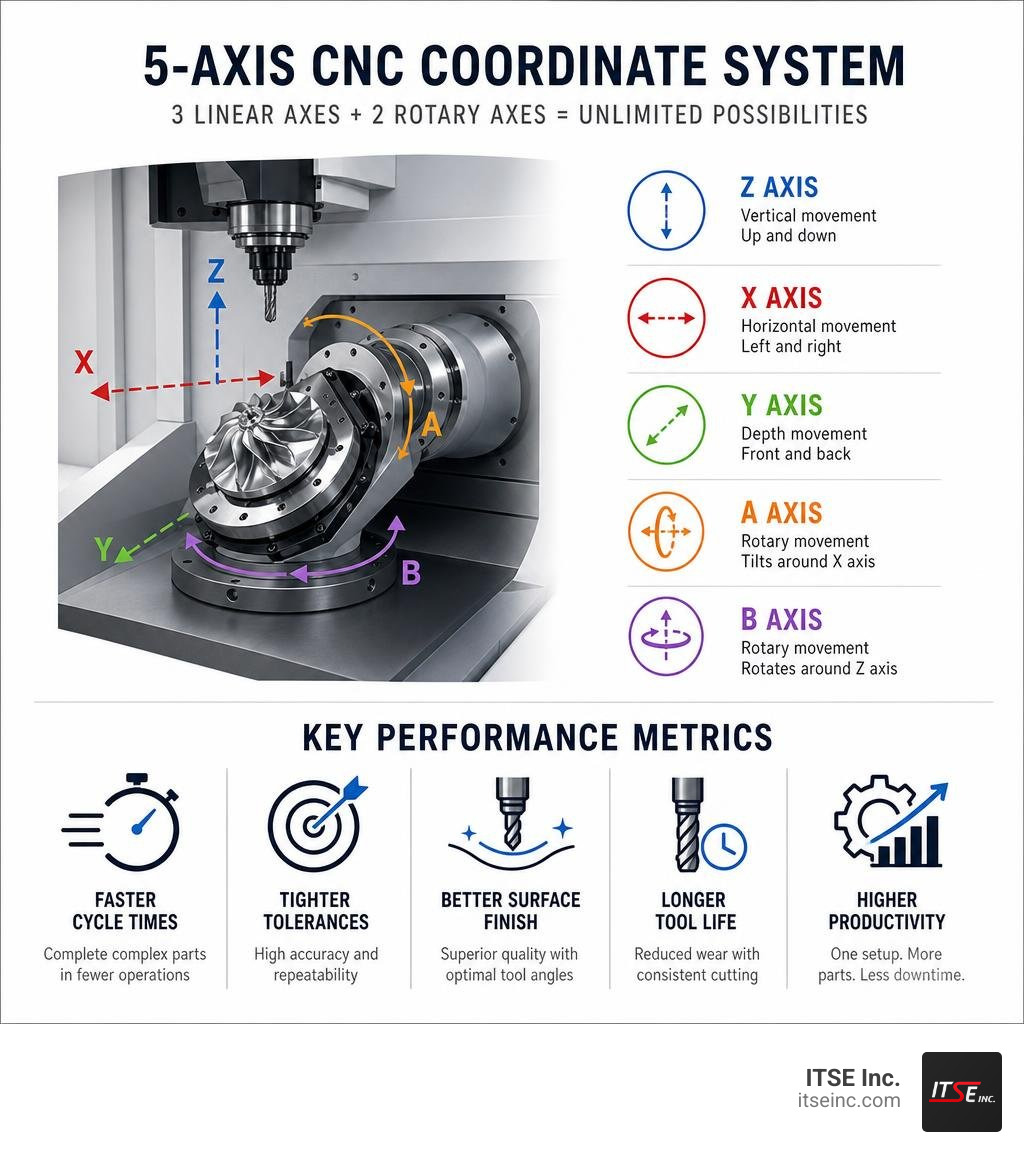
To understand why 5-axis machining is such a game-changer, we have to look at the mechanics of subtractive manufacturing. Traditional CNC milling works by moving a cutting tool along three linear axes: X (left to right), Y (front to back), and Z (up and down). While this is perfect for flat surfaces and simple brackets, it hits a hard wall when you need to machine complex, curved, or multi-sided features.
In contrast, a 5-axis CNC machine adds two rotational axes to the mix. Depending on the machine’s configuration, these are typically selected from the A-axis (rotation around X), B-axis (rotation around Y), or C-axis (rotation around Z).
By combining three linear movements with two rotational movements, the cutting tool can approach the workpiece from virtually any angle. This eliminates the need to manually stop the machine, take the part out, flip it, re-clamp it, and recalibrate your coordinates. Through advanced CAM software, we can perform complex toolpath optimization, ensuring the cutter maintains the perfect angle of contact with the material at all times. This level of control is exactly what we utilize when performing Precision 5-Axis CNC Machining Services in Lake Zurich to craft highly complex parts.
Understanding the 3-Axis vs. 4-Axis vs. 5-Axis Difference
When you are deciding on the right machining process, it helps to weigh your options. Each step up in axis capability represents a massive leap in geometric freedom and setup efficiency.
| Feature | 3-Axis Machining | 4-Axis Machining | 5-Axis Machining |
|---|---|---|---|
| Linear Axes | X, Y, Z | X, Y, Z | X, Y, Z |
| Rotary Axes | None | 1 Rotary Axis (typically A or B) | 2 Rotary Axes (A/C, B/C, or A/B) |
| Setup Changes | High (often 3 to 6 separate setups) | Medium (2 to 4 setups) | Minimal (usually 1 or 2 setups) |
| Part Repositioning | Manual intervention required | Partial automation via rotary indexer | Fully automated multi-angle access |
| Geometric Limitations | No undercuts or complex 3D contours | Limited to cylindrical or single-angle features | Virtually unlimited complex geometries |
| Dimensional Accuracy | Lower due to cumulative setup errors | Moderate | Extreme (eliminates stacking tolerances) |
With 3-axis machining, every time an operator handles a part to rotate it, you risk introducing a microscopic alignment error. By the time you reach your fourth or fifth setup, those tiny errors stack up. A 5-axis machine sidesteps this issue entirely by keeping the part locked in a single, secure fixture while the tool moves dynamically around it.
Simultaneous 5-Axis CNC Machining Illinois Capabilities
Not all 5-axis machining is created equal. There is a distinct difference between “3+2” (positional) machining and “simultaneous” 5-axis machining.
In a 3+2 setup, the machine uses its two rotational axes to tilt the workpiece into a specific position, locks those axes down, and then performs standard 3-axis milling. While this is fantastic for reaching different sides of a part without manual repositioning, it cannot create smooth, continuous organic curves.
Continuous interpolation—or simultaneous 5-axis machining—is where the magic happens. In this mode, all five axes move continuously and in perfect harmony. The spindle head and the workholding table rotate and slide at the same time to maintain a constant, dynamic tool motion relative to a stationary or tilting workpiece.
To pull this off without a catastrophic crash, we rely on advanced collision avoidance software and robust CAD/CAM program simulations (using tools like Siemens NX or Mastercam). At ITSE Inc., we pair this digital foresight with physical precision to provide top-tier CNC Machining Services that keep production runs moving smoothly.
5 Reasons to Choose 5-Axis CNC Machining Illinois
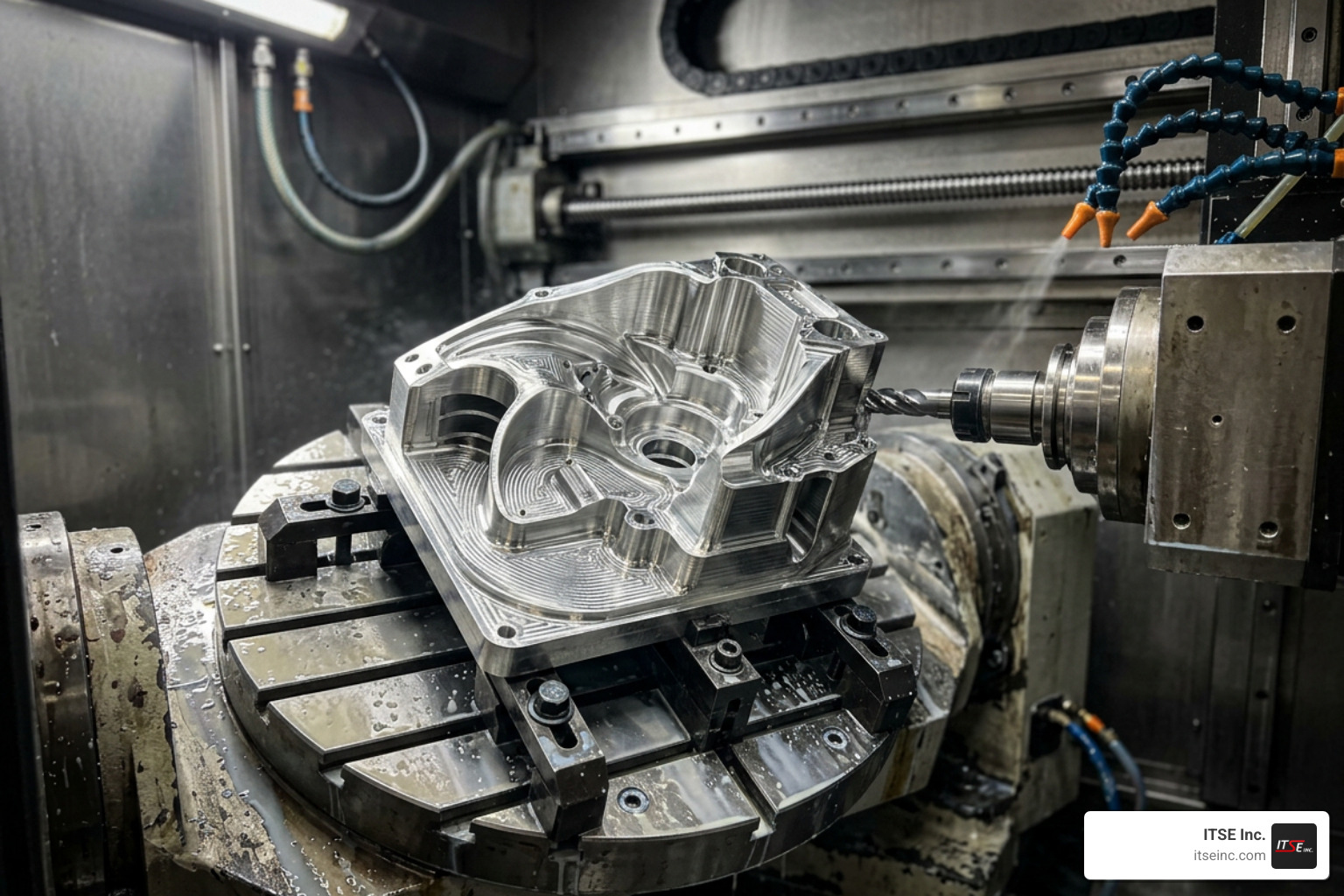
Now that we have covered the science behind the machines, let’s talk business. Why should an Illinois-based manufacturer make the leap to 5-axis machining? Beyond the cool factor of watching a multi-million-dollar spindle dance around a block of titanium, there are concrete, measurable productivity metrics that directly impact your bottom line.
1. Unmatched Setup Reduction and Efficiency
If you have ever spent a shift aligning fixtures, dialing in indicators, and resetting work coordinate systems, you know that setups are the ultimate productivity killer. In traditional manufacturing, a complex part might require five or six different fixtures. Each fixture represents time spent designing, machining, testing, and manually loading parts.
With 5-axis machining, we embrace “single-setup machining” (often called “Done-in-One”). By accessing five sides of a part in one go, you experience 70-80% fewer fixture changes.
This does more than just save time. It eliminates cumulative alignment errors caused by manual intervention. When an operator doesn’t have to touch the part between operations, the risk of human error drops to near zero. Your lead times shrink from weeks to days, allowing you to get your custom tube mill components or industrial machinery parts out the door faster. If you want to see how we apply this efficiency locally, take a look at our Precision 5-Axis CNC Machining Services in Lake Zurich.
2. Superior Surface Finishes and Tool Longevity
When milling a deep cavity on a standard 3-axis machine, you often have to use an extra-long, skinny tool to reach the bottom. Long tools are prone to deflection, vibration, and “chatter”—which leaves behind ugly witness marks and ruins your surface finish.
5-axis machining solves this by tilting the workpiece or the spindle to achieve the optimal cutting angle. This allows us to use shorter, more rigid cutting tools.
Because the tool can stay perpendicular (or at a constant, optimized angle) to the cutting surface, you get:
- A 25-40% improvement in tool life because the cutter wears evenly instead of chipping at the tip.
- Incredible surface roughness control, achieving Ra values so low that secondary hand-polishing or grinding operations are completely eliminated.
- Consistent chip load, which prevents heat buildup and protects the structural integrity of the material.
3. Extreme Precision and Repeatability
In sectors like aerospace, defense, and medical device manufacturing, “close enough” doesn’t cut it. A variation of a few ten-thousandths of an inch can mean the difference between a successful launch and a catastrophic failure.
Because 5-axis machining minimizes part handling, it delivers an astonishing ±0.0002″ repeatability across complex geometries.
To guarantee this level of precision, we don’t just rely on the machine’s internal encoders. We employ:
- Renishaw Probing: In-process probing systems that measure critical features on the machine bed before, during, and after the cut.
- Coordinate Measuring Machine (CMM) Inspection: Post-machining verification in a climate-controlled room to confirm every angle and radius.
- GD&T Verification: Rigorous Geometric Dimensioning and Tolerancing checks to ensure the physical part perfectly matches your digital CAD model.
4. Complex Geometries in a Single Operation
Some parts simply cannot be made on a 3-axis machine, no matter how many clever fixtures you build. If your design includes deep undercut features, complex 3D contours, compound angles, or internal cavities, 5-axis machining is your only viable path forward.
Consider parts like:
- Impellers and Blisk Assemblies: Where curved blades overlap, requiring a thin tool to snake through tight, twisting channels.
- Turbine Blades: Which feature continuous, organic aerodynamic profiles that require simultaneous multi-axis toolpaths.
- Deep Cavity Molds: Where the tool must tilt to reach deep corners without rubbing the tool holder against the workpiece walls.
By utilizing simultaneous motion, we can carve these intricate features seamlessly out of a solid billet, resulting in stronger, lighter, and more reliable components.
5. Long-Term Cost Savings and Rapid ROI
We won’t sugarcoat it: the initial setup and programming costs for 5-axis machining are higher than for a simple 3-axis job. You need highly skilled programmers who understand multi-axis kinematics, specialized CAM software, and robust workholding.
However, when you look at the total cost of ownership, the savings are massive. Transitioning to 5-axis processes typically yields a 40-60% reduction in total cycle time.
When you factor in:
- Fewer hours spent building and maintaining custom fixtures.
- Drastically reduced scrap rates due to fewer manual setups.
- Higher machine utilization (the machine is cutting, not waiting for an operator to flip a part).
The return on investment (ROI) for appropriate 5-axis applications is typically achieved within 18 to 36 months. For our clients in Illinois, this translates directly to more competitive pricing on production runs and faster prototype validation. You can learn more about how we structure these efficient workflows on our CNC Machining Services page.
Key Industries and Materials Driving Multi-Axis Manufacturing

Illinois has always been an industrial powerhouse. From the heavy machinery hubs of Peoria to the high-tech medical and aerospace corridors surrounding Chicago, Aurora, and Schaumburg, our state’s manufacturing sector relies on cutting-edge tech. The combination of low relative energy costs and a deep pool of skilled engineering talent makes Illinois a prime location for advanced multi-axis manufacturing.
High-Performance Materials and Tolerances
Machining soft aluminum is one thing; cutting aerospace-grade alloys is another beast entirely. 5-axis machining centers feature high-torque, rigid spindles that can handle tough materials while holding tolerances as tight as ±0.005 mm (0.0002 inches).
At ITSE Inc., we regularly work with a diverse palette of materials:
- Aluminum Alloys (6061, 7075): Lightweight and highly machinable, perfect for structural brackets and manifolds.
- Stainless Steel (304, 316, 17-4 PH): Essential for food processing, marine, and medical applications where corrosion resistance is key.
- Titanium Alloys (Ti-6Al-4V): Prized for its strength-to-weight ratio but notoriously difficult to machine due to heat generation.
- Inconel & Superalloys: Used in extreme high-heat environments like turbine engines and exhaust systems.
- Engineering Plastics (PEEK, POM/Delrin, Nylon): Requiring low-heat cutting methods to prevent warping while holding tight dimensional tolerances.
Illinois Sectors Leveraging 5-Axis CNC Machining Illinois Services
We proudly serve several critical industries across the state, from our home base in Lake Zurich to clients in Addison, Schaumburg, and Aurora.
The primary sectors driving the demand for 5-axis CNC machining in Illinois include:
- Aerospace & Defense: Structural airframe components, landing gear parts, and guidance system housings that require AS9100-level quality and full material traceability.
- Medical Devices: Orthopedic implants, bone plates, and surgical instruments that demand organic shapes and pristine surface finishes.
- Automotive & Heavy Equipment: Complex engine components, transmission housings, and custom tooling for assembly lines.
- Tube & Pipe Manufacturing: This is where we shine. We use our machining expertise to manufacture custom tube mill equipment, OD bead choppers, and ID scarfing systems that keep high-volume tube mills running without a hitch. You can read more about our background and mission on our About ITSE Inc. page.
How to Evaluate and Partner with Illinois Machine Shops
If you are ready to outsource your multi-axis projects, finding the right partner is crucial. Not every shop that has a 5-axis machine on their floor has the engineering depth to program and run it efficiently.
Here is a quick checklist of what to look for when evaluating an Illinois machine shop:
- Certifications & Standards: Ensure the shop holds an active ISO 9001:2015 certification for quality management. If you are in aerospace or defense, look for AS9100 certification and ITAR registration to ensure compliance with federal security guidelines.
- In-House Engineering Support: Do they have dedicated programmers who use modern CAD/CAM software (like SolidWorks and Siemens NX) to optimize your designs for manufacturability (DFM)?
- Metrology & Quality Control: Ask about their inspection equipment. A great shop should have a climate-controlled inspection room equipped with a CMM and provide full quality documentation and material traceability.
- Local Supply Chain & Lead Times: Partnering with a local shop in the Chicagoland area (whether they are in Lake Zurich, Addison, Carol Stream, or Elk Grove Village) means shorter shipping times, easier face-to-face consultations, and a more responsive supply chain.
At ITSE Inc., we are committed to providing premium, Made in the USA Manufacturing that meets these strict standards, ensuring your parts are delivered on time and exactly to spec.
Frequently Asked Questions About Multi-Axis Machining
What is the difference between 4+1 axis and continuous 5-axis machining?
In 4+1 (or 3+2) positional machining, the machine’s rotary axes position the part at a specific angle, and then lock in place while the three linear axes perform the cutting. In continuous (simultaneous) 5-axis machining, all five axes move dynamically at the same time. Continuous is required for smooth, organic 3D shapes like impellers, while positional is great for multi-sided parts with flat features.
What certifications should I look for in an Illinois CNC shop?
At a minimum, look for an ISO 9001:2015 certification, which proves the shop has a robust, documented quality management system. For defense-related work, ITAR registration is a legal requirement. For aerospace components, AS9100 is the industry standard. Additionally, ask if they provide full material test reports (MTRs) for complete traceability.
How does 5-axis machining reduce lead times?
By machining five sides of a part in a single setup, you eliminate the time spent designing, building, and loading multiple fixtures. What used to take five separate operations on three different machines can now be consolidated into a single run on one machine, cutting total production time in half.
Conclusion
When it comes to manufacturing complex, high-precision components, 5-axis CNC machining in Illinois is no longer a luxury—it is a competitive necessity. By slashing setup times, extending tool life, and unlocking the ability to machine highly complex geometries, multi-axis machining helps Illinois businesses stay ahead of the curve.
At ITSE Inc., we combine our passion for precision with deep expertise in the tube and pipe industry. Whether you need custom tube mill equipment, OD bead choppers, ID scarfing systems, or specialized multi-axis contract machining, we deliver US-made quality you can rely on.
Ready to take your project to the next level? Explore our Made in the USA commitment, learn more About our team, or request a quote for your next project on our CNC Machining page today!